
Eleven Candidates. Five Seats.
In the U.S. Senate race, Democratic incumbent Mark Warner is seeking a fourth term against Republican challenger Bert Mizusawa, a retired Army major general.

Six days left. Eleven candidates. Five seats.
Roanoke, VA
Author: Roanoke Rambler Staff, Hart Fowler Lead
Published: 11:59 AM EST October 28, 2026
Edited: 11:59 AM EST October 28, 2026
Listen Here: Roanokesradio.com
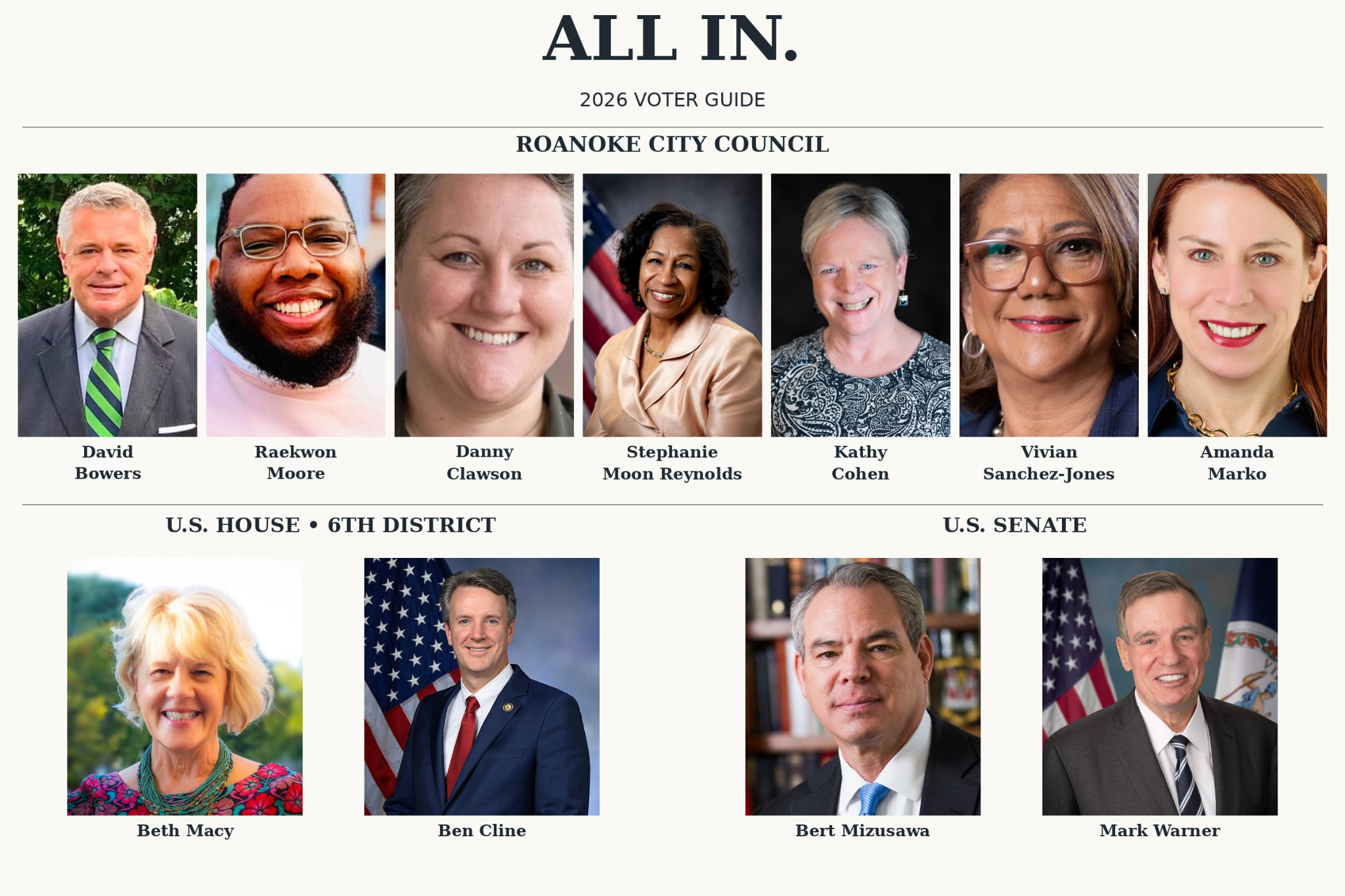
Three of those seats are on Roanoke City Council, where seven candidates are competing for four-year terms. Only one incumbent, Democrat Vivian Sanchez-Jones, is on the ballot. Fellow Democrats Danny Clawson and Raekwon Moore, Republican Amanda Marko, and independents Kathy Cohen, Stephanie Moon Reynolds and David Bowers round out the field. We gathered highlights from the candidates’ positions over the course of the race and from the two Roanoke Rambler Community Candidate Forums on local issues.
Then there’s the 6th Congressional District, where Beth Macy, an author and former newspaper reporter, is challenging four-term Republican Rep. Ben Cline. Long shots do come through: Abigail Spanberger flipped Virginia’s 7th District in 2018 on her way to the governor’s office.
In the U.S. Senate race, Democratic incumbent Mark Warner is seeking a fourth term against Republican challenger Bert Mizusawa, a retired Army major general.
Voters will also decide three constitutional amendments, on reproductive freedom, same-sex marriage and voting rights for people with felony convictions.
Early voting is underway, the ballots are printed, and the next move belongs to the voters.
City Council
The winners will join Mayor Joe Cobb, Vice Mayor Terry McGuire and council members Nick Hagen and Phazhon Nash. Of the three seats up, Vivian Sanchez-Jones is the only incumbent running. Evelyn Powers is not seeking re-election, and Peter Volosin was defeated in the August primary.
This section draws on the Rambler’s coverage of the race, including two Roanoke Rambler Community Candidate Forums. Candidate quotes come from their answers to community questions at those forums unless otherwise noted.
Residential Zoning
Roanoke’s 2024 zoning reforms expanded the number of homes permitted on residential lots, allowing more multi-unit housing in neighborhoods previously restricted to lower-density development. The 2024 rules remain in effect while the question returns to the Planning Commission, and whichever three candidates win will help decide whether they stay, change or go.
David Bowers (Independent) “This current city council has dilly-dallied about this rezoning issue for two years now... My position is to scrap the new ordinance, repeal it, implement the old ordinance, and then once again reassure the homeowners the right to a notice and opportunity to be heard if there’s going to be development in their neighborhood.”
Stephanie Moon Reynolds (Independent) “I was one of those on council that said no to the residential reforms on the zoning, and basically it was because of the process. The citizens had not had enough time to review and process what was being told to them... Each community has its own character and you cannot take a broad brush and go through each community and say this is what we want to do on your property... I think we need to go back and revisit this reform.”
Raekwon Moore (Democrat) “I am for development in this city. I am for reworking the zoning amendment to make sure that the things that the community have brought up are implemented. I don’t think that asking for taking into consideration street size so that people are actually able to drive through their neighborhoods is too much. I don’t think talking about parking spaces so that folks aren’t having to walk a block to their house, especially folks who are older or disabled, is too much.”
Danny Clawson (Democrat) “But since we do have to go back into a public comment period, my opinion of the resistance to the 2024 reform package is that a small group of privileged people didn’t get their way and are bullying the city council into rolling back those [20]24 reforms... So, I’m going to be spending my next year, however long it takes, creating opportunity, organizing our neighbors to be able to show up to these new town halls.”
Kathy Cohen (Independent) “I think the zoning amendment is a red herring. The point of the zoning amendment supposedly was to bring more affordable housing to Roanoke. It is not going to do that. With 24 units built since 2024, it would take over a hundred years to get as much housing as we need in Roanoke... What we really need to do is to look at the 4,000 units of dilapidated and blighted housing and to figure out a way, as has been done in other areas, to reconstruct those and to have them as truly affordable homes.”
Vivian Sanchez-Jones (Democratic incumbent) Sanchez-Jones declined to take the microphone during the zoning question at the Rambler’s July Melrose Mixer. She voted for the 2024 reforms. On July 6, she was in the 3-4 minority that opposed sending the housing density rules back to staff for a fourth review, siding with Mayor Joe Cobb and Peter Volosin, who wanted to move ahead with the planning commission’s compromises.
Amanda Marko (Republican) Marko did not attend the live Q&A at the Mixer, and her read-aloud opening statement did not address zoning. In an Oct. 14 WDBJ roundup on population growth, she said Roanoke needs a variety of housing, including downtown units, single-family homes and starter homes, and argued that faster city permitting would add more. She also proposed a city land bank to help residents rehabilitate vacant and older properties.
Surveillance Technology and Public Safety
Roanoke continues to operate its Flock license plate-reading cameras while neighboring localities move the other way. Lynchburg voted in September to end its contract, and at least 20 Virginia localities have paused or discontinued Flock devices since July. Roanoke has abandoned its separate gunshot-detection program after installation errors, but the plate readers remain. The police department says it retains the data for 21 days and does not use the system for facial recognition or immigration enforcement.
Asked where they stand, candidates answered:
David Bowers (Independent) “As to the Flock cameras, I’m opposed to them.”
Stephanie Moon Reynolds (Independent) “I am a person who pauses and I process … I have to research before I answer anything. I’m not one who just has a knee-jerk reaction.
But what I did when I researched was look at the public safety of it. And to me it was really looking at the public’s trust.
And when you don’t do your homework and you present it, you lose the public’s trust.
I do recognize that law enforcement uses technology as a tool, and that is to help solve the crimes, but I also look at what else they have that could help solve these crimes.
Flock cameras may not be the only thing, but what else do we have to offer?”
Raekwon Moore (Democrat) (Mixer, July) “So I am also against these Flock cameras. I think that our Roanoke City Police Department implemented these recording devices as a way to try to respond to situations quicker because ultimately that’s what police do... But I think from a right to privacy standpoint and these cameras are encroaching on our right to privacy.”
Danny Clawson (Democrat) “I will also say that I am on the record against Flock for several reasons, but not least of which is that it’s a terrible company. It was created by a tech bro that is trying to get as rich as he can.
He has consistently claimed that he has made improvements to Flock, and that has turned out not to be true. They’re incredibly insecure. You can hack into them with a decent Wi-Fi signal.
So we really do need to get rid of Flocks. There are legitimate reasons to have cameras, like speeding zones around schools, but Flock ain’t it, y’all.”
Kathy Cohen (Independent) “As a gun violence prevention chairperson, I met with the police. They showed me the data.
There’s no question that they do help solve crime, but the question is how do you weigh that against everyone’s privacy? And that is something that is not as easy as saying yes or no.
I fall on the no side. But I think we have to respect people who live in high-crime-ridden neighborhoods who say they want these because it will help them.”
Vivian Sanchez-Jones (Democratic incumbent) (Mixer, July)
At the July Mixer, Sanchez-Jones discussed the separate Raven gunshot-detection system rather than the Flock license plate readers
“One of the reasons why I voted for the Raven listening device, one, we were guaranteed that it was only going to be listening to shots fired or a call for distress. By doing this, it alleviates the need for residents to come forward and say when there is a shot because there’s a lot of times when police comes out to a neighborhood, they don’t want to say where the shots came from because they’re afraid of retaliation.”
Amanda Marko (Republican) “I [was] introduced to Flock cameras a few years ago in my small neighborhood. We were having some break-ins, and somebody brought them up to me.
I had never heard of these cameras before. I looked into this technology and immediately said, ‘No way do I want that on my street.’
And because we were just one little street and one little HOA, I was able to say no and keep those off our streets. I don’t want them on any streets in Roanoke based on what I learned.
I know we can have law and order and safety without compromising our civil rights.
Law enforcement could also say, ‘Well, we can solve more crimes if we can torture people when we question them, or we could solve more crimes if we were allowed to do search and seizure without warrants.’
Well, yeah, maybe you could, but no, that is not how we do things here. So therefore, no Flock cameras here in Roanoke.”
Homelessness
Roanoke’s homelessness debate continues amid concerns about public safety, access to services and affordable housing. The Blue Ridge Continuum of Care’s 2026 Point-in-Time Count found 401 people experiencing homelessness across the region on a single night in January, 97% of them in Roanoke City. At the Rambler’s Sept. 29 forum, an audience member who said they were homeless last year asked what steps candidates would take to protect Roanoke’s homeless community.
David Bowers (Independent) “It’s not just a Roanoke situation. It’s not just a Roanoke problem. It is a regional problem.
Roanoke is a magnet. We have the services. We have the hospital. We have all the things needed to help those who are downtrodden or poor and can’t find their way.
We need to reach out to other governments throughout our area. Bedford, Roanoke County — we need their participation.”
Stephanie Moon Reynolds (Independent) “When I hear about the homeless population, my heart aches because I see it around here.
Everyone is fussing about do something, do something with these people as if they are not even human, as if they don’t have dignity.
I look at it like they didn’t choose to be this way. Something happened. Something happened in their lives that caused them to have trauma.
I know my brother, when my father passed, he was 25 and my dad died suddenly. My brother is a crack addict. He can’t find his way back. He stays homeless.
We have the new RAM House who’s done some things, but you also have other organizations. Some of these services are duplicated services.
When I was on council, I was trying to bring four of these nonprofits to the table because instead of duplicating your services, I wanted them to look at how we can spread this money around and try to help.
At the same time, I’m looking at trying to address public safety when they’re standing in the median. I’m always concerned that somebody’s going to get hit.
It’s a complex issue, and I think we need to come to the table with the experts to really look at how we put some resolution to this to help these people.
I look at it as moving from trauma toward stability and ultimately toward home, and that’s a place of support, belonging and hope.”
Danny Clawson (Democrat) “First I want to say that unhoused people aren’t inherently dangerous. I think it’s important to remember that.
As somebody who works with a primarily unhoused population every day, I know them. I know them by name. I can look at them and see if they’re having a good day, a bad day, or somewhere in between.
We also need to start leveraging Carilion. They are required to invest in the community because they’re a nonprofit, and right now they spread that investment very wide.
In 2019, they had scheduled to revamp and expand their psychiatry department and to have better inpatient psychiatry services. COVID ended that project. Then they never went back.
We need to go back to Carilion and say, what our community needs is for you to go back to that original plan and reinvest back in psychiatric care.
Because even though you can get somebody into housing, if they don’t have the mental health care to keep them in that housing, it’s not going to work.
The vast majority, over 90%, of the people that are unhoused in this town have ties to this town, do live here, have kids.
We need to be making sure that we’re using opioid abatement funding to get more resources, get Botetourt and Roanoke County to the table, and help us fix this problem collaboratively.”
Vivian Sanchez-Jones (Democratic incumbent)
Sanchez-Jones voted in 2021 for the downtown ordinance banning camping on sidewalks. In a 2022 Rambler interview, she called it a hard vote but a necessary one: “we need to address the issue of the homeless in our community. It goes beyond housing.” Explaining her vote, she said the city should “help them find housing for those that will be successful in a house and look at the mental health issues, because a lot of it is due to mental health issues that have not been addressed because of the system.”
Kathy Cohen (Independent) “One of the things that I found out in researching this is that we are one of a handful of cities that does not have a designated legal parking lot for people who are sleeping in their cars overnight or for people who want encampments.
I believe we should have a designated legal parking lot. There should be facilities there, clean facilities, water, the ability to go to the bathroom, if possible showers.
Finally, I would like to see us look into what many cities have done, and that is taking abandoned warehouses and turning them into a series of rooms that are lockable, that have a bed and all sorts of services offered there.
People who are unhoused can go and sleep there, have a room assigned to them, and not have to be in a large facility with lots of other people like the Rescue Mission, which is doing great work.”
Amanda Marko (Republican) “I think strangely this is the first time we’ve been asked this at a community forum, which is so interesting to me because it is one of the top things that the community is asking me about.
We’ve got people who are fiercely advocating for the people who are unhoused to make sure that they are getting taken care of and that their needs are met.
We also have a group of people who are adamant that they, as taxpaying members of our community, should feel safe downtown.
Fundamentally, I’d like to find where we agree. We agree that there are people who are having the worst experience of their life, and we as a community need to help get them out of that as quickly as possible.
I’ve been meeting with the executives of our nonprofits that are serving the unhoused community, RAM House and the Rescue Mission. And I’ve also been meeting with the business community.
What I want to do is find where that common ground is because right now those are folks who are not talking to each other.
This is a national problem, and here in Roanoke it’s a regional problem. We need to make sure that we come up with a regional solution. That means regional funding and regional metrics that we work together.”
Raekwon Moore
Moore's primary platform explicitly targets improving public transportation and infrastructure accessibility as a way to assist low-income and vulnerable residents. He has advocated for expanding Valley Metro services—including adding benches and covers to all stops and pushing for Sunday service—asserting that reliable municipal transit is a critical lifeline for unhoused individuals attempting to access downtown jobs, medical appointments, and regional support services.
U.S. HOUSE: VIRGINIA'S 6TH DISTRICT
The Matchup: Beth Macy (D) vs. Ben Cline (R, Incumbent)
- The District Map: Virginia’s 6th Congressional District spans the historic Shenandoah Valley and includes the cities of Roanoke, Salem, Harrisonburg, and Staunton.
- The Fundraising Gap: In a rare flip for this district, challenger Macy has significantly out-raised the incumbent, pulling in $2.9 million to Cline’s $1.9 million.
- The 2024 Margin: Incumbent Ben Cline enters the final stretch with a massive historical advantage, having secured re-election in 2024 by 28.3 percentage points.
- Last Time a Democrat Won: No Democrat has carried the 6th District in over three decades; the last to win the seat was Rep. Jim Olin in 1990, who subsequently retired in 1992.
- The Debate Standoff: Macy’s aggressive, public campaign demands to get Cline on a live debate stage went completely unanswered by the incumbent's team, leaving the candidates to face off strictly through separate media profiles and stump speeches.
- Authors into Politics: Following a modern political trajectory similar to Ohio's JD Vance, Macy is attempting to parlay national bestseller fame into a congressional seat, leveraging her prominent background as the author of Dopesick.
- The Failed Redistricting Map: This race was originally predicted to be a highly competitive battleground. The General Assembly passed a voter-approved referendum creating a highly competitive, "salamander-shaped" district, but the Virginia Supreme Court ultimately overturned the redistricting plan, preserving the existing, safe-Republican map boundaries for the 2026 cycle.
United States Senate
Mark Warner (D) and Bert Mizusawa (R) face off on the ballot across all Virginia precincts for the U.S. Senate.
At a Glance: The Senate Matchup
|
Dimension |
Mark Warner (Democrat, Incumbent) |
Bert Mizusawa (Republican, Challenger) |
|
Ballot Status |
Seeking fourth Senate term; announced as final campaign |
First run for U.S. Senate; retired military officer |
|
Public Service |
U.S. Senator since 2009; Virginia Governor (2002–2006) |
Retired U.S. Army Major General; Senate Armed Services
staff |
|
Background |
Co-founder of Nextel; key negotiator on federal CHIPS
Act |
Silver Star recipient; West Point Valedictorian;
Harvard Law & Kennedy School |
|
Primary Data Center Stance |
Mandate tech firms build or supply their own power;
ratepayer protections |
Support local community vetoes; shift builds to remote
federal/military lands |
VIRGINIA CONSTITUTIONAL AMENDMENTS
Question 1: Right to Reproductive Freedom
• What a Yes vote changes:
Enshrines a fundamental right to reproductive freedom in the Virginia Constitution’s Bill of Rights, including decisions about contraception, prenatal care, childbirth and abortion. It protects patients and those assisting them from state punishment for exercising that right. The state could regulate third-trimester abortions but could not prohibit an abortion when a physician determines it is medically necessary to protect the patient’s life or physical or mental health, or when the fetus is not viable.
• What a No vote leaves in place:
Leaves the state constitution without an explicit right to reproductive freedom. Abortion access and reproductive healthcare parameters would continue to be governed by existing statutory state laws, which the General Assembly can alter through regular legislative sessions.
Virginia Department of Elections Question 1 Guide.
Question 2: Marriage Equality Amendment
• What a Yes vote changes:
Repeals the now-unenforceable provision in the Virginia Constitution that defines marriage strictly as a union between one man and one woman. It replaces it by enshrining a fundamental right to marry, requiring the Commonwealth to recognize and treat equally under the law any lawful marriage between two adults regardless of their sex, gender, or race.
• What a No vote leaves in place: Leaves the defunct same-sex marriage ban in the text of the state constitution. While same-sex marriage would remain fully legal and protected across Virginia under federal statutory law and the U.S. Supreme Court's Obergefell v. Hodges ruling, the state constitution would retain its traditional definition of marriage.
Virginia Department of Elections Question 2 Guide.
Question 3: Voting Rights Restoration Amendment
• What a Yes vote changes: Establishes an explicit fundamental right to vote within the Virginia Constitution. It makes the restoration of voting and broader political rights automatic for individuals convicted of a felony immediately upon their release from prison, eliminating the requirement to petition the governor's office. Additionally, it narrows the state's mental incompetence voting disqualification to apply strictly to individuals a court has specifically adjudicated to lack the capacity to understand the act of voting.
• What a No vote leaves in place: Preserves the current constitutional system where a felony conviction permanently revokes an individual's voting rights unless they successfully navigate an individual, discretionary petition process through the sitting governor's office. It also maintains the broad, un-narrowed language disqualifying anyone adjudicated to be mentally incompetent from casting a ballot.