
Inside Spectrum: 34 Years of Connection and Conversation Across Roanoke’s Racial Divides
The Rambler's latest Four Quadrants, One City Q&A, features a friendship built on a safe space.
Roanoke’s four quadrants reveal a deep and persistent divide. The city’s legacy of segregation continues to cast a long shadow, with access to education, job opportunities and even life expectancy varying widely depending on zip code.
In our monthly Q&A series, “Four Quadrants, One City,” The Rambler invites members of the community to reflect on what it means to live in a city shaped by a history of division. By sharing perspectives across generations, backgrounds and quadrants, we hope to spark honest conversations that are too often left unspoken.
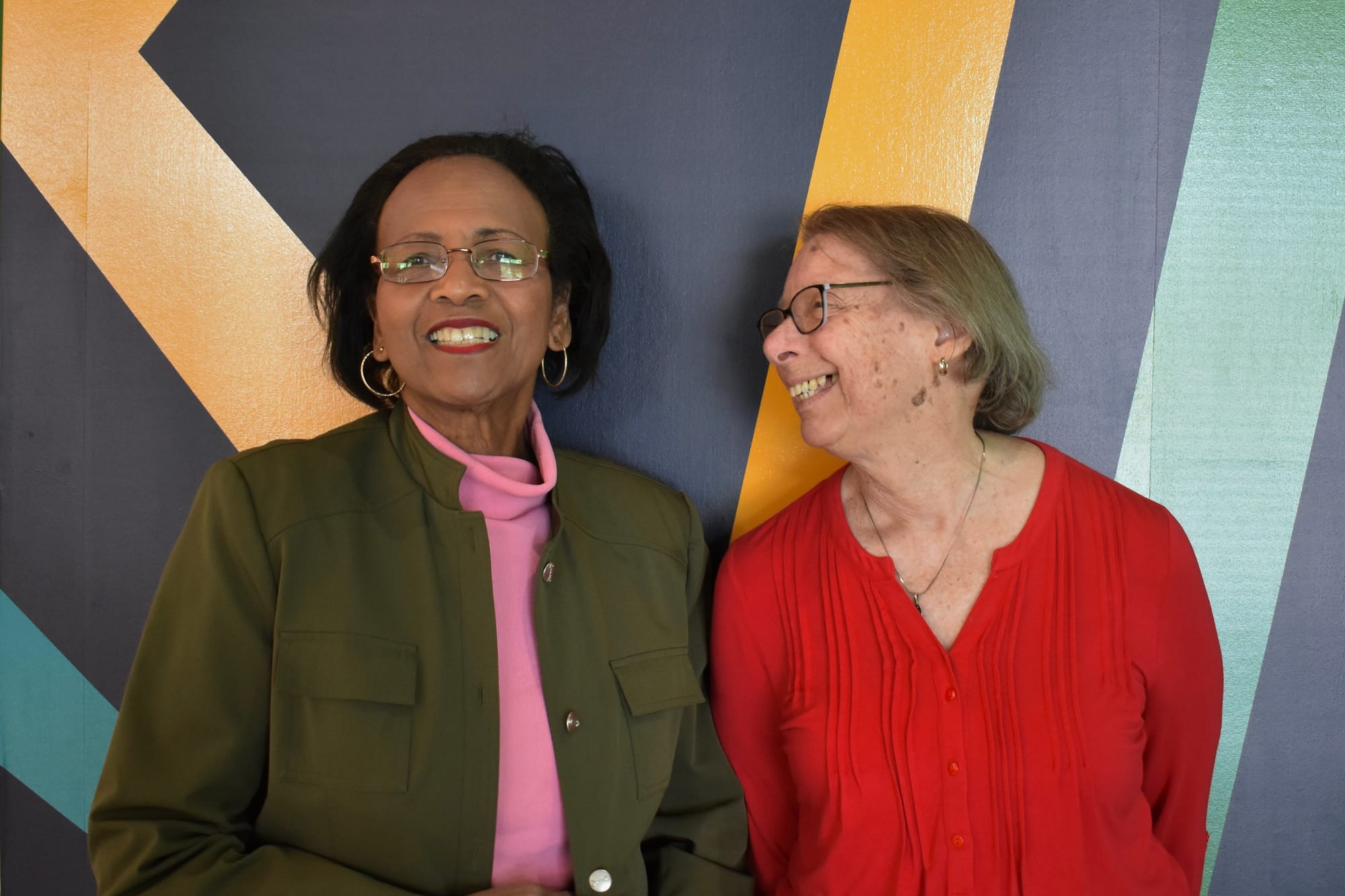
This month, we sat down with two women who have spent decades having those very conversations. Lorraine Fleck and Marylen Harmon are longtime friends and founding members of Spectrum Women for Diversity, a group dedicated to building relationships across race.
Spectrum was born in 1992, after a Hollins University panel “Black Women, White Women: Who Am I To You?” inspired a group of attendees to continue the dialogue. More than 30 years later, Spectrum continues to gather monthly for candid conversations about race — discussions that can be challenging, but always “enlightening,” Harmon said. Along the way, women have shared personal stories of segregation, discrimination and everyday resilience, from walking miles to school while white children rode buses to being mistaken for the maid in their own homes.
In recent years, Spectrum's membership has narrowed to about a dozen women. Newer members, including women from Iran and Gaza, have expanded the group’s perspective on global conflicts. While the group has evolved over the decades, Spectrum’s original mission has remained the same: to serve as a safe space to build relationships across differences, one conversation at a time.
We met with Fleck and Harmon to talk about Spectrum’s origins, the conversations that have sustained it and what their decades-long friendship has taught them about segregation and forging connections across divides.
This interview has been edited for length and clarity. If you or someone you know is interested in being interviewed for this series, please reach out to sinclair@roanokerambler.com.
VIDEO BY SINCLAIR HOLIAN FOR THE ROANOKE RAMBLER
When Spectrum was founded, what need did it fill in Roanoke? How did the group create space for women from different backgrounds to connect?
Fleck: What the group gives us is an opportunity to get to know people who we wouldn't necessarily otherwise have the opportunity to know and to really get to know them, to trust them, to develop relationships. I mean, for me, the most important thing is that the relationships you develop are trusting and respectful, and also that you really like the people. We came together because we were all interested in how, in a segregated city like Roanoke, you would have an opportunity to meet people who you don't regularly bump into in the course of your day.
Harmon: It’s kind of brought us together. The word “trust” has been a big thing from the beginning — to sit down and talk about things you had in your mind about the difference in another race, or that kind of thing. And it was a space that was a safe space. Nobody got mad at anybody if they asked a certain question.
And one of the early questions that came up was about hair. One of our members had a biracial adopted child that was Chinese and African American. And we could share where she could take her child to get a haircut so that they could understand their own cultures. It's been a good thing for us. And we just kind of like each other. [Both laugh]
Fleck: Yeah, to me, the most important thing is the relationships that we've developed. Because we know each other so well and because we trust each other and feel safe with one another, we can have conversations where we are more open and more vulnerable and don't have to feel like other people will call you on things, if you say things out of misunderstanding or whatever.
Harmon: We're just open doors. Whatever's on your mind, you just state it.
As members of Spectrum, what are your perspectives on segregation in Roanoke today? Does the fact that Roanoke remains segregated shape your work with Spectrum?
Harmon: I think so. It's still segregated. I don't know that for many whites they feel comfortable going to certain parts of town, where for African Americans, we're just used to always going, whether you’re the only person there or not. In some cases, for whites, it’s “Will I be safe in that neighborhood?” Well, I say, “Will I be safe in your neighborhood?”
And so I think that segregation line is still there in housing. We’ve had fair housing boards and all of that. But underneath, there's always the hidden part where people probably say, “Don't sell to those people.” Or some comment that will let you know that you are an African American, or you're a non-white person. And it's the subtle things, and some things aren't so subtle.
Fleck: Yeah. I would say that it was very surprising to me, when I moved here from Vermont, how segregated Roanoke is. It's incredibly surprising to me that it's still that way. On the other hand, it's not surprising because there are some deep historical reasons for that that you can't just get rid of all of a sudden in a big hurry. That's going to take a whole huge amount of time and a lot of effort and a lot of laws or regulations that nobody, at least now, is in any mood to even look at. So that's really sad.
So I find that what I need to do for me to have a less segregated experience is to make a conscious effort in the groups I choose to be with and the things I choose to do, to find those spaces — of which there are not always a lot — where you'll spend time with a much more diverse group of people. We let each other know where those places are, where you can find and meet and get to know and work with other people, but in Roanoke, you really have to make that effort. It has to be very intentional, because otherwise, if you just go about your daily life in Roanoke, oftentimes, as a white person, I mean, other than seeing people on the street, you really have no close contact with people from other races.
Do you feel the same way, Marylen?
Harmon: I do. And from the standpoint of what children see, they need to see the diversity too. They need to see it in the schools, teachers, staff. Children will set their own standards, but they have to have something to look at. And in the valley, I don't know how much diversity we have for smaller children, in daycares and that kind of thing. But racism is taught, you can't change that.
More than three decades after Spectrum was founded, what makes the group — and your friendship — special to you today?
Harmon: Well, we just kind of bonded. And as the years went by, we started going to more things together. And as Lorraine says, we're not short on words, and we enjoy hearing about traveling and experiences, and everybody's kind of open, even if it's not about a good thing. So we've just kind of developed that, and we've been in each other's homes and and gone to things.
Fleck: We obviously have a lot of shared interests and a lot of shared history. What's really a gift for me is the fact that Marylen and the other African American women in the group are willing to teach us. Because when you come down to it, the people who are really doing the teaching are the African American women, and the people who are doing the learning and benefiting from it are the white women, because we have been living in our white world all this time. And we kind of know what's going on publicly, but there's so much stuff that we have learned from these women that we wouldn't know otherwise. And Marylen is just, in addition to a wonderful friend, a wonderful teacher.
And so we have just continued the relationship. Numbers have decreased some — some of the membership has gone because of death, of moving — but it's almost like once you're in it, you're in it. And that has been a good thing.