
Roanoke’s Water, the Region’s Growth

Roanoke already supplies most of the region’s water, and the new data center boom makes that reality impossible to ignore
Roanoke, VA
Author: Roanoke Rambler Staff
Published: 5;05 AM EST May 6, 2026
Edited: 5:05 AM EST May 6, 2026
In 2004, Roanoke and Roanoke County merged their water systems into what is now the Western Virginia Water Authority, following votes by local governing bodies in 2003, according to city and county planning records from that period. For years, that decision worked as intended. Now, it is being tested by a level of demand few anticipated.
Data Center Project
A large-scale data center project is moving forward in Botetourt County, representing billions in investment that will lead to job creation for the region, according to company statements. Google purchased 312 acres at Botetourt Center at Greenfield in June 2025 for data center development. The company plans to invest at least $3 billion and hire 150 employees by 2030 under a county agreement. The Northern Virginia Technology Council (NVTC) released its sixth biennial research report in March 2026, “The Impact of Data Centers on Virginia’s State and Local Economies,” produced by Mangum Economics. The study finds that in 2025, data centers generated nearly $40 billion in total economic impact statewide, supported more than 112,000 Virginia jobs, and contributed over $1.5 billion in annual state tax revenue.
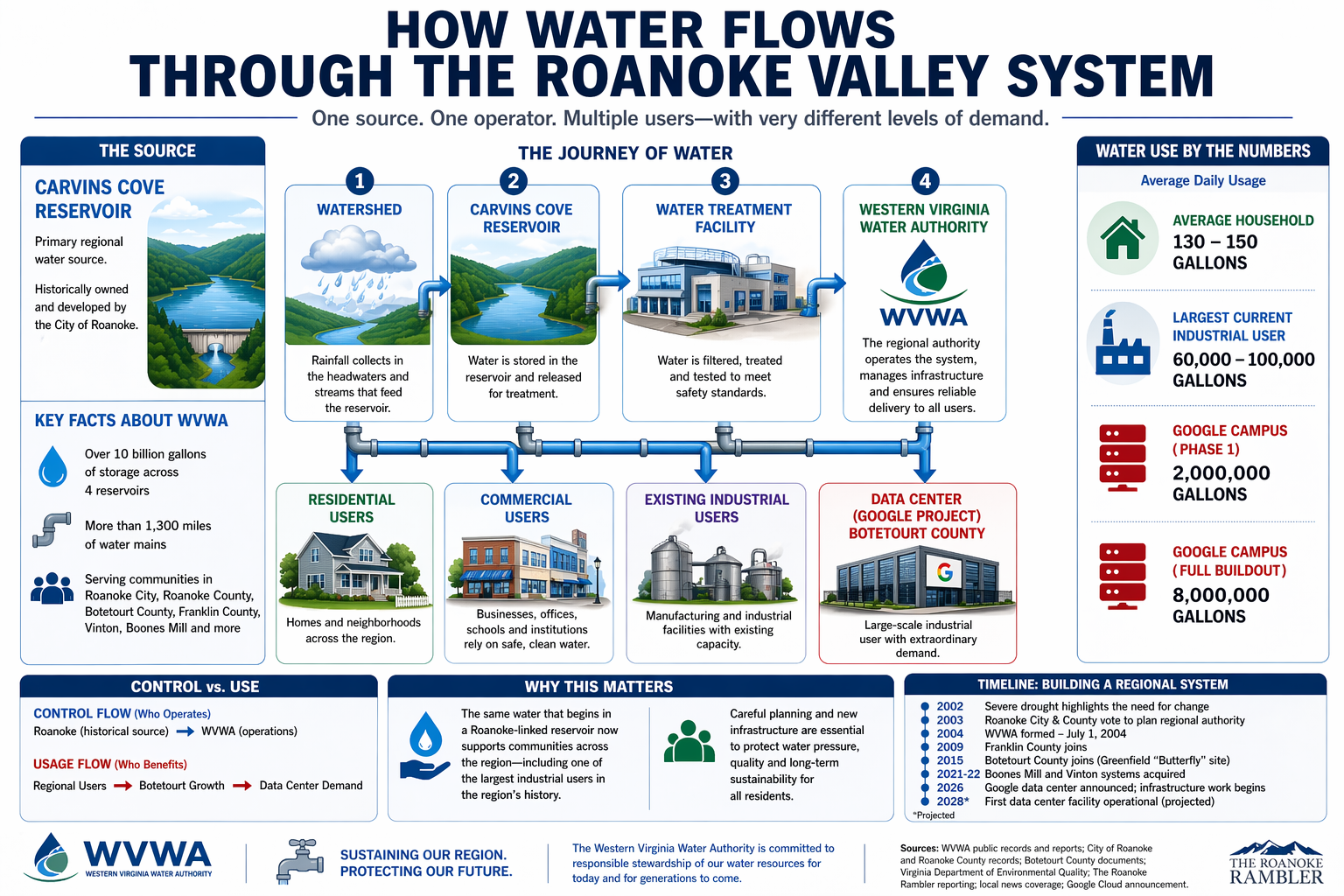
However, some say the real story is not the buildings, it is the system they rely on. Projected water use ranges from 2 million gallons per day initially to as much as 8 million gallons per day at full buildout, according to the Western Virginia Water Authority’s March 2026 planning report.
The History: From Drought to Unification
The drought of 2002 exposed vulnerabilities in the region’s water system, according to the Virginia Department of Environmental Quality. At the time, reservoir levels dropped and infrastructure stress revealed a lack of coordinated planning across jurisdictions. By 2003, Roanoke City Council and the Roanoke County Board of Supervisors moved toward a unified system, leading to the Authority’s creation in 2004, according to local government records and WVWA summaries.
What Officials and Residents Are Saying
One citizen told the Roanoke Rambler, “before the Authority, water service felt local. Bills were modest, typically issued quarterly, and adjustments were sometimes made when unexpected issues occurred. There was a sense of direct connection between residents and Roanoke City. That connection has shifted as the system has expanded into a regional model.”
At public meetings held in Fincastle in April 2026, residents raised concerns about water demand, transparency, and long-term planning tied to the proposed data center project. “It feels like decisions are already made before the public even understands what’s happening,” one Botetourt County resident said during the meeting. “Why are we just now hearing these numbers if this has been in planning for this long?” another attendee asked. “We’re talking about millions of gallons a day. At some point, that affects everybody,” a third speaker added. One speaker was inspired enough to write and read a poem during the meeting, reflecting concerns about stewardship, growth, and responsibility for shared resources. The comments were made during public meetings in Botetourt County as part of ongoing discussions surrounding the project.
Permitting and Construction Progress
Botetourt County received grading permit applications in February 2026, according to its Department of Development Services. A federal Section 404 permit application is currently under review by the U.S. Army Corps of Engineers to evaluate impacts on local wetlands, according to public notices issued in March 2026.Officials have indicated that grading could begin before the end of 2026, with the first structure potentially completed by 2028, based on county updates and regional reporting.
Regulatory and Political Response
Local groups have submitted concerns through the Virginia Department of Environmental Quality’s public comment process, urging stricter water-reuse requirements before final permits are issued. Former Governor Glenn Youngkin said during a May 1 press briefing that the facility would be subject to the same drought restrictions as other residential and industrial users within the Western Virginia Water Authority system, according to statements from the former governor’s office. This means the facility would be treated under the same water use rules and conservation measures applied to typical residential and industrial customers
Key Protections and Mitigation
County officials have stated that Google will fund its own infrastructure and contribute to future water supply development, according to Botetourt County project updates. They have also clarified that no water will be drawn from local wells and that wastewater will be pre-treated on-site before entering the regional system, according to county FAQ documents.
Where Water is Coming From
Water begins at Carvins Cove Reservoir, moves through treatment facilities, and is distributed across the region by the Western Virginia Water Authority, according to WVWA system descriptions.
Water Demand at Scale
At full buildout, demand could reach 8 million gallons per day, comparable to a small city, based on projections reported in 2026.That level of demand is forcing a reevaluation of long-term water planning across the region.
Following the Tradeoffs
Botetourt County gains economic development. The regional system gains revenue. The burden of long-term infrastructure expansion is shared across the system. The tradeoffs are not evenly distributed.
Roanoke remains tied to the region’s primary water source through Carvins Cove. However, it no longer directly operates the system. This creates a gap between where the resource originates and where decisions are made, a gap that is central to the current debate.
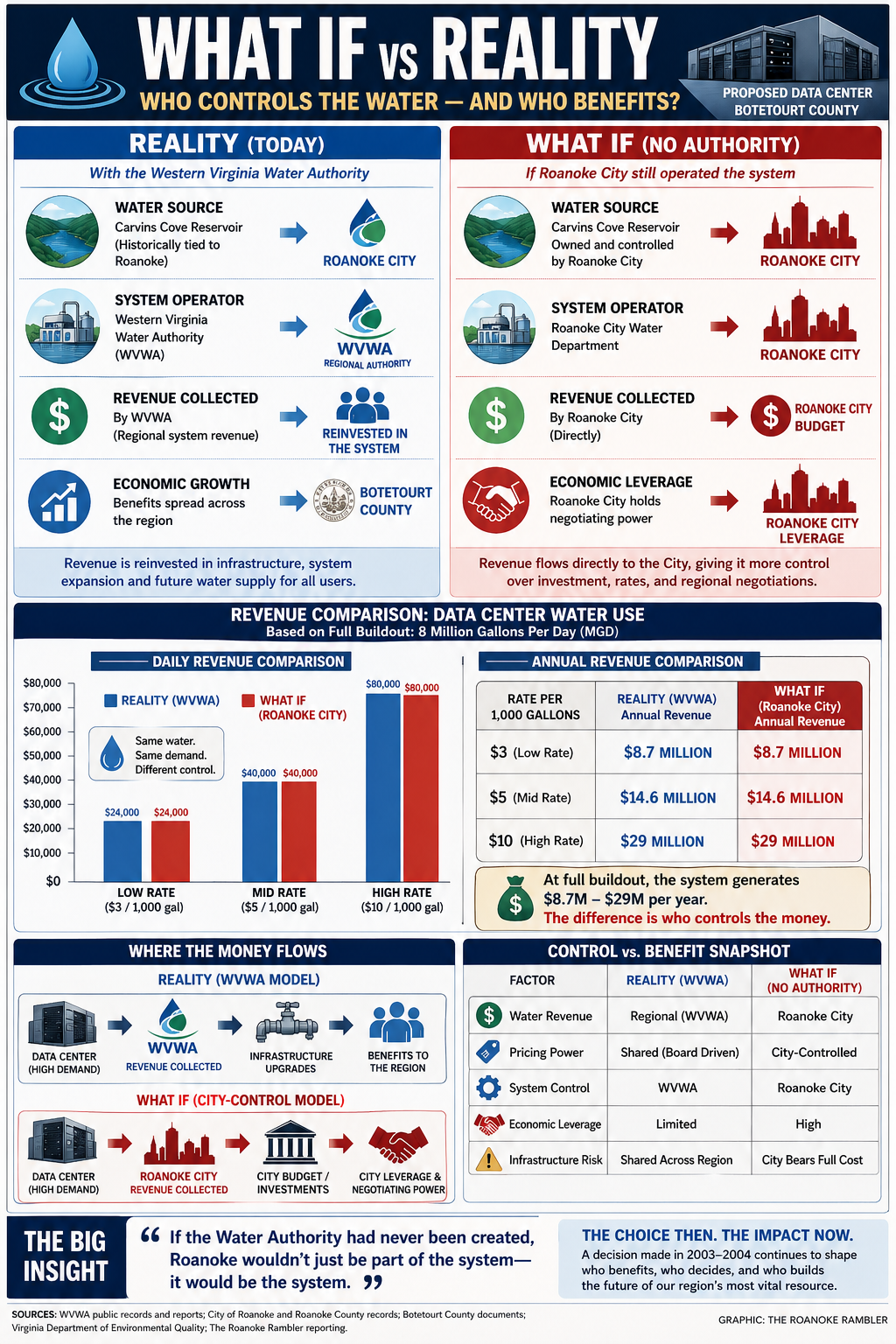
However, at full capacity, water usage at this scale could generate tens of thousands of dollars per day to the Western Virginia Water Authority in system revenue, based on typical industrial rate estimates discussed in regional reporting and public meetings. That revenue flows through the Authority and is reinvested into infrastructure, maintenance, and future supply planning.
What If the Authority Never Existed?
Without the Authority, Roanoke would likely retain direct control over water pricing, revenue collection, and allocation decisions. The amount of revenue generated would not change. The control structure would change.
The Community Divide
Public awareness of the project’s water demand did not emerge immediately. It took sustained questions, reporting, and legal pressure to disclose key financial figures, according to regional news coverage. That delay has contributed to broader concerns about transparency and public trust. The project has revealed a divide in public perception. Some see opportunity in economic growth and investment. Others see risk in increased demand on shared resources. Both perspectives are reflected in public discussion and community response.
Final Reflection
The Western Virginia Water Authority was created in 2004 to solve the problems of its time, fragmented systems, rising costs, and the need for regional coordination. For years, it worked. But the nature of demand has changed. What was once steady, predictable use is now shifting toward large-scale users capable of drawing millions of gallons a day on their own. The system still works, but it is working under a different kind of pressure. The question is no longer just whether the system can handle the demand at this point. It’s who benefits from it, and who carries the risks as demand continues to grow.