
Google's Gift
Consider It an Advance on Good Faith
Consider It an Advance on Good Faith
Roanoke, VA
Author: Roanoke Rambler Staff, Hart Fowler Lead
Published: 8:30 AM EST November 18, 2026
Edited: 8:30 AM EST November 18, 2026
Listen Here: Roanokesradio.com
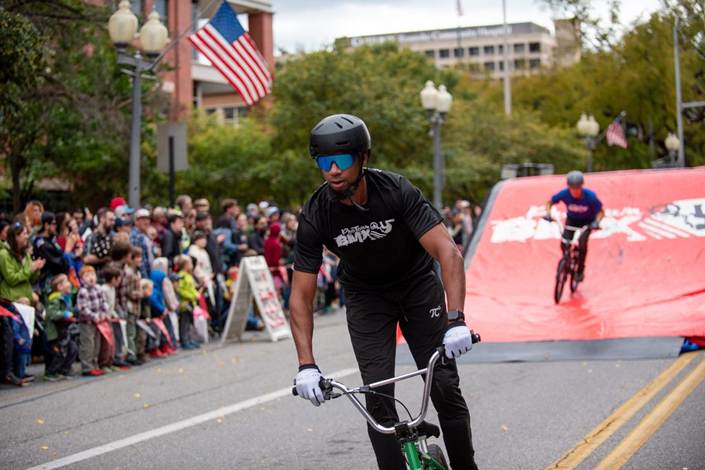
Still basking in the autumn glow of a GO Fest that organizers say drew 46,000 attendees and generated an estimated $3.3 million in regional economic impact, the Roanoke Outside Foundation now has a $2 million gift from Google to grow its Project Outside grant program.
For Google’s parent company, Alphabet, that amounts to less than three minutes of revenue at its 2025 annual pace; for Roanoke Outside, which co-organizes GO Fest with the city’s parks and recreation department, it is the largest gift in its history, more than twice its entire 2025 revenue.
Pete Eshelman, director of the Roanoke Outside Foundation, argued for connecting the region’s trails and parks a month before the gift announcement in an email to The Rambler about the region’s outdoor economy.
“Our visitors don’t see jurisdictional boundaries, so closing the gaps between trails, greenways and parks multiplies what each community has already built.”
Google’s philanthropic reach is vast, but its gifts now arrive amid criticism over its data center expansion. Its giving has supported job training, education and disaster recovery, including a $1 million contribution to help rebuild and weatherize homes damaged by Hurricane Helene in South Carolina. That support also extends to local journalism, including grants to The Roanoke Rambler in 2022 and 2023 and a $150,000 grant to Cardinal News through the Google News Initiative’s 2025 Growth Catalyst program.
Google selected Roanoke Outside because its Project Outside grant program, launched in 2020, already had a system for distributing money to local outdoor projects. Google imposed no restrictions on which projects would receive funding, and Roanoke Outside set a two-year window for distributing the grants, according to Eshelman. Roanoke Outside was established by the Roanoke Regional Partnership, whose CEO, John Hull, also leads the regional industrial authority pursuing the potential sale to Google of Wood Haven Technology Park in Roanoke County, near the Interstate 81–581 interchange.
Fifteen miles to the north, Google’s land purchase brought approximately $14 million to Botetourt County, alongside a separate $4 million commitment for community projects over five years. Money tied to the deal has already paid for three new ambulances and supported purchases of sheriff’s equipment and school transportation vans. The first data center building is expected to be ready for use in 2028, with county officials projecting at least $30 million in annual local tax revenue once all three planned buildings are operational.
Grading is underway at Google’s Botetourt campus while a resident’s open-meetings lawsuit against the county awaits a ruling, Cardinal News reported. The $2 million gift, meanwhile, has done little to quiet critics who argue that the region is trading away its natural resources for too little in return.
Before that debate takes up all the bandwidth, a closer look at the work the gift would support, and what Carnegie and casinos have to do with it.
Go Team Go!
Roanoke Outside might be best known for GO Fest, the free festival it launched in 2011 in partnership with the city’s parks and recreation department. But its roots extend beyond the festival grounds: event proceeds have helped fund the pump track at Wasena Park, while Project Outside has awarded $15,000 toward repairing the Southeast Roanoke River Greenway, $5,250 for a public mountain bike skills facility at Vic Thomas Park, and grants to expand Humble Hikes, which introduces Black youth to outdoor recreation. This year’s awards included $6,576 to restore Brushy Mountain Fire Road at Carvins Cove and $2,500 for a second phase of the Vic Thomas skills loop.
“The opportunity is to treat the outdoors as infrastructure,” Eshelman wrote in his October email. “For a long time we treated it like wallpaper, scenery in the background. It’s the fabric that connects our region, urban to rural, and it’s the reason many people choose to live here.”
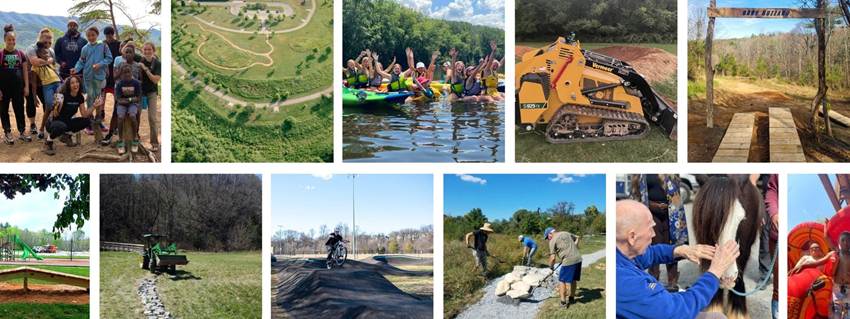
The Google gift changes the scale of that work. Project Outside’s previous grantmaking totaled $230,000 across 53 awards. The new funding provides $1.75 million for grants, while $250,000 will support a contract position for three to four years to manage applications and grantee follow-up, according to Stephanie Long, director of marketing for the Roanoke Regional Partnership.
Individual awards have ranged from $500 to $20,000 but will now range from $5,000 to $200,000. Applications close Feb. 28, 2027.
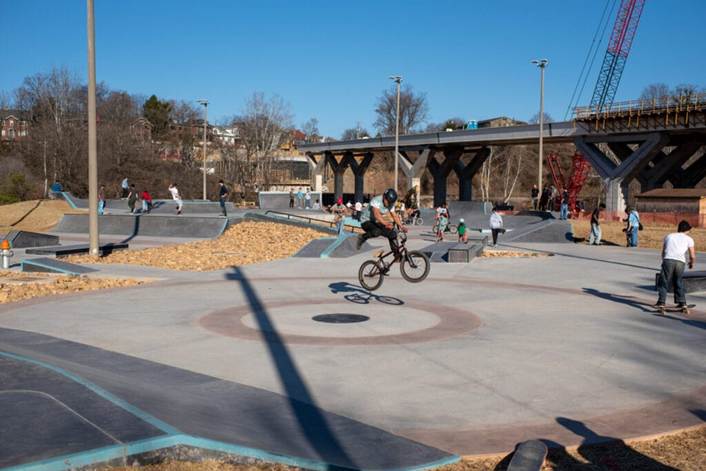
The gift arrives at an important moment in the battle over screen time. As parents and schools compete with phones for young people’s attention, and concerns about loneliness and isolation grow, Roanoke is adding reasons to put the phone down and get out and about: the reopened Wasena Bridge, the forthcoming in-river kayak park, and the recently opened pump track and skatepark at Wasena Park. Project Outside now has substantially more money to help grow that network across the region—a tangible investment in places where residents and visitors can move, gather and connect.
Mayor Joe Cobb sees the gift as support for amenities local governments struggle to fund.
“When local government budgets are limited in our ability to increase funding for outdoor amenities, including parks and recreation, this type of gift indicates an important investment,” Cobb wrote in an email to The Rambler.
Asked about criticism of the gift, Cobb challenged opponents to propose alternatives. “I would suggest that critics help us identify other and/or additional substantial ways to invest in local resources, especially in assets and amenities that local governments are challenged in supporting due to funding and budgetary restraints.”
The Price of Goodwill
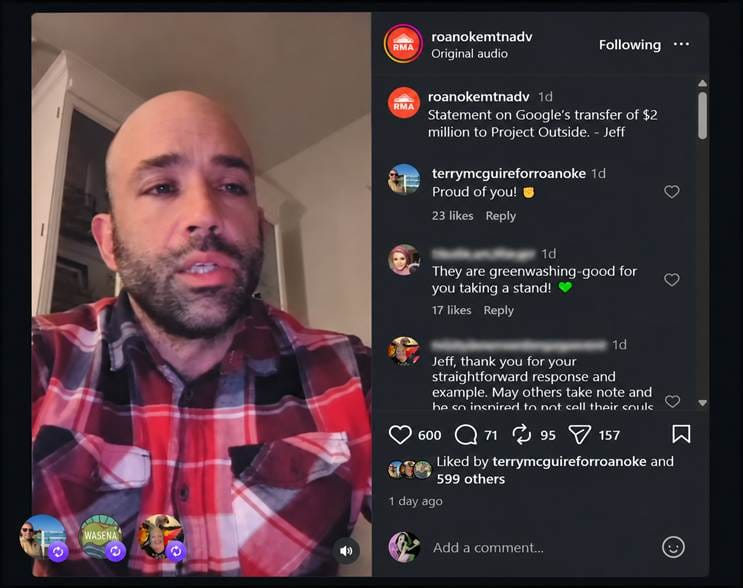
Jeff Todd’s criticism comes from within the outdoor business community. His Roanoke Mountain Adventures outfitting business recently moved from its original Wasena location to the Black Dog Salvage property along the Roanoke River Greenway, expanding its bike shop, gear sales and rental operations. In an October email to The Rambler, Todd wrote, “Without the Greenway and trail development in and around the city of Roanoke, my business would simply not exist.”
In an Instagram statement, Todd said the business had raised $5,000 for Project Outside at GO Fest and that he served on the outdoor advisory council helping administer the fund. But he declined to participate in the Google announcement or help administer the donated money.
“Firstly, I think it’s just deeply cynical to use outdoor giving to greenwash this data center project,” Todd said. “I just believe in calling it what it is.”
Todd argued that increased water demand could accelerate the need for environmentally disruptive water-supply projects, potentially harming the same outdoor resources the gift would support.
He acknowledged the argument for accepting money from a company whose project is already moving forward.
“Well, we do need to make the best of the situation. Maybe there’s a way for it to be a net positive. I hope so. But I don’t think that taking some pocket change payout from Google is that way.”
A Breeze Before a Windfall?
Roanoke knows something about fortunes built through industries that reshape the landscape. Railroads and coal helped build the region, while leaving environmental costs that outlasted their original owners. Carnegie’s libraries, museums and performance halls offered a lasting public benefit without settling the arguments over how his steel fortune was made.
Gambling operators have also made charitable giving part of their community presence. Rosie’s reports more than $5.4 million in cumulative cash and in-kind contributions across its Virginia operations, while Caesars Virginia reported nearly $1 million in giving around Danville between 2023 and October 2025. Virginia has directed all Lottery profits to K–12 public education since 1999, generating more than $914 million for schools in fiscal year 2026.
These charitable gifts and publicly dedicated funds reach communities through different channels, but both turn money from gambling into support for public needs.
For Roanoke Outside, the immediate question is what $2 million can accomplish. Google’s gift won’t balance a city budget. But it can move outdoor projects from the wish list to the trail, without requiring anyone to surrender their right to question the donor. Better outdoor amenities are a public benefit; they are not an answer to questions about water supply.