
Money on the Mind: Roanoke's Finances Generate Debate Amid Meals Tax, Debt Decisions
The city needs revenue -- and the city council may leave a tax in place past its sunset to do that.

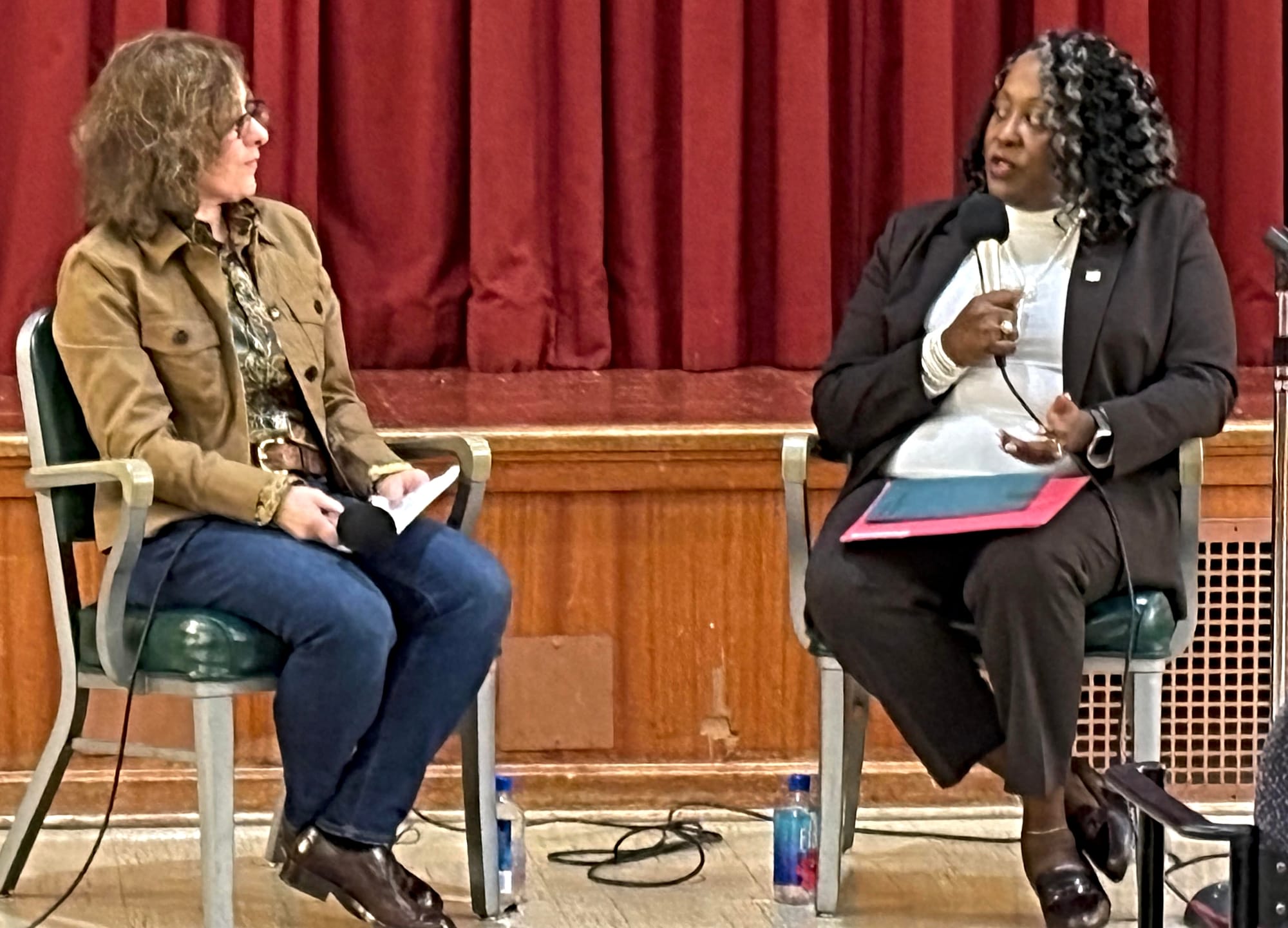
During a Deyerle neighborhood meeting last week, City Manager Valmarie Turner was asked to answer in one word the biggest challenge facing the city.
“Money,” she replied.
And one word that excites her about the city’s future?
“Money,” she said.
It has been the theme of her first 15 months on the job.
Turner says her administration is saddled with something that should have happened before her January 2025 arrival — finding a way to pay the debt on numerous projects already started. That’s happening now while the increase in the city’s revenue is expected to drop significantly, which could result in freezing more than 100 jobs.
“Additional funding should have been set aside in anticipation” of the bond needs, she told council during a recent meeting, adding that “funding is really tight for us.”
A proposed plan presented by the city’s financial advisor and backed by Turner — estimated to save the city a total of $3.2 million — would restructure a portion of the debt, and it would keep a meal tax increase past its 2027 sunset date. It’s presented as a way the city can get to a better place, maybe without the council having to raise the real estate tax rate. The city’s rate is the sixth highest in the state among 136 localities, according to the state Department of Taxation.
But the question is: Will the council break its word on the meals tax to do that?
Councilman Phazhon Nash, who cautioned his colleagues last year that sunsetting the meals tax was not a good idea, said the situation will make for some “real hard discussions in the back room.”
Trash pickup every two weeks?
One of the main budget issues is a pool of $92 million of bond funds that have to be converted to longer-term debt in the coming years. The money was accessed through a process to get it more quickly so projects can be started – and then it is moved to a bond payment schedule.
Most of that includes money for the Riverdale economic development project in Southeast, civic center improvements — and overdue maintenance and accumulating employee overtime that were defining factors in passing the meals tax increase.
Half of the revenue generated by that 1 percentage point meals tax increase – or $2 million — is paying for the maintenance issues. The other half is to make payments on bonded debt.
However, the extra meals tax revenue cannot cover anywhere near the total amount of the city’s capital needs, according to ongoing budget discussions. So, to make way for the $92 million conversion starting with the next budget, something had to go. More than half of other capital projects the city planned over the next five years — $50 million worth — were axed, including a new Williamson Road Fire Station and the Belmont Library expansion.
Asked if he was surprised by that, minutes after it was presented at a meeting last month, Mayor Joe Cobb nodded.
All the while, the city is staying within its set fiscal boundaries and maintains its AA bond rating, according to David Rose of Davenport, the financial advising firm. And with Davenport’s proposal, the city would pay off a sizable 75 percent of its outstanding $233 million in total bond debt in just a decade and find itself in a stronger position.
However, for the next few years, the city is planning to tighten its belt. Its main revenue producers — such as the real estate tax — are projected not to churn revenue at previous percentages. The increase in its main taxes is expected to drop from $21 million to about $5 million from this fiscal year to the next, for instance.
Turner’s administration is making cuts to the upcoming proposed budget, including freezing the 100 to 115 jobs. That was part of trimming the projected shortfall from $18.9 million to $5.1 million. The council reduced the percentage of revenue it will allot to education from 40 to 34 percent, and the school board is now discussing its own shortfall.
In recent weeks council members have been lambasted by dozens — including teachers, parents and students — for the school funding reduction and urged to reconsider the change. Councilman Peter Volosin responded Monday, pointing out that the schools are still set to get an increase in city funding and the actual impact of the new policy is being inaccurately portrayed by some.
In a recent social media post, the Roanoke City Council of PTAs/PTSAs took issue with statements by Cobb that the city faces tough times, while also saying during the Davenport presentation that the city is in good financial shape.
“Which is it?” asked the PTA group.
Asked that question by The Roanoke Rambler, Cobb said in an email: “This has been taken out of context to imply that a strong financial position means we have plenty of revenue to cover every funding request. We do not.”
Cobb warned during Monday’s council meeting that times may call for decisions such as trash being picked up every two weeks, versus weekly.
He said the city will need to look at all potential revenue options, including reducing the number of organizations that have tax-exempt status.
On that topic, he mentioned the Roanoke City Public Schools headquarters which opened last year in the former Roanoke Times building that was owned by Lee Enterprises.
“We have the building across the street (from City Hall), which we’re glad Roanoke City Public Schools is there, but when that was purchased, it came off our tax rates,” he said. “That was about $250,000 a year.”
‘People don’t trust politicians for a reason’
Last March, the council passed the one percentage point meals tax increase after a heaping helping of restaurant owner opposition. Because of that blowback, the council agreed to sunset that increase as of July 1, 2027.
The proposed budget plan would keep the increase in place for at least several years past that.
Next year’s council, which could include as many as three new members after the November election, will have to make the final decision on the meals tax sunset. But the budget passed this year will set the stage, because it would include parts of the proposed Davenport-pitched plan.
Restaurant owners will be watching.
Meals tax numbers, obtained by The Roanoke Rambler via an open record request, show the city collected more in 2025 after the increase went into effect in July versus the same months in 2024. The one exception being December of last year.
The increases included a doubling of the tax in August of 2025, from $802,628 the previous August to $1,669,157. The tax drop in December was more minimal, from $2,829,214 in 2024 to $2,724,512 last year. A reason for the substantial increase in August was not immediately available.
Vice Mayor Terry McGuire said during a Feb. 2 council meeting that restaurant owners “were quite sure” a meal tax increase would reduce sales but based on the first five months after the increase, “that was not the case at all.”
Restaurant owners in recent interviews say there’s more in the data than just the number of people eating out.
Texas Tavern owner Matt Bullington said increased prices are also part of the additional tax revenue. He said he raised menu prices recently due to economic pressures on his business. And that was prompted by increasing food prices and other costs business owners face.
The city always takes advantage of the restaurant industry to bail it out of problems, he said, also questioning the city’s strategy and ongoing decision-making.
He said the council should sunset the meals tax increase.
“People don’t trust politicians for a reason,” he said. “I would say don’t be that politician.”
Jason Martin, owner of Martin’s, Sidecar and Jaybird Tavern downtown, said he wonders what financial shape the city is really in, particularly when it had the city schools return over $20 million this year. What the city will do with that money has not been publicly discussed.
Diners pay a substantial 11.8 percent in sales and meals taxes in Roanoke – an amount that could climb by a percentage point if a school construction-related sales tax increase passes the state legislature and potentially a local referendum as well.
“It might say $17 or $18 on the menu, but it’s really $23 or $24,” he said of taxes plus other costs restaurant owners choose to absorb.
On the meals tax sunset, he said of the council: “If you say something, you should mean it.”
The city will hold public meetings on the budget, starting next month: April 9 at Williamson Road library and April 16 at South Roanoke United Methodist Church. Times have not been scheduled. The city will hold a public hearing on the budget and proposed tax rates on April 23, and the budget adoption is scheduled for May 11.