
Roanoke Police Chief Scott Booth on ICE, Crime Disparities in Four Quadrants, One City Q&A
In our monthly Q&A series, Scott Booth sat down with The Roanoke Rambler to answer questions about the city's crime numbers - and he didn't duck others.

Roanoke’s four quadrants reveal a deep and persistent divide. The city’s legacy of segregation continues to cast a long shadow, with access to education, job opportunities and even life expectancy varying widely depending on Zip code.
In our recurring Q&A series, The Rambler invites members of the community to reflect on what it means to live in a city shaped by a history of division. By sharing perspectives across generations, backgrounds and quadrants, we hope to spark honest conversations that are too often left unspoken.
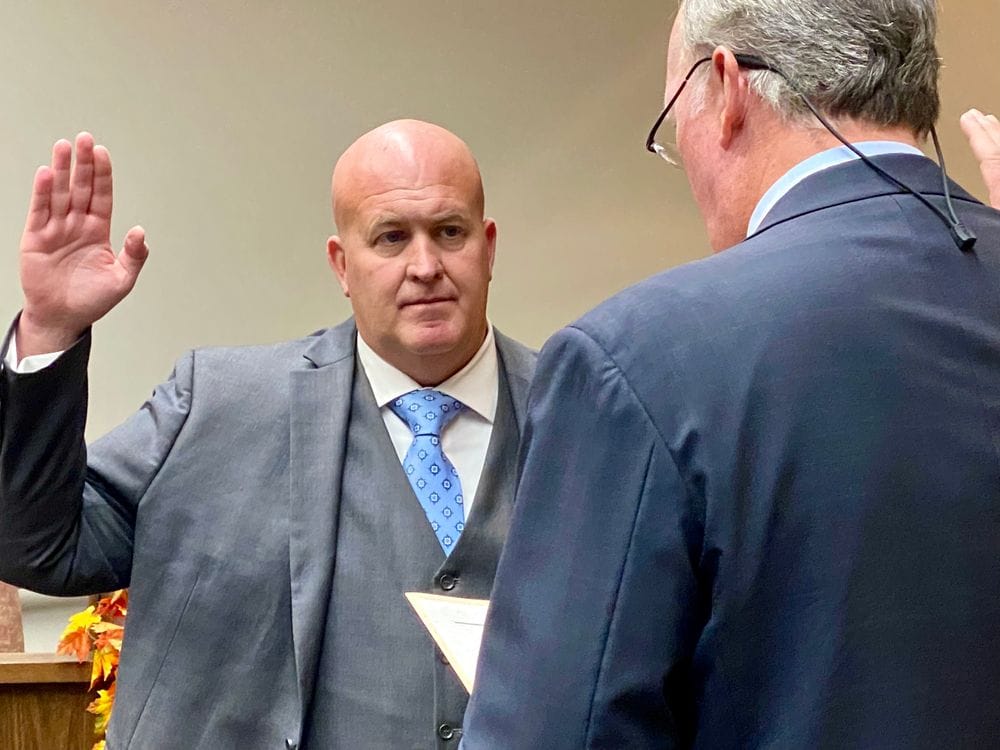
This month’s interview features Roanoke Police Chief Scott Booth, who joined the department in 2023 during a record-breaking year for fatal shootings. Gun violence sharply declined since Booth’s arrival, a trend he attributes to an increased focus on community policing, a philosophy that emphasizes collaboration and trust-building between law enforcement and citizens.
In 2025, Roanoke Police Department recorded 27 incidents where a victim was hit by gunfire, down from 35 in 2024. Despite the overall decline, gun violence continues to disproportionately impact one part of the city more than others. More than half of aggravated assaults or homicides where victims were hit by gunfire in 2025 occurred in the Northwest quadrant — a disparity Booth openly acknowledged.
In our discussion, Booth reflected on gun violence in 2025, his approach to community policing and how long-standing inequities and decades of disinvestment have shaped both crime patterns and community trust in police. In the wake of immigration crackdowns across the country, Booth also responded to growing concerns about immigration enforcement and clarified RPD’s relationship with federal agencies like ICE.
This interview has been edited for length and clarity. If you or someone you know is interested in being interviewed for this series, please reach out to sinclair@roanokerambler.com.
VIDEO BY SINCLAIR HOLIAN FOR THE ROANOKE RAMBLER
Recent ICE operations have raised tensions and fear in communities across the country. What can you say about RPD’s relationship with ICE, and what would you tell community members who might be concerned about immigration enforcement in Roanoke? (This interview was held after an ICE agent in Minneapolis shot and killed 37-year-old Renée Good on Jan. 7. After the interview, federal agents in Minneapolis killed a second U.S. citizen, 37-year-old Alex Pretti, on Jan. 24.)
You know, ICE is federal law enforcement. We’re local law enforcement. The majority of citizen contacts and all policing occurs at the local level. We do not actively work with ICE, right, but they are a law enforcement agency that, I would guess, ventures in our community from time to time.
In no way am I saying that, you know, we won’t support another agency. But we’re not going to actively work with them to support immigration enforcement. That’s not what we do. It’s not what we believe in. We believe in them doing their role. We’re going to keep communities safe.
This comes up at least once or twice a week: I’ll get a picture emailed to me, “Is this an ICE vehicle?” Majority of the time it’s an unmarked U.S. Marshals vehicle, or something like that. But what it’s shown me, and I talked about this at our staff meeting yesterday, it’s shown me that it creates a lot of fear in our communities.
When I see what’s going on in Minneapolis — and I won’t necessarily weigh in on that specific ICE shooting from a couple weeks ago — but the thing that I really despise is when folks lose trust in their police. And whether it’s ICE, or whether it’s local police, that has a direct runoff, it just does. We talked about this yesterday: It might be ICE that people are talking about harming their communities, but when they see my officers go in and my officers are responding to a call for service, their fear can be stoked by how they feel about ICE. So it is a concern for me. So I think in 2026 we have to really double down on how we treat folks with dignity and respect. We need to make sure that they clearly understand our role in the community, which is to keep them safe, not to do immigration enforcement, but to investigate crime, especially violent crime, to make sure that they are safe. And I guess that would be my overarching theme with that.
What stands out to you the most about Roanoke’s gun violence statistics in 2025?
I think one of our biggest successes as a community is when we look at 2023 to 2024, we saw a substantial decrease in gun violence. So we had about a 60 percent reduction in gun-related homicides in 2024, when you compare that to 2023. And then about a 44 percent reduction in non-fatal shootings in 2024 and 2023. When you look at 2025, we had an additional 10 percent reduction in gun-related homicides, and about another 28 percent reduction in non-fatal shootings.
We had some really bad years here in Roanoke in regards to gun violence, and any shooting or any homicide is too much but, I’m optimistic with that trend line that we’re seeing our shootings go down. And I’m saying that even though we’ve had a few pretty horrific incidents over the last week or so. But our trend line is showing that gun violence is decreasing.
Of the 25 cases of aggravated assaults or homicides where a victim was hit by gunfire in 2025, more than half of those occurred in Northwest. What are the factors that contribute to that high concentration of incidents in Northwest?
Northwest, that is a community that’s experienced a level of disadvantage that some of our other communities haven’t. Northwest, more so than Southwest Roanoke, I think it’s an accurate statement.
And that’s usually where crime, especially crimes of violence, are going to occur. Whether it’s a Richmond, a Danville or a Roanoke — I can speak from having policed in all three places — I think you’ll see a lot of similarities in those communities. In 20 years as a Richmond police officer, the majority of those crime scenes were in the East End of Richmond, the Northside of Richmond, pockets of Southside. Those Black and brown communities that experience more disadvantage, there’s usually an overlap with the levels of crime, levels of victimization.
Is mitigating the inequality in the distribution of violence something that’s on the police department’s mind?
Yeah, it is. But you know, policing is never the answer for mitigating the disadvantage piece, right? So the way we mitigate that is you invest more in the people in those communities.
As chief in Danville, I spent a lot of time in communities that I felt that needed us the most, and we do the same thing here. We continue to build more programming in the Northwest part of our city. We’ve built out our Community Response Bureau over 2025, and we’re going to continue to do that in 2026 because I want to put more officers and more programming for the folks that need us the most, over in Northwest especially.
I’m not saying we’re not going to touch other parts of the city. Certainly, we spend a lot of time in Southeast, Southwest, Northeast, we really do. But you know, when we look at communities of need, my lens for that is: “Where’s crime occurring, specifically violent crime?” Because that is where they need us the most.
And it’s not just building up programs, but it’s also, “What are we doing over there to increase our trust and legitimacy?” Those communities have a historic mistrust of the police — rightfully so, many times. But when we respond to an incident over there, especially an incident involving gun violence, we need people to trust us enough to tell us who harmed them and to work with us to get that victim justice. And so we have to invest in strategies that are going to build trust, where they humanize us, where they realize, “Hey, the police aren’t always the bad guys.”
One of the things that I’m really proud of is the police use of force from 2024 to 2025 is down 46 percent. We had zero officer-involved shootings in 2025. That’s the first time since 2016 that we have not had an officer-involved shooting. And so, as crime disproportionately impacts certain parts of the city, so does police use of force — more contact with people, more policing. So seeing a decrease in use of force, to me, is a positive impact for certain areas of our city.
And a lot of that I attribute to a de-escalation model we put in place in 2024, showing our officers a different way to communicate and interact with the public, which I feel is a smarter way. We did that in Danville, and we saw a tremendous decrease in use of force. And we’re able to do that, just like we are here, and still reduce crime. We can still do good policing. We can still arrest offenders — specifically violent offenders — but we can do it with less force. Force is a part of policing, but it’s important to me that we continue, like reducing crime, to reduce those uses of force when we can.
You’ve spoken before about the value of a community policing model. How has executing that model in Roanoke been different from your work in other cities? What is unique about Roanoke?
Roanoke, for me, continues to appeal deeply, because I love the fact that we have four quadrants here, four disparate communities. And sometimes we have to change our policing model a little bit — our Northwest sometimes requires a little bit of different things than our Southwest or Southeast or Northeast. But I love the challenge that it offers.
But at its core, at its foundation, community policing is about treating people with dignity and respect. That’s across the board, man. Whether you’re in Richmond, whether you’re in Danville, whether you’re in Roanoke, if you treat people with dignity and respect, and people see the human side of us behind the badge, you can really do good things.
And also, whether it’s Richmond, Danville or Roanoke, if you are hyper-focused on where crime occurs and who is committing crime, you can reduce crime. But you also have to have that dignity and respect as you’re doing it. You can't dehumanize people. Even those violent offenders — they’re still people. They still have families. You still have to offer opportunities for them to get better. You have to work with the communities to build programs to make those folks get better.
One thing that Danville really showed me is that intervention and prevention works. I had never really seen that model work until we were able to build that out in Danville. So we’re building that out here in Roanoke, and I think we have a really good Roanoke-specific template that’s going to allow us to get better.
What components are part of that template?
So with intervention and prevention, things like our RESET (Rapid Engagement of Support in the Event of Trauma) team, we continued to grow that in 2025. Our Champions of Change boxing program, which is under our RESET program. I think that’s big, especially for getting young people from Northwest involved with working with the police and building trust and legitimacy. I think that’s huge. RESET deploys whenever there is a critical incident or homicide or non-fatal shooting in our community, to go out there and build trust. That’s really big for us. We’ve been lucky enough to get a considerable amount of Safer Communities money over the last couple of years, which has allowed us to build out our RESET, our Community Response Bureau, also to invest in technology.
As police chief, how does Roanoke’s history of segregation and the way the four quadrants are divided play a role in your approach to policing, especially in communities that might have mistrust or fear of police?
Specifically, for me as a police chief, it’s: “What harm has been done to this community over the years?”
I think sometimes the police, we can be myopic and not understand any lens other than our own. What I try to do as chief is I try to understand the lens of how they are viewing us, right? How do the people of Northwest view the police when, historically, there’s been a level of injustice given to them? They have felt many times that they didn’t get police service like other parts of the community. They have felt like their justice wasn’t as important to us as it was in other parts of the city. So I want to make sure that I show them that it is important to me that if their loved one is killed or hurt or injured, that we are going to work to give them and their family justice.
That’s one reason that I’m like, if we have a homicide in any area of the city, we’re going to work doggedly to arrest that offender, because that family deserves that. You know, we’re going to keep that family informed. And every person that’s a victim is important, everybody deserves the same level of service. It doesn’t matter — Southwest, Northwest, Northeast. My role as police chief is to make sure that equality and equity is a part of what we do