
Affordable Housing: Questioning the Meaning of Zero and the Importance of the Caper Report
The PowerPoint presenting the annual report was left out in a sparsely attended City Council meeting, with no mention of the many zeros filling out this year’s scorecard for federal Affordable Housing initiatives.

The PowerPoint presenting the annual report was left out in a sparsely attended City Council meeting, with no mention of the many zeros filling out this year’s scorecard for federal Affordable Housing initiatives.
Roanoke, VA
Author: Roanoke Rambler Staff, Hart Fowler Lead
Published: 9:15 AM EST September 9, 2026
Edited: 9:25 AM EST September 9, 2026
On the Thursday before Labor Day, Roanoke quietly posted its federally mandated affordable-housing report card. The scorecard, buried on page 34, is filled with zeros, row after row of them, marking a year in which the city completed none of its planned affordable-housing activities. Yet when the report landed on the City Council's agenda days later, not a single official said the word "zero" out loud. In a city where nearly $1.5 million in neighborhood funding sits frozen and three council seats are up for grabs, that silence may prove louder than the numbers.
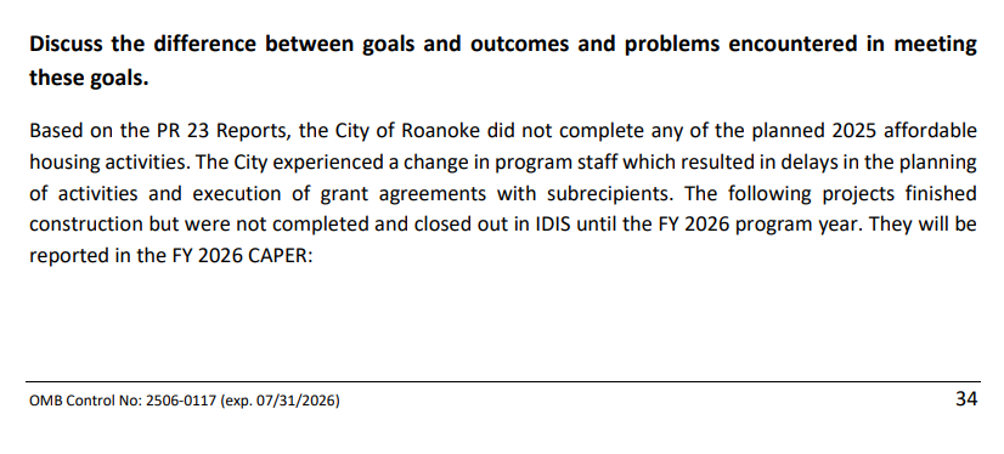
The Thursday before Labor Day marked the official public release of the city's draft Consolidated Annual Performance and Evaluation Report (CAPER) for review, launching a mandatory 15-day public comment window before council votes to finalize it.
Yesterday afternoon, the report card was on the agenda for a formal briefing at City Council. But despite a glaring administrative bottleneck on full display in the text, there wasn’t a single mention of the flat rows of zeros on the floor.
A State of the City Address, a standard budget overview, or a celebratory announcement of newly awarded funds, this is not. A CAPER report is a rigorous, federally mandated annual report card required by the U.S. Department of Housing and Urban Development (HUD). The audit forces the city to show the exact number of completed projects and precisely where—or if—local grant money was spent over a 12-month calendar. Because HUD uses these metrics can be used to assess administrative capacity, these self-reported figures directly affect the city's eligibility for future federal funding.
Specifically, these audits look past citywide operations to focus entirely on the stabilizing of low-to-moderate-income neighborhoods, with an explicit legal concentration on Affordable Housing infrastructure. The line-by-line accounting shows how real-world actions measured up with actual completions, measured directly toward HUD-set benchmarks.
The report notes a dramatic increase in optimism within this year's target columns. This sudden spike in projected goals is due to a new, formulaic Five-Year Consolidated Plan required by HUD, which saddles local municipalities with much higher, macro-demographic expectations based on total regional housing needs. Immediate local staffing limitations are not factored in. Yet even when factoring in these heightened baselines, the report is alarming.
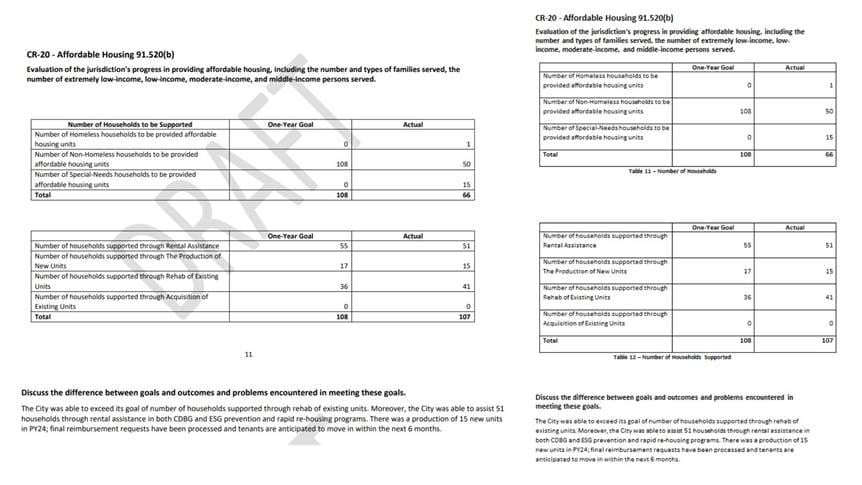
Here is a look at the striking zero columns running through many of the key performance metrics released Thursday. This data is drawn directly from the city's self-reported data inside Section CR-20 of the draft report, tracking the 12-month fiscal window between July 1, 2025, and June 30, 2026, and placed side-by-side with last year’s completed numbers:
TWO YEARS OF HUD HOUSING METRICS IN ROANOKE
|
Affordable Housing Initiative |
PY 24-25 Target |
PY 24-25 Completed |
PY 25-26 Target |
PY 25-26 Completed |
|
Homeless Households (Units Provided) |
0 |
1 |
12 |
0 |
|
Non-Homeless Households (Units Provided) |
108 |
50 |
357 |
0 |
|
Special-Needs Households (Units Provided) |
0 |
15 |
2 |
0 |
|
Rental Assistance (Households Supported) |
55 |
51 |
23 |
0 |
|
Production of New Units (Households) |
17 |
15 |
12 |
0 |
|
Rehabilitation of Existing Units (Households) |
36 |
41 |
35 |
0 |
|
Total Delivery |
216 |
173 |
441 |
0 |
Page 12 of the 2024–2025 CAPER contrasted against Page 34 of the newly released draft, illustrating the complete administrative freeze inside Roanoke's affordable housing tracking system.
To set the context, City Manager Turner had six months of runway before the audit period began.
Former City Manager Bob Cowell’s forced resignation occurred in June 2024, triggering a prolonged executive vacancy and a critical personnel departure within the department. Following a six-month national search process handled by City Council, Turner permanently assumed the center seat in mid-January 2025.
This was now entirely her administration's watch, rather than an active transition period handled by an interim manager. She voiced concerns over staffing issues and workload during a recent council meeting involving added work for the department regarding by-right zoning amendments, and expressed concerns in her interview with the Rambler: Watch, Listen, and Read: The Valmarie Turner Interview …
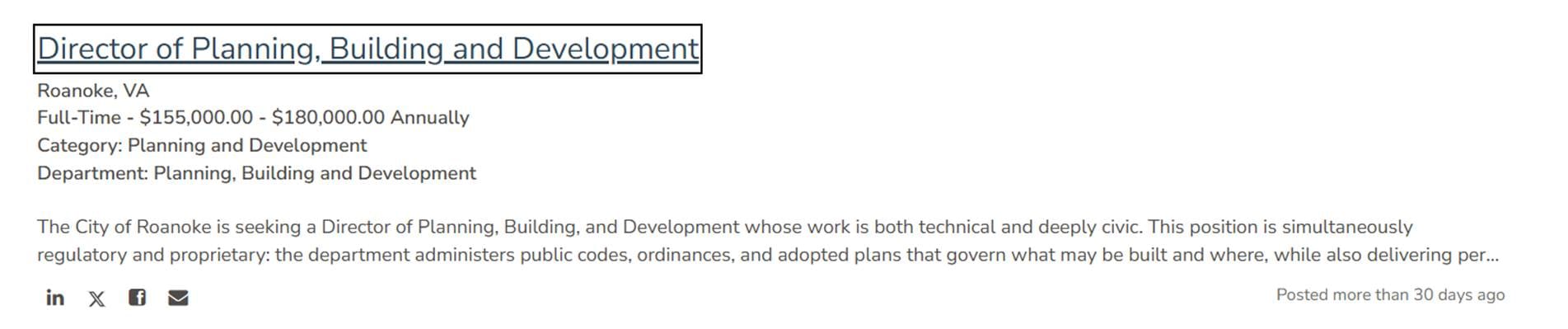
The gap in accounting in the CAPER report may be partially due to IT issues.
In July 2024, the city implemented a new Oracle enterprise software system. It was a rollout that City Councilmember Evelyn Powers noted staff were not prepared to handle, and at a tumultuous time.
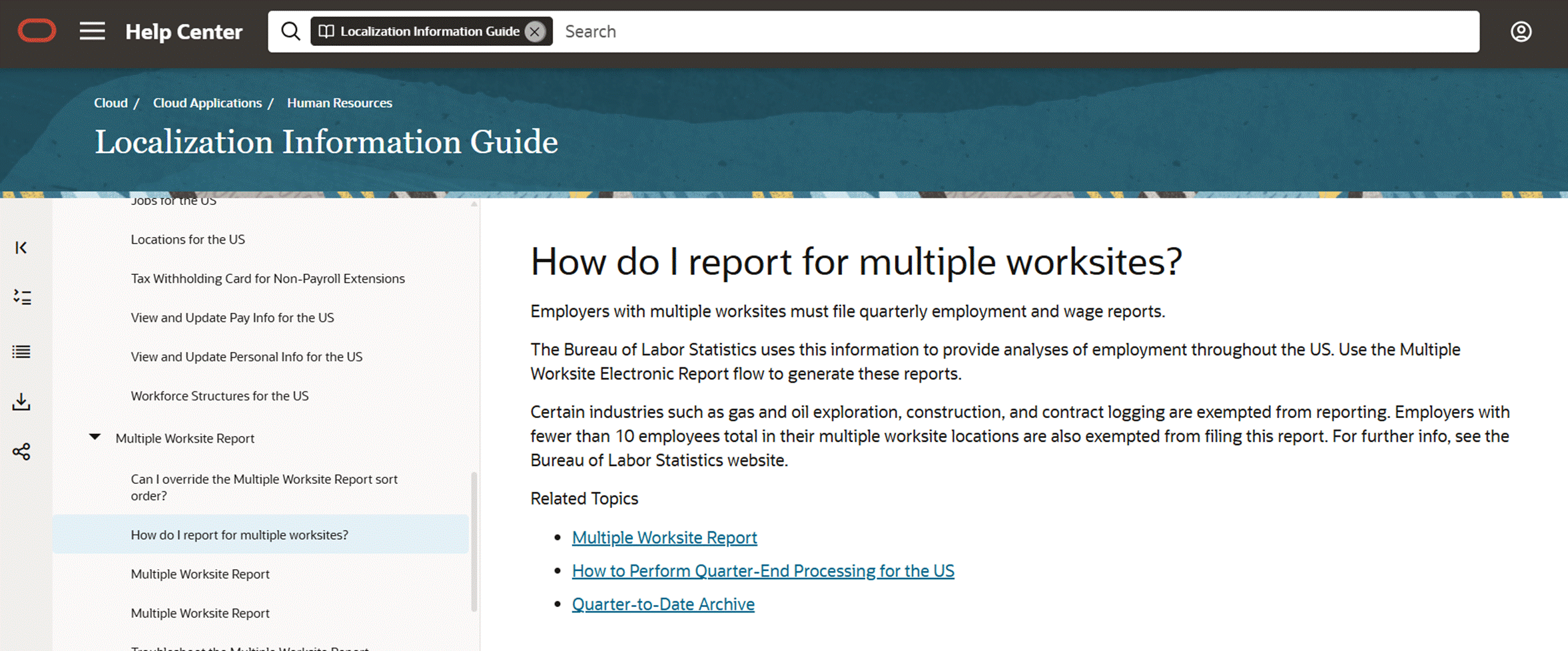
It appears that software transition triggered a compounding backend delay that continues to impact municipal logistics, and has slowed the finance department’s ability to reconcile cash and process complex grant documentation on time.
Thankfully for those most in need, this unspent capital does not vanish. The funds roll over and remain available for use next year, meaning the physical projects are delayed rather than abandoned.
However, because HUD uses these annual processing metrics to evaluate local administrative capacity, the prolonged delay on paper carries a secondary risk: it could directly affect the city's eligibility for future federal grant opportunities.
While City Hall can treat this 15-day public review window as an emergency editing extension to clear backlogs, it did not last year in the midst of the manager changeover. The public display window has traditionally opened with the city's tracking numbers already fully locked in and reconciled.
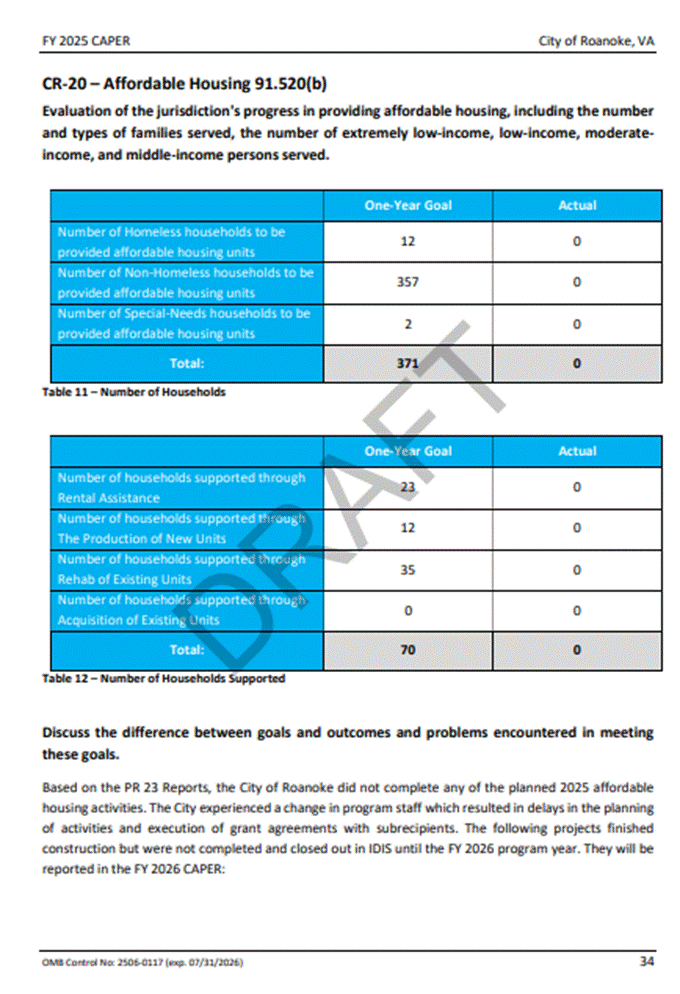
Should this draft stand as the final filing, ongoing projects are pushed forward to the next CAPER report. This leaves the meaning of the zeros and money left on the table to be a potential target for affordable housing and neighborhood improvement advocates in an election year for three council seats, while potentially adding scrutiny from federal grantmakers.
A teacher would say that it remains a zero until the work is turned in. There was a strict deadline, backed by a mandatory 15-day public comment window required by HUD, giving time for the city to add unfiled work.
This report card, on paper at least, shows a real-world accounting that tends to fall on those that know what zero means the most.
The full Caper Draft Report is 60 pages, and revealed many cases of money left on the table and spent elsewhere and of work pushed back to future dates. Here’s a few three excerpts, and the full report can be found here. https://www.roanokeva.gov/350/Community-Resources
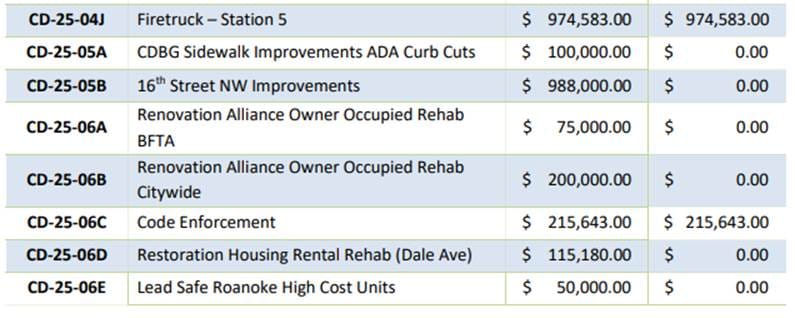
This section of the report shows a $0.00 balance across every single localized housing line item, revealing that nearly $1.5 million in authorized neighborhood funding sits completely frozen in the system, with $988,000 of that for 16th Street NW, reduced to a single bullet point.

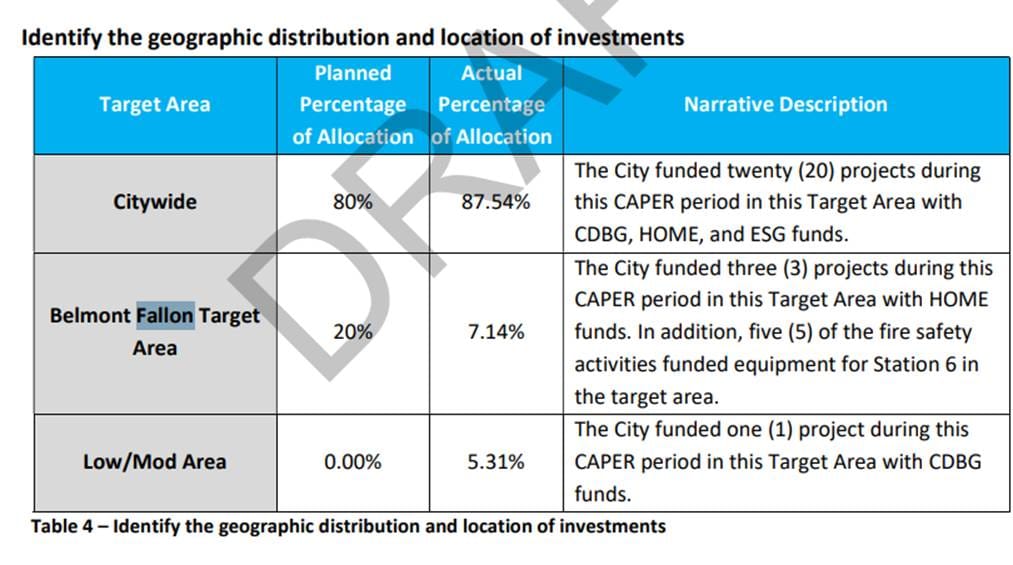
While targeted funds for vulnerable Southeast neighborhoods like Belmont-Fallon dried up, broader "Citywide" allocations overreached by 7%.
Behind every zero on this report is a porch that didn't get rebuilt, a roof that didn't get replaced, and a family in Belmont-Fallon or along 16th Street NW still waiting on money the city already has. The rollover keeps the dollars alive on a spreadsheet, but it doesn't keep the rain out. Roanoke has 15 days to change the number, and a long list of neighbors who already know what zero feels like when it lands on their block.