
"Are You Going to Complain About It, or Fix It?"

A Conversation with Councilman Phazhon Nash
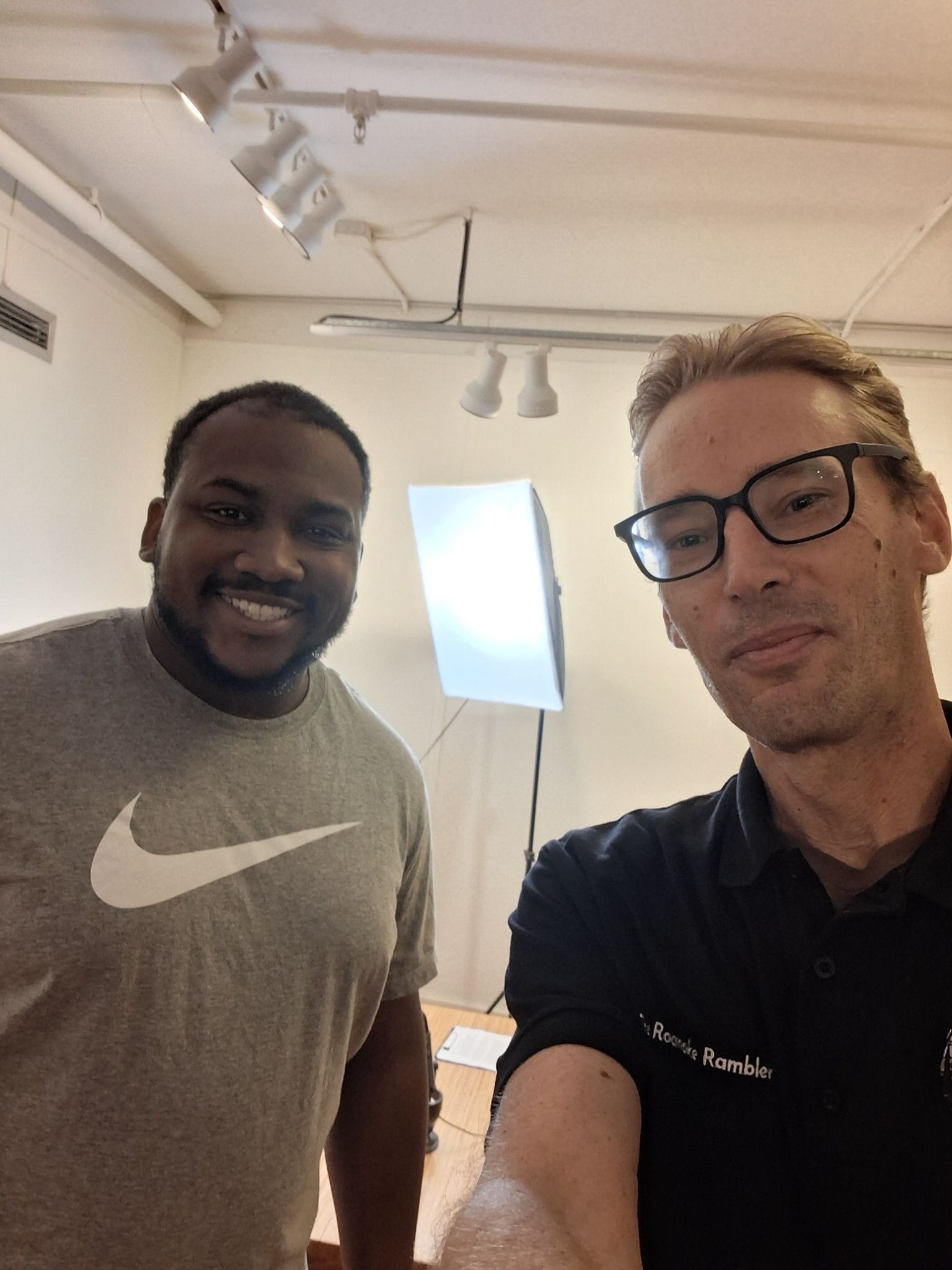
For his first interview with the Roanoke Rambler, Hart Fowler sat down with Roanoke City Councilman Phazhon Nash for a wide-ranging conversation about the future of the Berglund Center, the casino debate, Evans Spring, the reopening of the Eureka Center, and what it means to serve as the youngest council member in Roanoke history—a role Nash says he might never have pursued without a challenge from his grandmother: "Are you going to complain about it, or are you going to fix it?"
Roanoke, VA
Author: Roanoke Rambler Staff, Lead Hart Fowler
Published: 8:00 AM EST June 24, 2026
Edited: 8:00 AM EST June 24, 2026
The following conversation has been edited for length, clarity, and organization. Minor edits have been made to reduce repetition and improve readability while preserving the substance and voice of both participants. You can watch the full video here: https://www.youtube.com/@RoanokeRambler/videos
The Berglund Center: A Crown Jewel at a Crossroads
Led by Councilman Phazhon Nash, the Entertainment District Focus Group met from January 27, 2026, to May 20, 2026, to evaluate redevelopment options for the financially struggling Berglund Center, including a highly debated proposal for a casino-anchored complex.
Fowler: I was hoping you might be able to update us on what has come out of that now that you've been through this focused process.
Nash: The entertainment district focus groups concluded in May. One of the last things we had participants do was a post-focus group survey. We had them do a pre-survey as well, asking general questions to get a sense of where they were coming from.
These folks came from larger organizations and groups in the community—from downtown businesses to Williamson Road businesses to neighborhood association leaders representing their neighborhoods.
The participants were very diverse in who they represented.
One of the key takeaways was that it was not lost on anyone that the Berglund Center needs major renovations—not just the $30 million in deferred capital needs, but literally giving it a facelift.
Someone said, "Can we just start with pressure washing it?"
We said, "Actually, pressure washing and painting are on the capital improvement list, and here's how much that costs."
They said, "That's a lot of money."
And we said, "It's a big building."
A lot of people either knew or came to understand the urgency of the deferred maintenance, but there was also a common denominator: yes, we need a major overhaul, renovation, and restart for the building.
Another thing identified by participants—and I really liked seeing the conversations between them—was that some people said, "We have great entertainment offerings at the Berglund Center."
Others said, "I haven't been there in years."
One of their homework assignments was to go back into the community, talk to five people, ask them these questions, and bring their responses back.
One of the questions was: "When's the last time you've been to the Berglund Center?"
Some people said, "I was there for The Nutcracker," or, "I went to a Rail Yard Dawgs game."
But if it wasn't Broadway performances or hockey games—the number one reasons people attended—the answer was often, "Years ago."
It was really enlightening.
We realized we need to diversify our entertainment offerings. We think, as a city, that because we have many events, we have enough variety. But I would argue that we don't.
A lot of it is the same genres, the same bands, the same kinds of acts.
We need to diversify what we offer entertainment-wise.
Parking was another major issue. Participants said that before we do anything at the Berglund Center, we have to address parking. That has to be step one.
Whatever we do, we have to fix the parking because what's available now isn't adequate.
Interestingly, when the Berglund Center was first created, it was designed in phases. One later phase included the special events center built around 2008.
Another planned phase was a parking garage because they knew decades ago that as the center expanded and hosted more events, parking wouldn't be sufficient.
Several other phases were intended to follow.
So the need for a parking structure has long been understood. The challenge is finding the means to finance and build it.
A Looming Burden: The Berglund Center's Growing Costs
Fowler: That sounds like adding to the tab that's already there. There's already this $30 million in needs and repairs. Is that inclusive of the parking garage?
Nash: It's not.
Fowler: From my research, I've seen words like "looming burden" and even "Achilles' heel" used to describe what used to be the “Crown Jewel” [of Roanoke]. We can talk about the casino idea, and we can also mention programming and the curation of talent there, but how looming is this bill? Can the Berglund Center keep going if nothing happens?
The director's testimony was pretty serious about the boiler breaking and potentially having no hockey for a while. If something goes down during a Broadway show—even hints of a fire hazard—how pressing does that feel at council before we even start talking about the talent performing there?
Nash: A story that she (the director) shared was that every year we have the bar exam at the Berglund Center. A portion of it takes place in the Special Events Center.
During the last bar exam, the fire alarm system—which needs to be replaced because it's basically the original system built with the building—went off in the middle of the exam. It's an antique, a relic. It's nowhere close to modern technology.
Imagine how stressful that exam already is. People have spent years preparing for it. Then the fire alarm goes off, the building has to be evacuated, the fire department responds, and several people couldn't even complete their exams afterward because of the anxiety and stress.
That's a small example. You mentioned the boilers. The building originally had five boilers. Now there's one that works. The hot water line leaks excessively, and if we lose that line, there's no hot water in the building. That affects concessions, cooking, handwashing—everything.
There are immediate needs we have to address.
One of the exercises participants did was asking: if you have to take out a bond, what do you address? Do you tackle the full $30 million? Just the life-safety issues like fire suppression, hot water, boilers, air handlers?
Then comes the question: How do you pay it back? That's taxpayer debt. Do you raise taxes? Divert money from another department?
People struggled with that exercise. They said, "We don't know how to do it without raising taxes or taking funds from somewhere else."
I told them, "That's the reality city council and city administration face. For you, this is a tabletop exercise. For us, it's real life."
Fowler: It seems like a lot needs to be done, and the worst-case scenario is closure and it feels a little like life support. Something has to give eventually, and there seem to be a lot of questions without many answers.
The Gambling We Already Live With: Regulation, Risk, and Reality
Fowler: That leads into brainstorming what it could become.
For example, the casino idea generated a lot of debate on social media. I don't know if that reflected a true awareness of the dire financial reality.
You brought in research, including police authorities from other localities. I'm curious about the anti-casino position and whether the data actually supports concerns over increased gambling problems.
You can gamble at gas stations now. You can gamble on your phone more than ever.
What did you find?
Nash: During our second session, we brought in the police chief from Danville, where Caesars operates.
One concern we kept hearing was that casinos would bring violence, disorder, and chaos. There are certainly places in America where casinos have caused negative impacts. That's true.
But Virginia's model is different. There are prerequisites, checks and balances, referendums, and public involvement. I wanted people to understand what a Virginia casino looks like—not Atlantic City or Las Vegas.
The Danville chief said there was an increase in calls for service, but that's expected when you're bringing in an entirely new facility that attracts visitors.
Many of those calls involved parking lot accidents or people who had overconsumed alcohol. Casinos have their own security teams. They work with local police. If someone refuses assistance—say, refusing a hotel room to sober up—and becomes disorderly, that's when police get involved.
On gambling addiction, we worked with Blue Ridge Behavioral Health. I sat down with them personally. My background is in community health, and I'm pursuing my master's in population health science.
What's interesting is that there isn't great pre- and post-casino data because gambling addiction isn't consistently tracked that way.
What really stood out to me is that gambling is already here.
Kids encounter it through Roblox, Fortnite, Madden, NBA 2K—buying packs, chasing rare items, spending more money hoping to get what they want.
That's gambling behavior.
Whether Roanoke gets a casino or not, we need to address gambling addiction through education and mental health resources.
As for the skilled games in gas stations, my concern is that there are no safeguards. No security. No ID checks. No intervention.
It's the Wild West.
So, regardless of the casino conversation, we need to get a handle on gambling in our community.
From Fiscal Reality to Public Backlash
Fowler: It seems like the casino debate generated a lot of loud feedback built on assumptions.
Some local politicians came out strongly against it early on.
Does that mean waiting until next year?
Part of the reasoning behind a casino was generating revenue to help keep the Berglund Center alive.
Could you envision an entertainment district without a casino?
Nash: That's a tricky question.
Could we have an entertainment district without a casino? Yes.
Would it be challenging? Also yes.
One major challenge is the deferred maintenance. That $30 million estimate is already outdated. It's probably closer to $38 million now.
Under Virginia law, a casino operator has to invest at least $300 million in capital. None of it can be taxpayer money.
That means deferred maintenance gets addressed. Bathrooms get updated. Technology improves. Roofs get repaired. Lighting, sound systems, and video boards get upgraded.
Even the parking garage becomes part of the conversation.
An entertainment district without a casino is possible.
But a casino operator brings unique benefits that the city wouldn't otherwise receive.
The average Virginia locality receives around $20 million annually from casino revenue.
Roanoke had an $18.8 million deficit last year.
I'm not saying we'd automatically receive that amount, but when you compare it to other localities, it's notable.
Some communities have raised taxes or cut services.
Meanwhile, Danville has lowered utility rates. Portsmouth reduced its real estate tax rate.
So, to me, these are separate conversations:
Entertainment district without a casino.
Entertainment district with a casino.
One path is simply much steeper than the other.
Why He Ran: A Grandmother's Challenge
Fowler: I wanted to ask about a quote from your grandmother.
"Are you going to complain about it, or are you going to fix it?"
Did that stick with you?
Nash: That's the PG version.
My grandmother, Francine, was the first Black woman to serve in an executive position with the local CWA union.
She took advocacy seriously.
I was living with her and helping care for her when I came home one day frustrated about city council decisions.
I went on a 30-minute rant.
She listened and then said:
"You going to complain about it, or are you going to fix it? Because if you're just going to complain, go downstairs and talk to yourself. I want to hear what you're going to do about it."
That stayed with me.
That's what led me to run for council.
I love local government because it's where people can actually make a difference.
I love that people stop me in Walmart to tell me what they think.
I asked for this. I prayed for this.
I take the rain with the sunshine.
The Youngest Voice at the Table
Roanoke Rambler Reporting on Nash’s Election Victory
Fowler: Being the youngest council member in Roanoke history, what's that like?
Nash: In Roanoke history, yes.
Our council ranges from people in their twenties to their sixties.
You definitely notice different perspectives.
I represent working professionals trying to decide whether to stay in Roanoke, start families here, and build their futures.
I also represent young Black men from Northwest Roanoke who understand the realities of gun violence.
Those perspectives matter.
When we talk about retaining young people or addressing violence, I bring experiences no one else on council can bring.
Evans Spring: More Than Policy, A Neighbor's Perspective
Fowler: You were one of the major champions behind Evans Spring [including the unanimous council vote to amend the comprehensive plan].
Nash: I live extremely close to Evans Spring. I could practically throw a baseball from my yard onto the property.
It was one of the biggest reasons I decided to run for council.
I initiated the council member initiative that restarted the comprehensive plan process.
Planning staff returned with amendment options.
The final outcome included adding conservation as a possible outcome, removing interstate access, reducing density, and shifting away from large-scale big-box development.
It passed unanimously, 7–0.
That unanimous vote mattered because it gives people confidence that conservation efforts can actually happen.
Friends of Evans Spring have worked tirelessly on this since 2023 and 2024.
Fowler: What happens next?
Nash: Council has done its part for now.
I'm moving on to other issues while Friends of Evans Spring continues its work.
It's not my place to broker deals or recruit developers.
I'm optimistic that conservation has a real chance now.
I think there's an incredible opportunity to magnify the natural beauty already there.
Northwest's Next Chapter
Fowler: Another positive development is the reopening of the Eureka Center.
Nash: I actually stopped by recently.
Seeing the walkways, trees, picnic shelters, and renovated building left me speechless.
I don't think we can fully measure the impact it's going to have.
The programming opportunities, the year-round gathering spaces, the sense of community—it will transform Eureka Park.
I think the future of Northwest Roanoke is bright.
Between Eureka, Evans Spring, and the younger generation coming up, I'm very optimistic.
Check Your Sources - Nash advised next
Nash: Absolutely reading, but also being able to know fact from fiction and sense bias in something. Quick story—I know you want to get there—but I'm a community health major, and I was talking to my friends about the direct-to-consumer telehealth marketing schemes, all these lifestyle medications like hair-loss medicine and GLP-1s.
One friend was looking at peptides because he has some injuries. He was like, "Oh dude, I can inject these peptides and it'll help heal my injuries." I told him, "You probably shouldn't. You can't trust them."
He said, "But look at the company. Look at the benefits. It says it's tested and third-party verified."
Then he sends me an article. The article is written by a doctor who's paid by the company.
I'm like, "Dude, you don't know how to really take all this in." Like you said, it's digital. We have media, media, media—short form, long form, paper, print, text. It's all these forms of media coming in, and people don't know how to navigate it.
Fowler: So I'm glad to speak on that because media literacy is certainly relevant to all things. The Rambler has been great about being a solid news source, and this conversation will absolutely touch on that.
Lighter Side
Fowler: What music are you listening to right now?
Nash: Summer vibes. A lot of house music. Calvin Harris.
I've also been listening to Drake's new album.
Mostly house and hip-hop.
Fowler: Favorite local spots?
Nash: Fork in the Market. I like watching karaoke, though I'm not doing it.
I also like Sidewinders.
I really appreciate their security model—the ID checks, metal detectors, and overall approach.
Fowler: Last one. Summer grilling?
Nash: Shrimp kebabs, steaks, maybe chicken if I feel patient enough to cook it properly.
I also have a Blackstone, so I'll do vegetables on there while the meat cooks on the charcoal grill.
That's my go-to.
Watch the full interview: https://youtu.be/m-Ku-q9t5xk?si=9mD0OPyVsvOBmNwY