
Beyond the Headlines: More from Roanoke's Council Candidates
From homelessness and Flock cameras to Evans Spring, race and religion, five candidates answer questions from Roanoke residents.
From homelessness and Flock cameras to Evans Spring, race and religion, five candidates answer questions from Roanoke residents.
Roanoke, VA
Author: Roanoke Rambler Staff, Hart Fowler Lead
Published: 8:01 PM EST October 13, 2026
Edited: 8:01 PM EST October 13, 2026
Listen Here: Roanokesradio.com
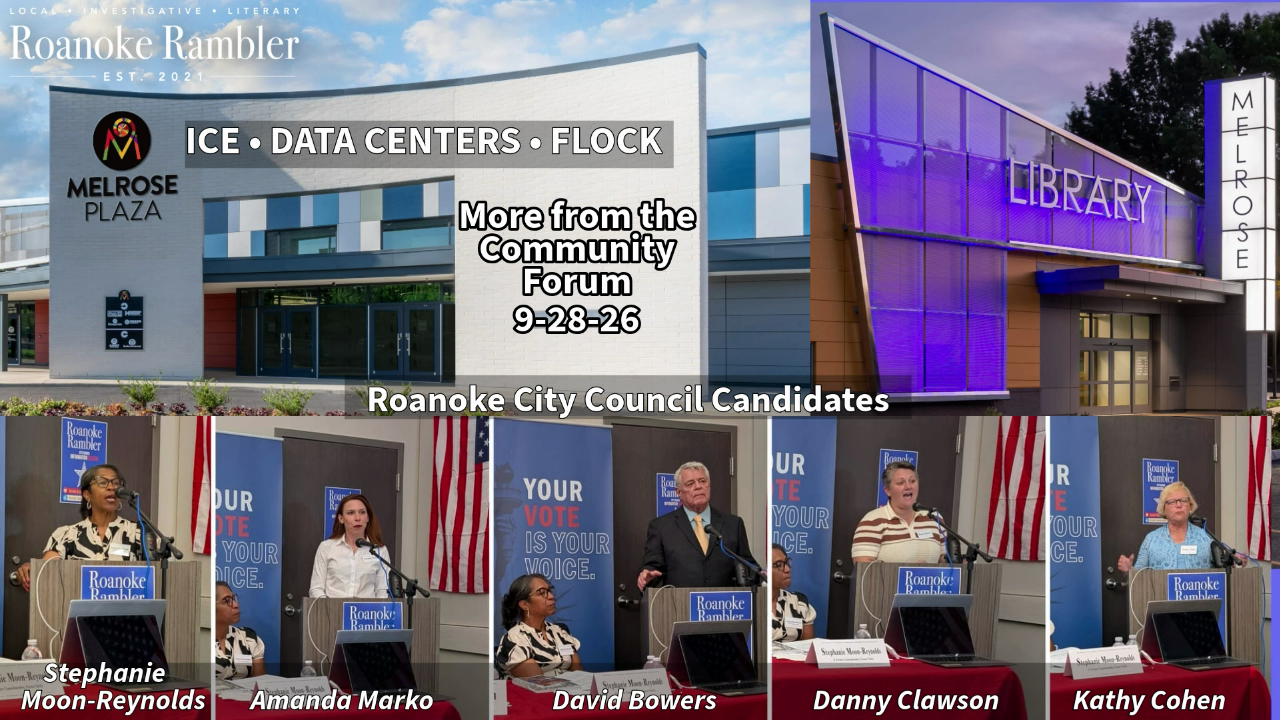
Five Roanoke City Council candidates gathered at Melrose Library on September 29, 2026, for The Roanoke Rambler's community forum, answering questions from residents on issues facing the city ahead of the November 3 election.
Following last week's Roanoke Rambler Candidate Community Forum at Melrose Library, we're taking a closer look at what five participating City Council candidates had to say about some of Roanoke's most pressing issues. Their responses reveal differing approaches to public safety, development and homelessness, along with a few personal details about the people seeking a seat on council.
City Council candidates Vivian Sanchez-Jones and Raekwon Moore were invited but unable to attend the forum due to work commitments.
Homelessness
Roanoke's homelessness debate continues amid concerns about public safety, access to services and affordable housing. According to the Blue Ridge Continuum of Care's 2026 Point-in-Time Count [page 9 & 13], 401 people were experiencing homelessness across the Roanoke region on a single night in January, with 97% located in Roanoke City.
Recent efforts to address homelessness include the opening of RAM House's new 12,000-square-foot Jain Care Center on Elm Avenue and Trinity Commons, a former church in Old Southwest converted into 15 affordable apartments for low-income seniors.
Meanwhile, The Least of These Ministry, which provides meals, showers and other services to Roanoke's unhoused population, filed a lawsuit against the city in June after losing a zoning appeal. The dispute centers on outdoor storage lockers and a portable restroom that city officials determined violated downtown zoning regulations.
Questions also remain about how Roanoke measures its progress. Following an earlier Rambler article examining the city's housing statistics, city officials identified what they described as inaccuracies requiring correction or clarification. The city has not yet provided those specific corrections, despite requests from the reporter.
For more background, read our earlier report Affordable Housing: Questioning the Meaning of Zero and the Importance of the Caper Report.
Grayson Cotes, audience member:
My name's Grayson Cotes. My question to you all is, what steps will you take to protect Roanoke's homeless community? They're one of the communities that definitely gets overlooked, but they're here. I was one of them last year.
Excerpts from candidate responses, edited for length and clarity.
Danny Clawson
First I want to say that unhoused people aren't inherently dangerous. I think it's important to remember that.
As somebody who works with a primarily unhoused population every day, I know them. I know them by name. I can look at them and see if they're having a good day, a bad day, or somewhere in between.
We also need to start leveraging Carilion. They are required to invest in the community because they're a nonprofit, and right now they spread that investment very wide.
In 2019, they had scheduled to revamp and expand their psychiatry department and to have better inpatient psychiatry services. COVID ended that project. Then they never went back.
We need to go back to Carilion and say, what our community needs is for you to go back to that original plan and reinvest back in psychiatric care.
Because even though you can get somebody into housing, if they don't have the mental health care to keep them in that housing, it's not going to work.
The vast majority, over 90%, of the people that are unhoused in this town have ties to this town, do live here, have kids.
We need to be making sure that we're using opioid abatement funding to get more resources, get Botetourt and Roanoke County to the table, and help us fix this problem collaboratively.
Kathy Cohen
One of the things that I found out in researching this is that we are one of a handful of cities that does not have a designated legal parking lot for people who are sleeping in their cars overnight or for people who want encampments.
I believe we should have a designated legal parking lot. There should be facilities there, clean facilities, water, the ability to go to the bathroom, if possible showers.
Finally, I would like to see us look into what many cities have done, and that is taking abandoned warehouses and turning them into a series of rooms that are lockable, that have a bed and all sorts of services offered there.
People who are unhoused can go and sleep there, have a room assigned to them, and not have to be in a large facility with lots of other people like the Rescue Mission, which is doing great work.
Stephanie Moon-Reynolds
When I hear about the homeless population, my heart aches because I see it around here.
Everyone is fussing about do something, do something with these people as if they are not even human, as if they don't have dignity.
I look at it like they didn't choose to be this way. Something happened. Something happened in their lives that caused them to have trauma.
I know my brother, when my father passed, he was 25 and my dad died suddenly. My brother is a crack addict. He can't find his way back. He stays homeless.
We have the new RAM House who's done some things, but you also have other organizations. Some of these services are duplicated services.
When I was on council, I was trying to bring four of these nonprofits to the table because instead of duplicating your services, I wanted them to look at how we can spread this money around and try to help.
At the same time, I'm looking at trying to address public safety when they're standing in the median. I'm always concerned that somebody's going to get hit.
It's a complex issue, and I think we need to come to the table with the experts to really look at how we put some resolution to this to help these people.
I look at it as moving from trauma toward stability and ultimately toward home, and that's a place of support, belonging and hope.
David Bowers
It's not just a Roanoke situation. It's not just a Roanoke problem. It is a regional problem.
Roanoke is a magnet. We have the services. We have the hospital. We have all the things needed to help those who are downtrodden or poor and can't find their way.
We need to reach out to other governments throughout our area. Bedford, Roanoke County — we need their participation.
Amanda Marko
I think strangely this is the first time we've been asked this at a community forum, which is so interesting to me because it is one of the top things that the community is asking me about.
We've got people who are fiercely advocating for the people who are unhoused to make sure that they are getting taken care of and that their needs are met.
We also have a group of people who are adamant that they, as taxpaying members of our community, should feel safe downtown.
Fundamentally, I'd like to find where we agree. We agree that there are people who are having the worst experience of their life, and we as a community need to help get them out of that as quickly as possible.
I've been meeting with the executives of our nonprofits that are serving the unhoused community, RAM House and the Rescue Mission. And I've also been meeting with the business community.
What I want to do is find where that common ground is because right now those are folks who are not talking to each other.
This is a national problem, and here in Roanoke it's a regional problem. We need to make sure that we come up with a regional solution. That means regional funding and regional metrics that we work together.
Flock Cameras: Crime Fighting or Government Surveillance?
While Roanoke continues operating its network of Flock license plate-reading cameras, neighboring localities are moving in the opposite direction.
In September, Lynchburg voted to terminate its contract with Flock Safety, while the sheriff's offices in Bedford, Amherst and Montgomery counties announced suspensions of the technology. At least 20 Virginia localities had taken steps to pause or discontinue Flock devices since July.
The debate has now reached Washington. On October 2, Sen. Bernie Sanders, joined by Sen. Jeff Merkley and Rep. Alexandria Ocasio-Cortez, introduced the Ban Flock Act, which would prohibit federal agencies from using automated license plate readers and restrict certain federal grants to state and local governments that fail to adopt similar restrictions.
Roanoke's Police Department has defended the cameras as valuable crime-fighting tools, citing their ability to identify suspect vehicles, assist investigations and locate missing people. Police Chief Scott Booth has emphasized safeguards intended to prevent misuse, including audits and restrictions on access.
The cameras also collect information about vehicles whose drivers are not suspected of crimes, recording license plates and other identifying characteristics as vehicles pass. According to the department, that information is retained for 21 days, and the system is not used for facial recognition or immigration enforcement.
Roanoke has already abandoned a separate Flock gunshot-detection program following installation errors, but its license plate-reading cameras remain in operation.
Mark Kaplan, audience member:
I just want to know where everyone stands on the Flock cameras right now. Can we get down to it? Can we get real?
Excerpts from candidate responses, edited for length and clarity.
Stephanie Moon-Reynolds
I am a person who pauses and I process … I have to research before I answer anything. I'm not one who just has a knee-jerk reaction.
But what I did when I researched was look at the public safety of it. And to me it was really looking at the public's trust.
And when you don't do your homework and you present it, you lose the public's trust.
I do recognize that law enforcement uses technology as a tool, and that is to help solve the crimes, but I also look at what else they have that could help solve these crimes.
Flock cameras may not be the only thing, but what else do we have to offer?
Danny Clawson
I will also say that I am on the record against Flock for several reasons, but not least of which is that it's a terrible company. It was created by a tech bro that is trying to get as rich as he can.
He has consistently claimed that he has made improvements to Flock, and that has turned out not to be true. They're incredibly insecure. You can hack into them with a decent Wi-Fi signal.
So we really do need to get rid of Flocks. There are legitimate reasons to have cameras, like speeding zones around schools, but Flock ain't it, y'all.
Kathy Cohen
As a gun violence prevention chairperson, I met with the police. They showed me the data.
There's no question that they do help solve crime, but the question is how do you weigh that against everyone's privacy? And that is something that is not as easy as saying yes or no.
I fall on the no side. But I think we have to respect people who live in high-crime-ridden neighborhoods who say they want these because it will help them.
Amanda Marko
I [was] introduced to Flock cameras a few years ago in my small neighborhood. We were having some break-ins, and somebody brought them up to me.
I had never heard of these cameras before. I looked into this technology and immediately said, ‘No way do I want that on my street.’
And because we were just one little street and one little HOA, I was able to say no and keep those off our streets. I don't want them on any streets in Roanoke based on what I learned.
I know we can have law and order and safety without compromising our civil rights.
Law enforcement could also say, ‘Well, we can solve more crimes if we can torture people when we question them, or we could solve more crimes if we were allowed to do search and seizure without warrants.’
Well, yeah, maybe you could, but no, that is not how we do things here. So therefore, no Flock cameras here in Roanoke.
David Bowers
As to the Flock cameras, I'm opposed to them.
Evans Spring: Development or Preservation?
The future of Evans Spring, a 150-acre tract of largely undeveloped land in Northwest Roanoke, remains unsettled.
In the latest development, the Blue Ridge Land Conservancy has secured a $50,000 grant to work with Roanoke-based Hill Studio and Friends of Evans Spring on a new community-driven conservation plan. The proposal would explore a community land trust as an alternative to commercial development, with the hope of eventually acquiring the privately owned property.
Question submitted to the forum:
What are your thoughts on Evans Spring?
Excerpts from candidate responses, edited for length and clarity.
Stephanie Moon-Reynolds
When I was a member of Roanoke City Council, the administration came up with an economic development plan for Evans Spring, and I voted no on that because I looked at it from the standpoint of engagement from the community.
Melrose-Rugby, Villa Heights, Fairland Lakes — the surrounding neighborhoods did not have an opportunity to have input.
Even the consultants had to agree at some point that the neighborhood had not been included, and therefore council still went along and adopted that Evans Spring plan.
So yes, I support the neighborhood and what's going on over in Evans Spring, and I would like to see it developed according to what the neighbors want.
Kathy Cohen
There are so many places in Roanoke that are green, but there are so few places in Northwest that are green. And I think that is a huge problem.
On the ecological level, my desire would be that the vast majority of Evans Spring remains untouched.
There already is a small portion that has a few houses on it that has room maybe for another 15, 20 houses, and I wouldn't have a problem with that.
The rest of the area I think is very important for our air quality, for our neighbors in Northwest to have green space.
I would love to see some of it become more accessible with bike lanes or with more greenway through it.
I have spoken with the Friends of Evans Spring, and I know that's what they would like as well. I will do everything I can to support their vision.
Danny Clawson
I first want to say how impressed I am by Friends of Evans Spring.
A couple years ago, the city tried to say this was a done deal and it needs to happen. They have been so tenacious and have never stopped advocating for their community, for green spaces in our community.
Even though Roanoke as a whole has met the climate recommendations for tree cover, we know that in a place like South Roanoke, I believe the tree cover is around 70%, whereas here it is far, far lower in Northwest.
It is an issue of equality and justice in this city, and maintaining Evans Spring helps address the heat island.
If you look at a map during the summer, Northwest is a full 10 to 15 degrees higher.
When we talk about climate resilience and climate justice, we need to be talking about protecting our vulnerable communities, people who live close to waterways, people who don't have as many resources. And Evans Spring is an important part of that.
Amanda Marko
We need to have our tree cover here. We need to have economic development, though, too. My background is economic development, and I've worked with communities to attract businesses and jobs and help businesses that are in place to grow.
I think we can have both. I don't think we need to trade our tree cover or our beautiful clean water or our views for jobs.
We could find a way to be the national leader and a national example for sustainable economic development.
I think Evans Spring, quite honestly, is the place where we can start to do that. I'm very excited about that opportunity to work with the community to make sure that we have both.
David Bowers arrived after the Evans Spring discussion.
Race and Justice
The death of Nolan Wells, an 18-year-old Black man found in waters off Mississippi's coast in July, has raised questions about racial bias and the investigation into his death. A grand jury declined to issue indictments, finding no credible evidence of criminal wrongdoing, although the cause and manner of death remain undetermined. At the Melrose Library forum, a question from a Northwest Roanoke resident brought the national controversy into a local discussion of racism and white supremacy.
Boyd, Northwest Roanoke, asked:
What are your thoughts on the Nolan Wells case being ruled a drowning and your thoughts on white supremacy?
Excerpts from candidate responses, edited for length and clarity.
Stephanie Moon-Reynolds
Although this is not a local candidate question, I too have not really followed it because you read so much, you don't know what is true and what is fake.
All I know is a young man was killed or died, and I just look to the justice system and pray that the truth will come out.
Whether it's white supremacy or not, sometimes we just jump to conclusions because we want to believe such horror, and it may not be.
So I just stand back and stay neutral on it until I read the final analysis.
Kathy Cohen
As an attorney's daughter, I was always taught not to comment on a case while it is still under investigation. I have read as much as I could about the case, and I find it very disturbing.
But I'd like to answer the second part of the question, and that is about white supremacy.
I think that any kind of supremacy among a particular race in our society is horrendous and leads to the destruction of society. I think that's what we saw on January 6th at the Capitol.
We need to come to an understanding as humanity that all people are created in the image of God, that all human beings are equal, that the color of our skin, the religion that we hold, our gender, none of these things matter when it comes to the true nature of humanity.
I believe that white supremacy is a scourge upon our society, and I would hope that we here in Roanoke would do everything we can to join hands together and make sure that it does not further infest our wonderful city.
Danny Clawson
As somebody who has a degree in sociology, I learned that racism's real power comes from structural inequality.
All of us, because our founding was based on the displacement of the native peoples here and our entire economy and government was built up by slaves that were unjustly kidnapped from their homes and brought here forcefully, cannot get away from the fact that we were all raised in a racist soup.
Oftentimes, I think people of my skin color, of my race, white, get really caught up in anxiety around, "Oh, I'm not racist. I don't think Black people are different or Asian people are different."
What my sociology degree taught me is that where you are internally is very different from the impact of your actions.
The most important thing that we need to be working on at a societal and governmental level is looking at the structures and systems that empower racism.
An individual racist, an individual white supremacist, has a very limited ability to cause harm. But structuralizing that supremacy is what's killing our children. It's what's destroying our environment.
It is something that we as elected officials should be competent in and thoughtful about.
Amanda Marko
We still have, unfortunately, embedded into our justice system, unfairness and inequality. We jump to conclusions too often that turn out later to be incorrect, in part because we're human and in part because we have some fundamental flaws that we're still dealing with as a country.
I have faith in our justice system that ultimately the truth will prevail in this case and in any other ones. Any chance that I would get to participate in seeing justice prevail, I would always look for that opportunity.
David Bowers
I really don't know a lot about it, and I haven't been able to follow it except briefly in the news. I have my hands full.
Beyond the Ballot: Work and Faith
Two questions from Southeast Roanoke residents offered a glimpse into the candidates' lives beyond politics. Pam B. asked how they earn their living, while Thomas asked about their religious backgrounds and beliefs.
Candidate responses are paraphrased.
Stephanie Moon-Reynolds
Work: Retired in 2019 after 42 years with the City of Roanoke. Receives a city pension and Social Security, works part-time as a substitute teacher and serves on several community boards.
Faith: Identifies as a Baptist Christian. She spoke about praying in Jesus' name while serving on City Council and supporting opportunities for people of different denominations to offer prayers.
Kathy Cohen
Work: Retired rabbi of Temple Emanuel. Her income comes from Social Security and a pension.
Faith: Jewish and an active member of the clergy. She described different religions as equally important pathways toward divinity, personal enrichment and helping others.
Danny Clawson
Work: Executive director of the Virginia Harm Reduction Coalition, which provides services to people who use drugs. Clawson said the organization employs approximately 21 people and has an annual budget of about $2 million.
Faith: Raised in a strict Christian household but now identifies as agnostic. Clawson said Christian teachings continue to influence their work helping vulnerable people.
Amanda Marko
Work: Owner of Connected Strategy Group, an economic development consulting business. Her previous experience includes working as a U.S. senator's press secretary, for a major chamber of commerce and for companies in the United States and abroad.
Faith: Raised Catholic and attended Catholic schools. She described carrying her religious values in her heart rather than on her sleeve, emphasizing honesty and finding common ground with people of different faiths.
David Bowers
Work: Attorney who has practiced law in Roanoke for 48 years. He also previously taught U.S. government as an adjunct professor at Virginia Western Community College for 10 years.
Faith: Practicing Roman Catholic who attends St. Andrew's Basilica. He described his involvement in church activities and Catholic organizations, including the Knights of Columbus.
Get out the Vote
Roanoke voters will elect three City Council members on November 3. Early voting is already underway at the city's Office of Voter Registration and Elections, 317 Kimball Avenue NE, weekdays from 8:30 a.m. to 4:30 p.m., with additional weekend hours available. The deadline to register to vote or request a mailed absentee ballot is October 23, and early voting concludes October 31. For voting hours, registration information and sample ballots, visit the City of Roanoke's election website.