
Claudia Whitworth Spent a Lifetime Making Sure Roanoke’s Stories Were Told
The longtime Roanoke Tribune publisher, who died at 98, sustained a family newspaper through upheaval, and quietly helped the community it served.

The longtime Roanoke Tribune publisher, who died at 98, sustained a family newspaper through upheaval, and quietly helped the community it served.
Roanoke, VA
Author: Roanoke Rambler Staff
Published: 9:00 AM EST October 21, 2026
Edited: 9:00 AM EST October 21, 2026
Listen Here: Roanokesradio.com
On Wednesdays, the newspaper was a family affair. Copies of The Roanoke Tribune came off the presses, and relatives, friends and volunteers gathered to fold and prepare them for mailing. The gathering could include children, grandchildren and babies, four or five generations in one room, doing their part to get the news out.
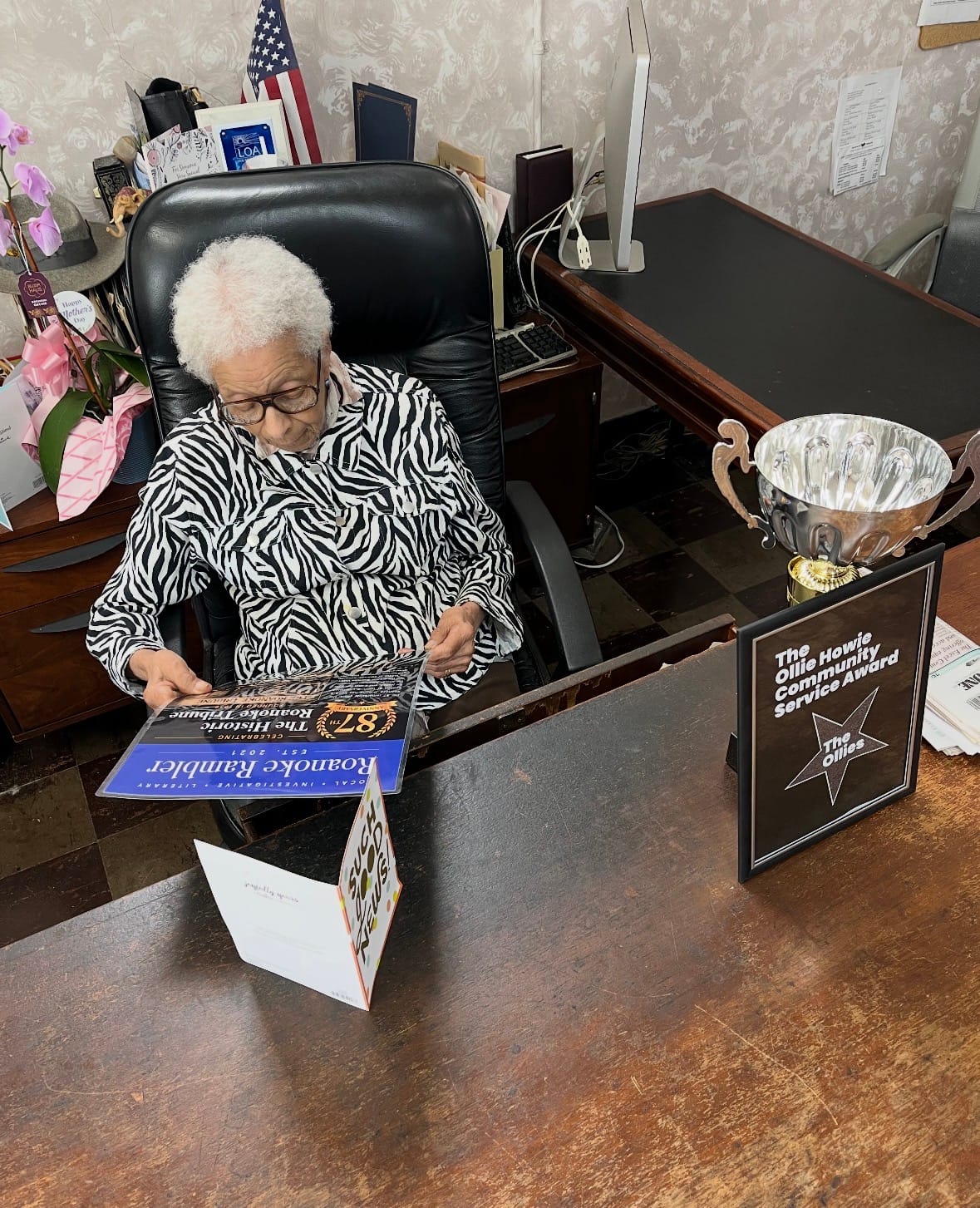
Claudia Sedonia Alexander Whitworth showed up to work every day, sometimes staying late into the evening. There were stories to edit, papers to mail and readers waiting. Whitworth, the Tribune’s longtime editor and publisher, died Oct. 8 at age 98. She leaves a newspaper whose history is inseparable from Roanoke’s Black community, and a family still carrying forward the work.
Her son, Stanley “Stan” Hale, provided a detailed account of his mother’s life for this remembrance. It begins in Fayetteville, West Virginia, where she was born in 1927 to the Rev. Fleming E. Alexander and Sedonia Rotan Alexander. After years in Lynchburg, the family moved to Christiansburg in 1935 when her father became pastor of Schaeffer Memorial Baptist Church. Whitworth graduated from Christiansburg Institute at 16 and briefly attended Bluefield State College.
Her father believed black residents needed a newspaper that would reflect their lives, concerns and accomplishments. He established The Roanoke Tribune in 1939; regular publication followed in the early 1940s. He also pursued newspaper ventures in other communities, but the Roanoke paper endured.
Whitworth began helping at the Tribune in her youth. Hale traced her path from the family paper to newspaper shops in New York and Ohio, where she worked as a linotype operator, a skilled, demanding trade in an industry largely dominated by men. She worked at The New York Age and other publications before ultimately returning to the Tribune. She knew the production of a newspaper from the machinery up.
In 1971, after her father was injured in an automobile accident, she purchased the paper and took responsibility for keeping it alive. That same year she married Clifton Whitworth Jr., who helped with public relations and bookkeeping. A weekly newspaper is not sustained by convictions alone: advertising must be sold, stories edited, pages produced and papers delivered, week after week.
Then came the kind of setbacks that could have ended a smaller publication. During the 1970s, the Tribune’s Gainsboro office was firebombed amid a period of upheaval and urban redevelopment. Records and equipment were lost. Whitworth later told WDBJ7, in an archival interview featured in its Oct. 9 remembrance, “We’ve had fire bombings, bulldozings, everything else, and we still never missed an issue.”
That determination was matched by a clear editorial philosophy. Whitworth believed her readers should encounter more than the familiar headlines about crime and trouble. She wanted them to see neighbors starting businesses, young people achieving milestones and organizations making a difference. As she explained in a 2021 WSLS interview, “Most papers headline bad news. You know. And I don’t do that.”
Her choice was not a refusal to confront injustice. Hale recalled an appearance by civil rights leader the Rev. Ralph Abernathy following a racial incident during the early years of school desegregation an experience that reinforced for his mother the influence a newspaper could have. In a 1977 interview later revisited by WDBJ7, Whitworth explained that she wanted her editorials to provoke thought rather than simply choose sides. The purpose was to encourage readers to think.
Her Bahá’í faith also shaped that outlook. Whitworth embraced the faith in 1972, according to a tribute from Roanoke’s Bahá’í community. Its emphasis on unity across racial and religious lines found expression in her relationships, her hospitality and the pages of the Tribune. Hale’s account describes a woman who made room for people from different backgrounds and believed service was a responsibility, not a performance.
Sometimes that service was quiet and practical. Victor Q. Banks, a longtime Roanoke resident, remembers Whitworth taking a sincere interest in neighborhood entrepreneurs and finding ways to give their businesses visibility, often beyond what they had requested. What stayed with him was not any single article or advertisement but her instinct to help, and her lack of interest in being recognized for it.
Her work reached beyond the newsroom. Hale described her involvement with organizations including the Bradley Free Clinic, the Salvation Army and Habitat for Humanity. In 1991, mother and son opened a community center on Melrose Avenue beside the Tribune office. She also developed a 24-unit housing complex. These efforts reflected a belief that stronger neighborhoods needed more than encouraging words; they needed places, services and opportunities.
Public honors eventually followed. Whitworth entered the Virginia Women’s Hall of Fame in 1992, was named Roanoke’s Citizen of the Year in 2004 and was recognized by the Library of Virginia as an African American Trailblazer in 2009. Yet Hale remembered her discomfort with personal acclaim. “Nothing I’ve ever done has been a plan of mine,” she said, according to his family account. “I’m just an instrument. You don’t honor instruments.”
In June 2026, Whitworth and The Roanoke Tribune received a Lifetime Achievement Award at Ollie Howie Community Day. The recognition came only four months before her death and honored decades of work that had touched readers, families, churches, businesses and civic life across Roanoke.
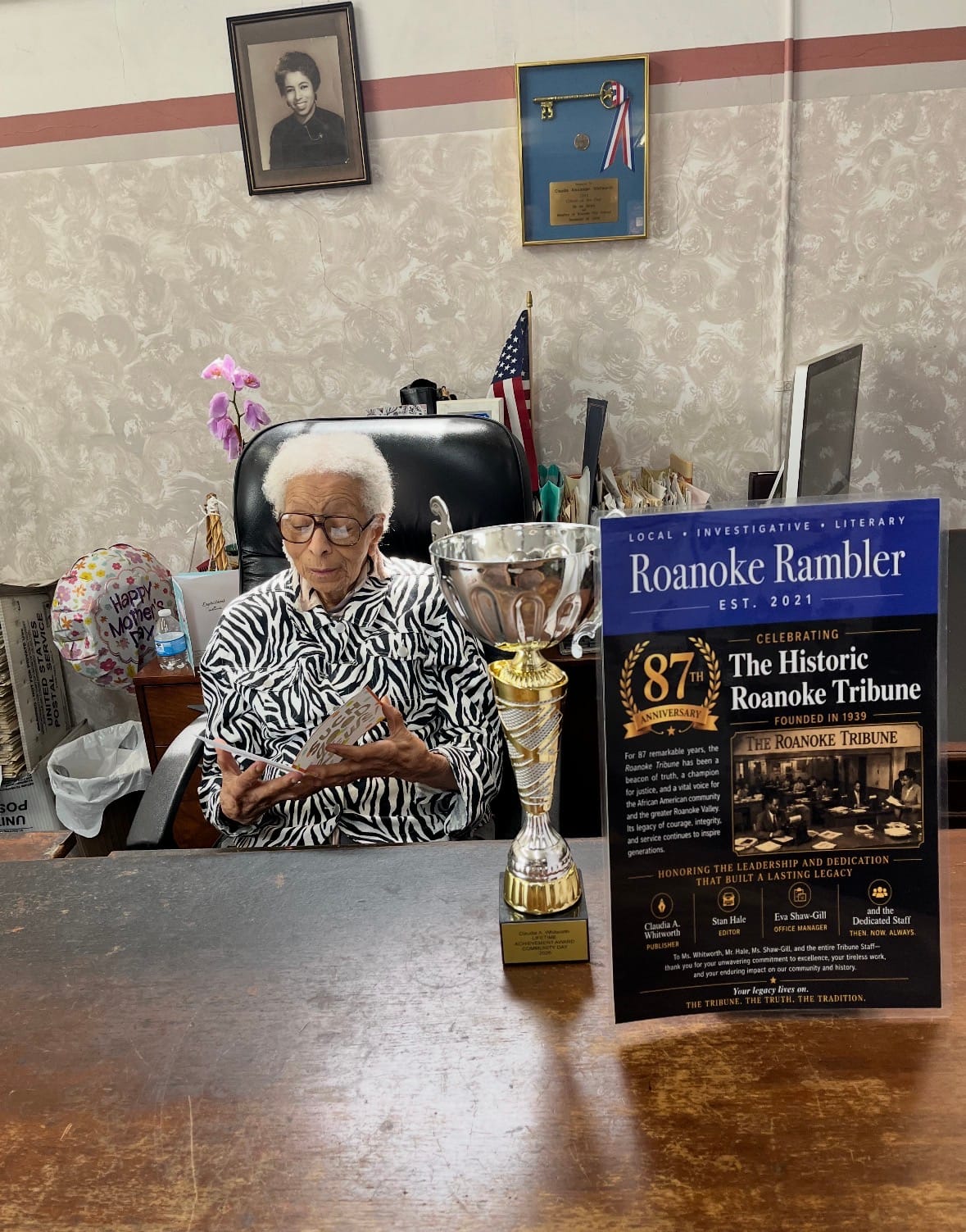
At the Tribune, the work has long belonged to more than one generation. Whitworth’s daughter, Eva Shaw-Gill, and son, Stan Hale, have played central roles in its operation, with younger family members joining in. The family’s Wednesday routine: folding, stacking, mailing, returning the next week and doing it again helped the community. What might look like an ordinary chore was also a lesson in stewardship.
“Our mother was an incredible individual that forged a dynamic path for our family to follow,” Hale wrote in the account he shared. His words speak to the fuller story: a daughter who inherited her father’s mission, kept it alive through extraordinary difficulties and made room for another generation to carry it forward.
For generations of readers, the Tribune offered evidence that their lives mattered: a graduation, a church gathering, a new business, a neighborhood effort, a life worth remembering. Whitworth understood the value of those stories. She made sure they had a place to be told.