
Democrats Find a Crack in the Tech Industry's NDA Armor
Governor Spanberger’s transparency directive was months, if not years, in the making, but did it arrive soon enough to affect the data center planned for Wood Haven?

Governor Spanberger’s transparency directive was months, if not years, in the making, but did it arrive soon enough to affect the data center planned for Wood Haven?
Read last week’s coverage here Where the Data Centers Could Go
Roanoke, VA
Author: Roanoke Rambler Staff, Hart Fowler Lead
Published: 8:10 AM EST September 23, 2026
Edited: 8:30 AM EST September 23, 2026
It is certainly not the first time Virginia has been at the center of an epic conflict that could affect the future of millions. Today, 54 graded acres of a broader 111-acre tract on the immediate outskirts of Roanoke City provide a vivid microcosm of the nation's most aggressive attempt to rein in the data center industry.
On Friday, September 18, exactly one week after the Western Virginia Regional Industrial Facility Authority (WVRIFA) announced its closed-door approval of a purchase agreement for the Wood Haven Technology Park, Governor Abigail Spanberger signed Executive Order 22 and unveiled her sweeping Data Center Accountability Framework.
The move fires the largest targeted state-level attack on data center confidentiality in the nation to date. It aligns with parallel federal pressure from U.S. Senator Mark Warner to strip economic non-disclosure agreement (NDA) protections, specifically regarding noise, water, power, and profits from big tech developers.

In a notable shift for public transparency on Tuesday morning, Spanberger’s strike cracked the protective privacy armor sooner than anyone expected.
In a rapid, real-time development, the WVRIFA, which manages the property on behalf of Roanoke County, Roanoke City, Salem, and Vinton who had originally signed off on NDAs, formally cited the Governor's new executive order as the direct reason they were forced to confirm to the public that Clearview Dynamics is evaluating the site for a hyperscale data center.
Furthermore, the authority confirmed that the Western Virginia Water Authority would supply the facility from the Spring Hollow Reservoir in western Roanoke County, a 3.2-billion-gallon off-stream storage system near Glenvar currently operating well below its daily treatment capacity. While the exact daily volume of water and power required is unknown until engineering studies conclude, the newly unsealed terms reveal that Clearview Dynamics is contractually bound to pay for 100% of all utility overhauls, ensuring regional taxpayers will not absorb the infrastructure expansion costs.
The City and the County
The local debate, however, centers on a high-stakes jurisdictional divide over a piece of property sitting a mile and a half out into Roanoke County.
The Roanoke City Council successfully shielded its own borders through a proactive municipal ordinance passed earlier this summer, setting strict layout and impact rules designed to prevent any industrial surprises within the city proper. Coupled with the Governor’s aggressive new statewide measures, the Star City is highly likely to remain data center free for the long-term future.

But those local protective walls stop at the city line. Neighboring Roanoke County administrators and the WVRIFA have already signed a binding corporate non-disclosure agreement for the Wood Haven property. That confidentiality agreement advanced after a behind-the-scenes Roanoke City Council executive session established a 5-2 consensus — with Councilman Phazhon Nash and Vice Mayor Terry McGuire dissenting.
That internal city hall consensus effectively cleared the city’s appointed directors, City Manager Valmarie Turner and Economic Developer Marc Nelson, to cast affirmative votes at the regional table, allowing the final WVRIFA board motion to proceed with the purchase agreement to pass unanimously by the directors present.
This morning's sudden, calculated move by WVRIFA and Clearview Dynamics reveals that the deal is still very much alive. By choosing to bend to the spirit of the Governor's new transparency standards now rather than later, the developers have pivoted strategically — willing to play by the rules of disclosure if it means keeping their multi-million-dollar transaction safely on the tracks.
The Big Picture
Coming to the aid of activists and protesters who have secured few wins in a state with nearly 400 operating data centers, and actively entering direct combat to halt non-disclosure agreements with Big Tech over these facilities (along with a wide array of new regulations), Spanberger’s move carries a distinct Democratic midterm election momentum. Her plan is entirely unprecedented in its immediate scope and sprawling in its design.
The administrative directive immediately halts all data center NDAs among state employees, then lays the groundwork for permanent legislation to ban confidentiality agreements from city councils and regional authorities like the WVRIFA heading into the 2027 General Assembly. Alongside the NDA bans, the executive order simultaneously triggers a sweeping review of data center noise regulations, infrastructure water-use limits, and power grid stability metrics to curb the industry's rapid resource consumption.
Spanberger’s framework is the boldest action taken yet by a state executive to dismantle these protective shields. In August, Pennsylvania Governor Josh Shapiro signed an executive order banning the use of non-disclosure agreements on large-scale infrastructure and data center projects for all agencies under his direct oversight, but explicitly left local municipal governments free to keep signing them.
Spanberger raised the ante by proposing sweeping mandates designed to force transparency across those exact independent, multi-jurisdictional local political bodies and regional authorities. Prior to these executive actions, banning NDAs for data centers had been handled entirely through a grinding legislative process. Over the last few months, lawmakers in Michigan, Oklahoma, Kentucky, and Ohio have introduced standalone bills to ban corporate NDAs for tech operators. None have successfully cleared floor votes into law yet.
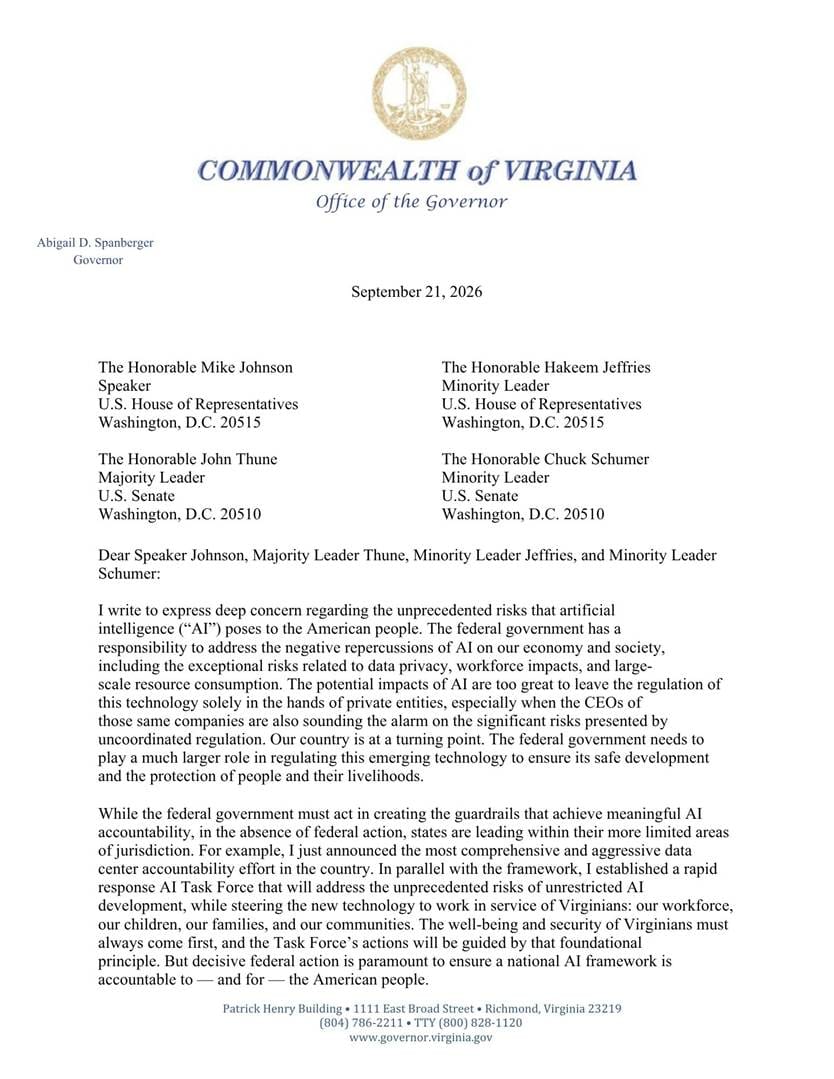
The Governor’s aggressive moves line up naturally toward a potential 2028 presidential bid, as Democrats across the Commonwealth strike while the iron is hot, riding a wave of data center backlash with distinct political leverage. Reinforcing this state-level momentum, U.S. Senator Mark Warner and Representative Suhas Subramanyam pushed forward a coordinated slate of federal data center regulation bills to directly coincide with the energy behind Spanberger’s release.
Warner's Data Center Tax Accountability and Disclosure Act (S. 5054), targets the financial engine of Big Tech. The bill denies valuable upfront bonus depreciation tax write-offs to developers unless their facilities abandon corporate NDAs and publicly disclose their exact infrastructure water draws, power consumption metrics, and grid emissions to local communities.

This coordinated federal push builds upon recent Democrat-led legislative actions in Washington. Lawmakers recently introduced the No Data Center NDAs Act (H.R. 10118), a standalone bill aimed at legally barring members of Congress from signing confidentiality agreements regarding tech resource planning. By conditioning federal tax advantages on absolute transparency, this national framework aligns directly with Spanberger's state-level campaign. It ensures that developers who choose corporate silence over public transparency will forfeit public subsidies and absorb the full financial risk alone.
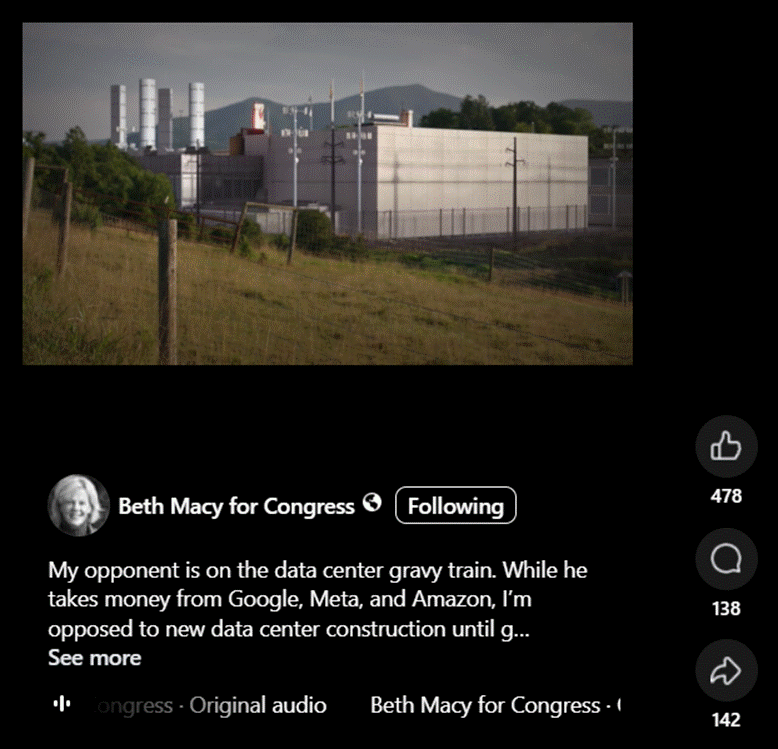
This state-and-federal policy collision drops directly into the 6th Congressional District race between Republican incumbent Ben Cline and Democratic challenger Beth Macy. While Macy has made federal transparency mandates a cornerstone of her campaign platform, Cline maintains that local zoning boards and free-market negotiation, rather than sweeping top-down federal mandates, should dictate regional economic development.
Financial Windfall
The Wood Haven Technology Park still locked in a pending, pre-closing purchase agreement with Clearview Dynamics LLC and operating under the recently enacted local non-disclosure agreement, will now serve as a definitive regulatory litmus test for data center transparency and stands as the absolute before-and-after image of how hyperscale data centers operate across Virginia moving forward.
The transaction did not move forward with the blessing of the WVRIFA board and the Roanoke City Council to pioneer breakthroughs in generative AI or high-density cloud computing infrastructure.
It was advanced for the potential financial windfall, of course.
By leveraging its 44.2% cost-and-revenue-sharing ownership stake in the property, the city stands to collect millions on the final transaction alone—liquidating a ten-year-old industrial property that regional taxpayers have poured $9.3 million into over the last decade to appeal to big-business operations. Local planners project the future machinery tax returns to reach well into the tens of millions over the next decade if the project continues as planned.

With seven candidates vying for three City Council seats this November, every challenging candidate has built a platform attacking recent municipal budget cuts, with few offering revenue-generating solutions. Facing immediate capital overhauls at the Berglund Center, the Jefferson Center, and a third high school, the city's official civic wish-list is long. The massive backlog of unfunded infrastructure projects made a multi-million-dollar corporate windfall difficult for local leaders to turn down.
Direction is Lost in the Minutiae
After the regional authority board vote on Friday, September 11, 2026, a public call for transparency served as the primary argument driving the initial backlash from Vice Mayor Terry McGuire and Councilman Phazhon Nash.
The confrontation initiated by McGuire directly after the session concluded targeted unelected administrative executives, Roanoke County Administrator Richard Caywood and City Manager Valmarie Turner, on camera. Both administrators were operating under binding corporate NDAs that legally restricted them from expanding on the transaction details.
Specifically, Turner was present at the regional meeting strictly to execute her administrative duties by casting a vote based on a pre-established city hall consensus, not to hold an impromptu press conference. It is a fine line between being impassioned for a cause and grandstanding at the immediate expense of staff.
The local Democratic infighting re-emerged into full public view on Monday when Mayor Joe Cobb issued a sharp public reprimand, accusing his two colleagues of allowing their "activism to override their governance responsibilities." Rather than a formal, legislative censure resolution, Cobb used the weight of his office to declare that the councilmen’s aggressive joint social media statements and McGuire’s confrontational behavior toward the City Manager and regional directors directly breached the City Council’s Code of Conduct and Ethics.
Following a tense, closed-door executive session to hash out the code breaches, Council moved forward with the reprimand. The action was finalized with Vice Mayor Terry McGuire casting the lone "nay" vote, a final act of defiance that solidifies a boundary line the city's political establishment simply refused to leave unchecked.

What’s Next?
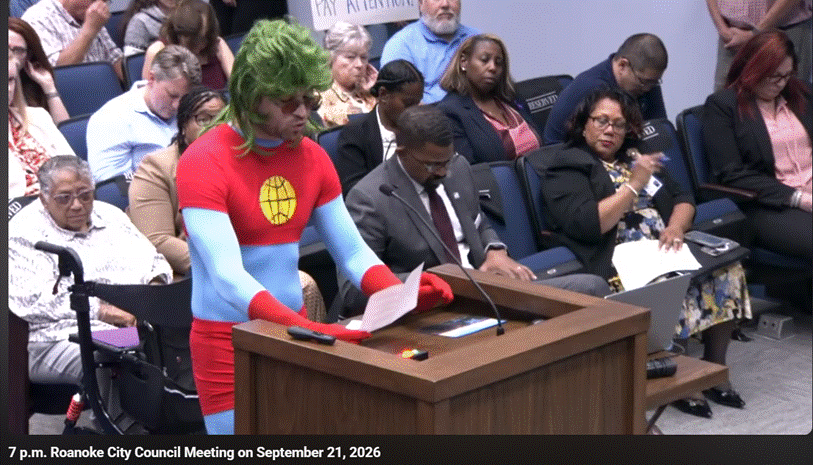
With no major local votes or council sessions scheduled for the next two weeks, the anti-data center advocates who packed Monday night's chamber, some in elaborate superhero costumes, others holding standard protest signs, are effectively in a waiting game for developments at Wood Haven. Spanberger’s statewide measures for public transparency may have already begun taking effect and are expected to shift the landscape of the data center development world, but they can do nothing at this moment to alter how Wood Haven will, or will not, proceed.
The regional authority has confirmed that Clearview Dynamics LLC is locked into an official due diligence evaluation window expected to run through March 2027. Over the course of the next six months, the community can expect the next major developments to arrive in the form of mandatory state environmental filings, land engineering assessments, and definitive utility capacity studies tracking the physical pipeline layouts from the Spring Hollow Reservoir.
Meltdown Aftermath
The long-term fallout of the Council's reprimand remains deeply uncertain, but neither side is giving ground in the short term. Vice Mayor Terry McGuire has signaled defiance, projecting confidence that his push for disclosure was entirely justified. He remains unapologetic for publicly targeting a City Manager who serves at the pleasure of the Council, or for pushing the boundaries of executive session rules.
Meanwhile, Councilman Phazhon Nash executed a subtle political backpedal. While he joined the unanimous vote to establish the new ad hoc professionalism and ethics committee to rein in future council conduct, he loudly reaffirmed that his primary obligation is to do his job by demanding transparency for his constituents.
Mayor Joe Cobb, Vice Mayor Terry McGuire, and Councilman Phazhon Nash all have two full years remaining on their terms, leaving their seats entirely insulated from the immediate voter backlash this November.
The same cannot be said for incumbent Councilwoman Vivian Sanchez-Jones. As she fights a re-election campaign to protect her seat next month, her position has been dramatically complicated by revelations that she quietly backed the behind-the-scenes administrative consensus to clear the WVRIFA non-disclosure wall.
No candidates have publicly endorsed the Wood Haven Technology Site as a potential data center. Protests, organized social media backlash, and sharp commentary during the public portion of City Council meetings are expected to be on the rise for the foreseeable future, while statewide advocates celebrate a victory for transparency.
Outside the Minutiae
As for Roanoke County and all Virginia localities, there is now a ticking clock hanging over the use of NDAs in all future data center negotiations, signaling that enough is enough in the Commonwealth. If the Governor's proposed legislative package passes next spring, the state will fall just short of a total moratorium on data-center NDAs. The law will effectively draw a hard line against any future skirting of public transparency in data center dealings, leaving the door open only for the select communities that actively choose to do business with Big Tech in the full, open light of day.
This represents a major statewide victory for the reigning data center capital of the world. For all future builds across the Commonwealth, this policy shift will echo far beyond the borders of the Old Dominion, serving as a model for other states scrambling to rein in the secretive practices of the technology sector. It stands as a sharp reminder that this conflict between humankind and machine is about much more than what is happening just across the county line.