
Evans Spring Plan: Conservancy Pursues Purchase of 150 Acres in Northwest Roanoke
A conservation group is negotiating to buy much of the land as Northwest Roanoke residents shape a plan of their own.

A conservation group is negotiating to buy much of the land as Northwest Roanoke residents shape a plan of their own.
Roanoke, VA
Author: Roanoke Rambler Staff
Published: 10:30 PM EST November 24, 2026
Edited: 10:30 PM EST November 24, 2026
Listen Here: Roanokesradio.com
On a Saturday afternoon at Melrose Library, the future of Evans Spring was laid out across several tables. There were hand-drawn streams, wetlands shaded blue, walking paths and places where homes might fit. Visitors studied three possibilities, marked A, B and C, then placed colored dots beside the ideas they favored.
It was a modest exercise for a consequential piece of land: roughly 150 acres of mostly undeveloped property in Northwest Roanoke, across Interstate 581 from Valley View Mall. For years, Evans Spring has been the subject of plans, public meetings and arguments over what development would mean for the neighborhoods around it. This time, the people organizing the session said the drawings were meant to begin with the neighbors, not end with them.
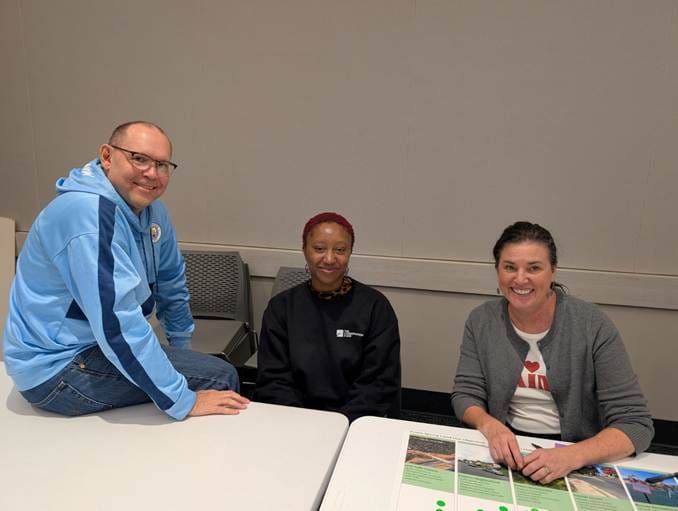
“The primary difference is where it’s coming from,” said Stephen Niamke, founder of Friends of Evans Spring, in an interview at the Nov. 21 session. He recalled earlier planning exercises in which residents offered suggestions but believed the outcome had already been determined. “We’re not doing that,” he said. “This is coming directly from the community.”
The effort is being organized by Blue Ridge Land Conservancy, Friends of Evans Spring and Roanoke-based Hill Studio, with a $50,000 planning grant from the national nonprofit The Conservation Fund. The goal is to turn community priorities into a detailed proposal that could be shown to the private owners whose decisions will ultimately determine much of the property’s future.
A different route from the city’s earlier plan
Roanoke adopted an Evans Spring master plan in March 2024 that contemplated residential and commercial development while setting aside substantial natural areas. Nearby residents objected to the prospect of more traffic, flooding risks and the loss of green space. In May 2026, City Council amended the plan to recognize conservation as an acceptable alternative, remove language calling for an interstate connection and broaden potential uses of one area to include education, parks and open space. The amendment changed the planning framework; it did not transfer ownership of the land.
That distinction matters. The city owns about 30 acres, according to WDBJ7 reporting, while several private owners control the remainder. A plan, whether drawn by the city or by residents, does not compel those owners to sell.
Niamke said the new process is also about more than protecting a pretty landscape. He cited tree canopy, flood mitigation, community health and the legacy of institutional racism in Northwest Roanoke. “They say they want to preserve tree canopy,” he said of city officials. “Okay, we’re talking about preserving tree canopy.”
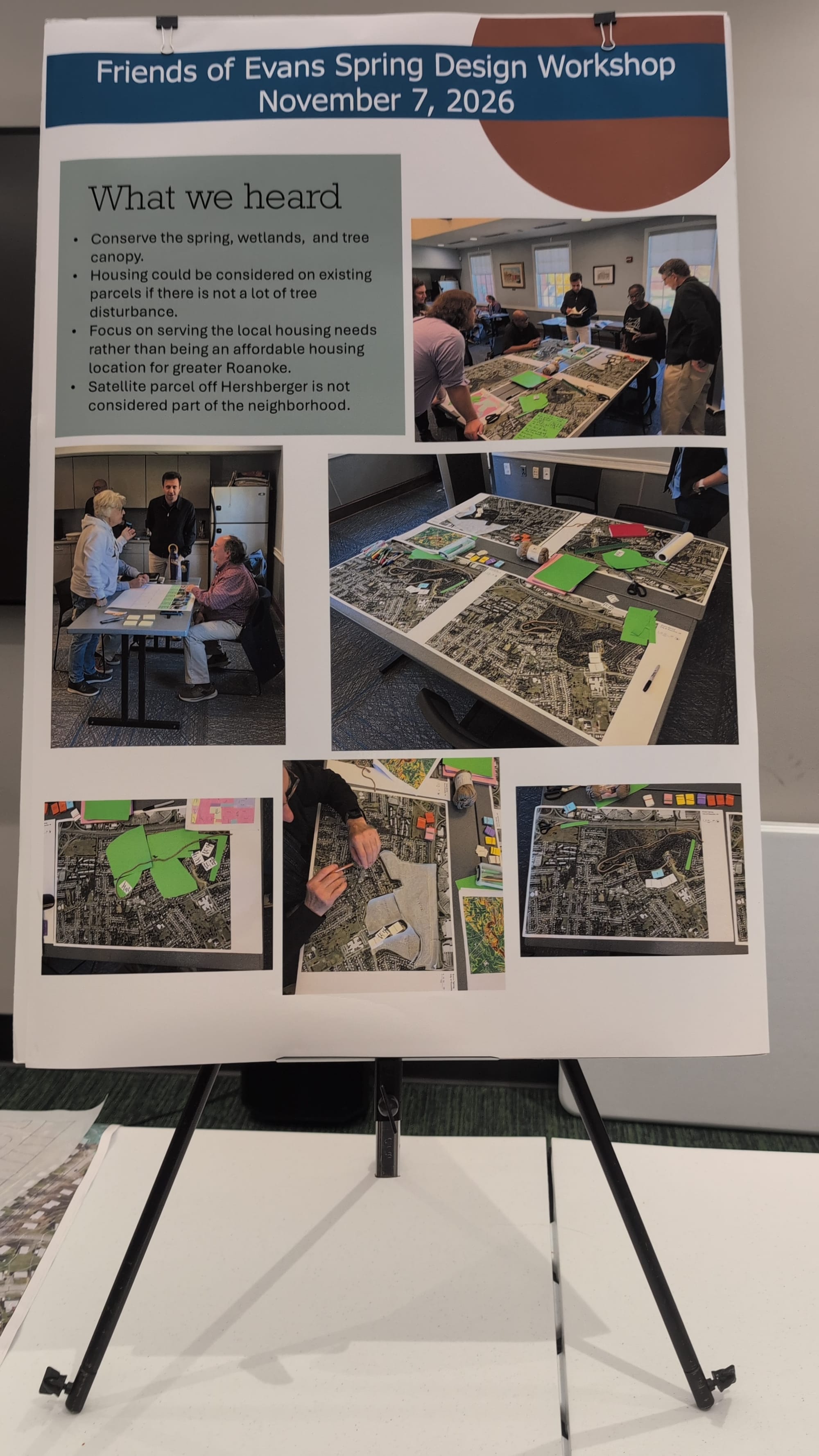
A display summarizing a Nov. 7 design workshop listed priorities that included conserving the spring, wetlands and trees, considering housing on already-platted parcels with minimal tree disturbance, and focusing on nearby residents’ housing needs. At Melrose Library, the three illustrated alternatives offered different arrangements of trails, access points, wetland protection and potential building areas. The dots recorded reactions; they were not a binding vote or a final selection.
By the end of the Nov. 21 workshop, a display of participants’ preferences showed the greatest concentration of stickers under “Promote Environment.” Other objectives, including preserving neighborhood character and improving access, also drew support. The informal exercise was not a scientific survey, but it offered a visible indication that environmental protection was a leading priority among those who took part.
The purchase that could change everything
David Perry, executive director of Blue Ridge Land Conservancy, described an approach that goes beyond preparing another plan: his organization and The Conservation Fund are pursuing a purchase. The national group is talking with landowners and could acquire the property first. The local conservancy would then seek to buy it from the fund using state and federal grants it has identified.
“We’re getting closer and closer — good discussions, but not there yet,” Perry said at the library. The difference from earlier planning efforts, he explained, is the possibility of an actual transaction: “We’ve got cash. If we can agree on a price, we’ll buy it.” No completed sale was announced at the session.
The conservancy is not new to protecting land. Founded in the 1990s as the Western Virginia Land Trust, the nonprofit now reports more than 21,000 acres protected across the region. Much of its work involves voluntary conservation easements, which limit future development while land remains privately owned. Evans Spring could take a different path, with an outright acquisition and a public-facing conservation vision.
That vision may include a nature park with walking paths and elevated boardwalks, educational opportunities and some affordable housing on less environmentally sensitive portions of the property. Perry has discussed a community land trust model, in which a nonprofit retains ownership of land beneath homes to help preserve affordability. The number and location of any homes have not been decided.
The proposal is not the only possible outcome. Private ownership, funding, infrastructure needs and the preferences of residents still present questions. And a public park would bring practical concerns of its own, including maintenance, access and how visitors would affect nearby streets.
What happens next
Perry said Hill Studio plans to return to the community with a summary of what residents have said. Another input session is scheduled for Dec. 12 at 10 a.m. at the Gainsboro Library, and a more complete plan is expected in spring 2027. Residents will have further opportunities to respond, he said.
“The last thing I’m going to do is come in and tell the Evans Spring community and Melrose-Rugby and Northwest Roanoke what to do,” Perry said. He acknowledged that he does not live in the neighborhood and would not experience the consequences in the same way its residents would.
For now, Evans Spring remains both a landscape and a question. The maps at Melrose Library suggest what the community might want. The conversations with landowners will determine whether that vision has a place to take root.