
Four Quadrants, One City: Q&A with Former Mayor and Historian Nelson Harris
In this Q&A series, we invite the community to reflect on living in a divided city. We sit down with Nelson Harris, whose experience brings a unique look at where Roanoke stands.

Roanoke’s four quadrants reveal a deep and persistent divide.
While legal segregation ended with the Civil Rights Act of 1964, its legacy continues to shape cities and their neighborhoods across the country. In Roanoke, access to education, job opportunities and even how long you live can look vastly different depending on the zipcode you were born in. Just a few miles apart, life in Roanoke can often feel worlds away.
In our recurring Q&A series, The Rambler invites members of the community to reflect on what it means to live in a divided city. By sharing perspectives across generations, backgrounds and quadrants, we hope to spark honest conversations that are too often left unspoken.
For the last edition of the year, we met with local historian and former mayor, Nelson Harris. Born and raised in Roanoke, Harris spent most of his life living in the Southwest neighborhood of Raleigh Court. At the age of 27, he started a decades-long career in Roanoke government, first on the school board, then as a city councilman and eventually as mayor from 2004 to 2008.
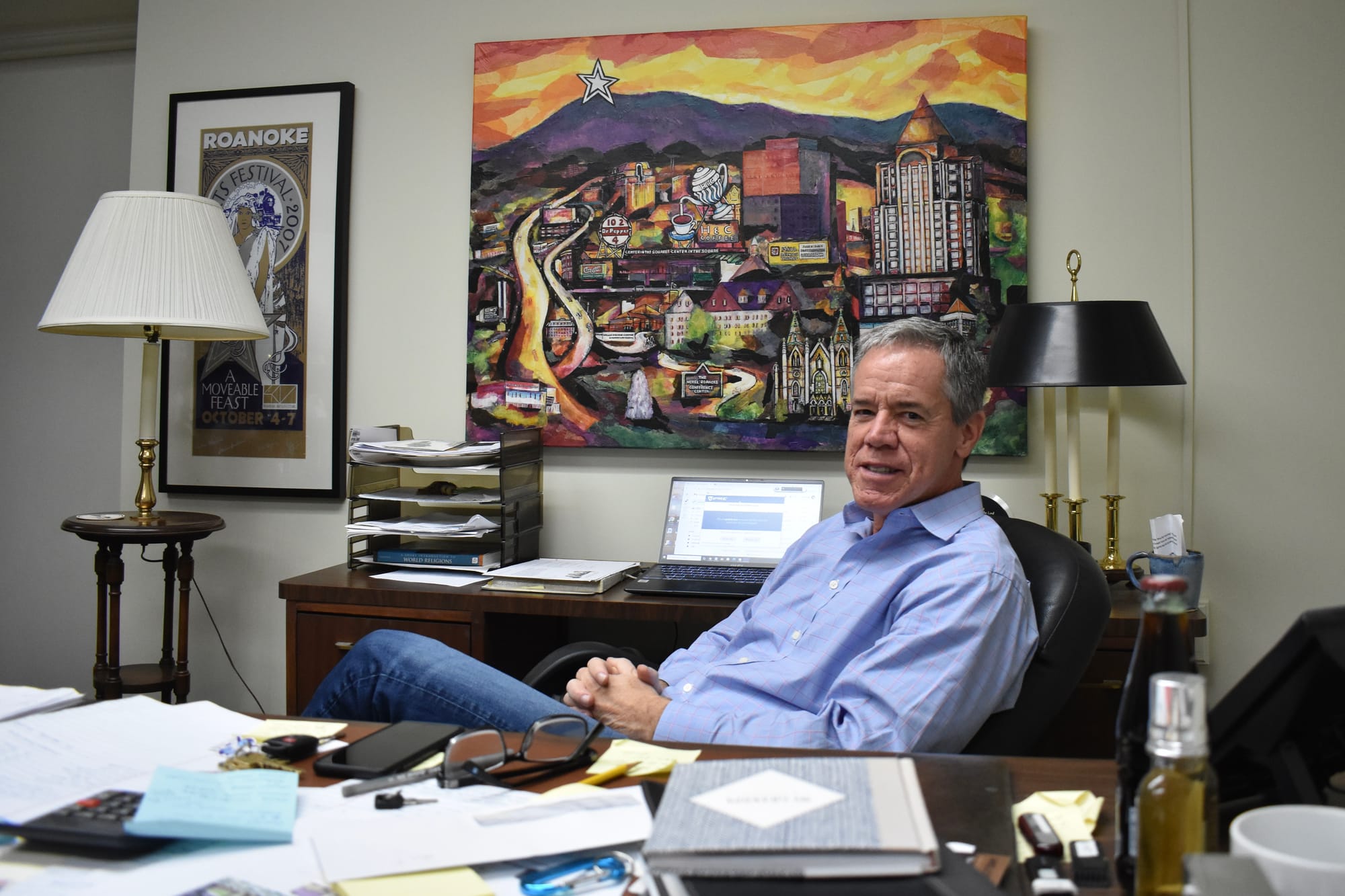
Now 61, Harris has transitioned from local official to local historian, authoring 14 books on Roanoke’s history with a 15th on the way. Over the years, he has played a key role in placing markers throughout the city that honor significant historical sites and figures. We met Harris in his office at Heights Community Church to discuss his years in local government, the importance of preserving local history and the impact he hopes to leave on his hometown.
This interview has been edited for length and clarity. If you or someone you know is interested in being interviewed for this series, please reach out to sinclair@roanokerambler.com.
VIDEO BY SINCLAIR HOLIAN FOR THE ROANOKE RAMBLER
Tell me a bit about your longtime neighborhood of Raleigh Court.
Well, Raleigh Court was, and still is, a white, middle class neighborhood. And I think the appeal of Raleigh court architecturally is that it has all these now century-old homes, and so it has unique architecture to it, and it’s very walkable to schools and to the library, Grandin Village. All of that makes up Raleigh Court. I grew up on Laburnum Avenue in Raleigh Court, and literally could walk to my elementary school, my junior high school and my high school.
You said the neighborhood was, and still is, majority white. Why do you think that is?
You know, like other neighborhoods and sections of the city, I haven’t seen a tremendous amount of transition racially or ethnically from when I was growing up 50 years ago. And you know, I think some of that is probably due to the fact that for people that stay in Roanoke after they’ve grown up here, a lot of them have an emotional attachment to the neighborhood they grew up in. And so a lot of my high school friends that went away to college but came back and got employment here, if they grew up in Raleigh Court, that’s where they moved. And so I think that factors in a little bit. And I think too that, you know, that folks have a proclivity to be homogeneous — right or wrong. I think that that does play a part.
And of course, going back into the deeper history of the city of Roanoke, much of the “white neighborhood, Black neighborhood,” kind of thing really kind of grew out of, historically, the era of segregation, the era of redlining, the era of school attendance zones, which put people in racial neighborhood pockets. For me, that’s one of the backstories of why we have predominantly white, or predominantly Black and now predominantly Hispanic neighborhoods. But with Blacks and whites, a lot of it, I think, was due to the fact that when these neighborhoods were created, some of them had deed restrictions to them, so that Blacks, Jews, other folks, couldn’t move into certain neighborhoods, couldn’t buy property in certain neighborhoods. And then that was compounded by redlining. And then that was compounded by racial segregation in public schools. So all of that kind of layered one on top of the other over decades really laid the base for having predominantly one-race neighborhoods.
Over the years, you’ve served on the School Board, the City Council and as mayor. What did your time in public office teach you about Roanoke?
Oh, gosh, it taught me a tremendous amount about the city. I got much better grounded in the life of our city, the history of our city, the neighborhoods of our city that I don’t think I otherwise would have had that kind of in-depth exposure to. Whether it was the School Board or Council or mayor, over a period of a decade and a half, it really did give me a much broader perspective on the city, both its present as well as its past. And that then has served me well as an author of books on the history of the city. I truly did learn a lot about my hometown.
Tell me more about that “exposure” to different neighborhoods.
Somebody once said that — and this would be true — you could grow up in Raleigh Court, go to school in Raleigh Court, be employed in Raleigh Court, and be buried in Raleigh Court at the Evergreen cemetery. And so all your needs would be met just within the neighborhood. And that could be said about Williamson Road. It could be said about Northwest, you know.
As I would engage with the larger community when I was in elected office, it always kind of amazed me how people in one neighborhood, like maybe Williamson Road, really didn’t know that much about Raleigh Court. Or how people in Raleigh Court really didn’t know that much about Northwest. Or Northwest didn’t really know that much about Southeast. I mean, they knew where it was and what it was, and maybe some things that it had. But in terms of its past and its present set of issues and the life of those particular neighborhoods, it was very much insular. Neighbors kind of focused on their particular neighborhood, and not always having the totality of the life of the city and the needs of the city in mind. So that was always kind of an educational piece, reminding people that the city is more than Northwest, it’s more than Williamson Road, more than Raleigh Court. And so that was always an interesting community conversation to have.
You have 14 books out and a 15th on the way. After your years in local government, what inspired you to pivot into historical research and writing?
Well, I’d always had an interest in local history, but had never really done anything with that. And because of my city involvement, I really became quite acquainted with the resources that we had for documenting, preserving and celebrating Roanoke’s history, and how much of that had not really gotten broad public exposure. And so my initial books were “Roanoke in Vintage Postcards,” then “Downtown Roanoke,” which is about vintage photos of just the downtown area. I was really amazed at how many people enjoyed those, because it brought these old vintage photographs to life, that visually captured the development and the growth and the change that had happened in our city.
And then with the decade books, which are much more significant, about 600 pages each, it really gave me an opportunity to go beyond photographs and to really put narrative to it, and to help document the city that way. There were some books out on the history before, but it had been a while since anybody had really brought the history of the city forward. And so with this, I felt like I was able to contribute to the public’s enjoyment of local history and enlightenment around local history, and in so doing, I hope that I have deepened their appreciation and sensitivity to the life and history of the city.
Can you tell me more about your work with historical markers? How did you first get involved, and why are they important?
Well, first of all, just a word about historic markers. I think they’re one of the best tools that we have to educate the public about local history. They’re visual, they tell a story, and they’re permanent.
I got involved years ago because I read an opinion piece in The Roanoke Times, where a marker had been approved for the civil rights attorney Oliver Hill, who grew up in Gainsboro, but had never been funded. And at that time, it only took $1,800 to do a marker. And I remember drinking coffee and reading that op-ed, and I thought, “You mean to tell me that this marker has been languishing for years because it can’t find $1,800?”
And so I got on the phone, made some calls, and by mid-afternoon that day, we had $2,000 pledged and in hand, and Oliver Hill marker went up.
That really got me involved in the whole historic marker program, because then I got to be well versed in the application process. And so I’ve now done, I think, 10 historic markers — been a part of, been the applicant for — after Oliver Hill. And each and every one of them is remarkable.
I worked on a historic marker for the birthplace of Henrietta Lacks whose HeLa cells contributed tremendously to medical research; markers for the Hunton Life Saving and First Aid Crew, the first all-Black volunteer rescue squad in the United States; Burrell Memorial Hospital, which, in the era of segregated medicine, served a 17 county region for Black patients in western Virginia; Virginia Western Community College, the first community college in the Commonwealth of Virginia; the Claytor Memorial Clinic, one of the few Black-owned medical private medical clinics in the Commonwealth; Gainsboro Library, which was only the second library in the state to open for Black patrons in the era of segregated libraries. It was the only one in the Commonwealth of Virginia, West of Norfolk, with an amazing story about the librarian, Virginia Lee — she’s part of the marker. Edward Dudley, who was our nation’s first Black ambassador.
There’s been a number of these markers, and all of them tell something about Roanoke, yes, but they are part of a national story. And so when, when we think about Roanoke, you know, and that we had Oliver Hill, and we had Edward Dudley — these prominent Black legal minds came right out of Roanoke. And you know, when we think that we had the first volunteer rescue squad in the nation. I mean, these are mind-blowing — and most people in Roanoke would have no idea that these things, these people, these organizations, were around, or first in the nation, or anything like that. But these historic markers tell that story, and I think communicate something very unique about Roanoke in that regard.
Between your historical research and your government experience, you have a unique perspective on the city. What has your time in both of those sectors taught you about segregation in Roanoke?
I think it has taught me that the past is so reflective in the present, and so when we think about the segregated neighborhoods of our city, that’s not a recent phenomenon — it’s a historic phenomenon, you know, and it goes back decades. I think there’s a lesson in that, because when someone says, you know, “What’s the value of history?” Well, the value of history is that if you can take the past and bring it to the present, it’ll help you do better in the future.
And I think for me, the story of segregation, and the ripple effect of segregation, is still with us in terms of our neighborhoods. It just says to me that things that were done then are still around today. And so I think when we’re thinking into the future, we need to do the best we can knowing that the decisions we’re making now aren’t just for five or 10 years, but they may have generational impact. If you take the long view, it’ll help you make a better decision.
Why do you think it’s important for people to know about their city’s history? And why is it important for people to know about the history of segregation, specifically?
I think, first of all, history is a fascinating subject, and local history is even more fascinating because it’s where you live. And so I think the more you can know about the backstory of your community, the better appreciation you’ll have for your community, and the better perspective you’ll have on your community. I think it really adds to who you are as a neighbor, who you are as a citizen of that particular city.
Regarding segregation, you know, so many people now grow up and don’t remember segregation. Don’t know what segregation was about. And a lot of them will say, “Oh, yeah, that’s when Black kids and white kids went to different schools.” That’s kind of it. And they don’t realize that there was neighborhood segregation and there was employment segregation, and there were libraries that were segregated and hospitals were segregated. I mean, Roanoke Memorial Hospital did not get desegregated until the ’60s. The ’60s! I mean, there was a time, even into the early ’60s, where the only job a Black person could get in a department store was a custodian. And segregated restaurants, segregated theaters. Segregation was everywhere. It was everywhere, in every element of entertainment and transportation and employment, and I don’t think people had the broad view to realize how much segregation permeated the larger life of Roanoke, or really any community, back in the day.
I’ve had people my age and younger that have looked at one of my books and said, “I never knew that at the Roanoke theater downtown that Blacks had to enter through a side door.” And it blows them away, you know, because they’ll say, “Well, gosh, that was my grandparents’ generation.” So I think for the whole the broad topic of segregation, I think this is really lost on so many people. I don’t know enough to know about what’s being taught in schools currently, but I think most of the time when segregation comes up, it’s about Brown v. Board of Education and the desegregation of public schools and maybe Rosa Parks, and that’s kind of it. And I don’t think people really have an understanding of the depth of segregation in communities and societies that was not just personal preferences, but was by law. By law — had to be that way. And when you have that context, then you realize who the heroes were. Then you realize that the Oliver Hills and the Claytors and the Edward Dudleys and the others who, you know, led efforts to overturn and eliminate all of that. That uphill effort, the counter-cultural effort, all of that was back in the ’40s, ’50s and ’60s.
We talked about the permanence of the historical markers and their role in telling Roanoke’s story. What kind of permanent impact or legacy do you hope you will leave on Roanoke?
Fifty years from now, the markers will still be up. Now, people won’t know Nelson Harris was the applicant — it says nothing about me on any of these markers. But I just think that when I pass from here, I would like to say that my legacy will have been that I have contributed in a permanent way to the good and the benefit of my hometown. Whether it’s a book, whether it’s a marker, whether it’s in the vocation of the church or public life. You know, if I can say I did something to help make Roanoke better than how I found it, I’d be well satisfied.