
Hailed as Visionary, Roanoke Libraries Director Sheila Umberger Retires after 43 Years
Sheila Umberger, who began working for the city in 1982, leaves behind a transformative legacy.

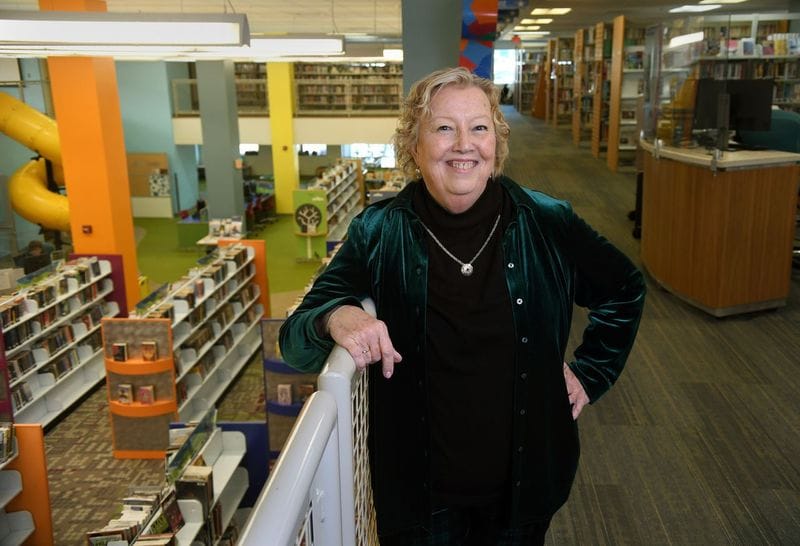
On a chilly December morning in downtown Roanoke, dozens gather inside the Main Branch of the Roanoke Public Libraries. Some find a seat and shut their eyes after a long night out in the cold. Others flock upstairs to a row of public computers.
Sheila Umberger proceeds to the third floor. From there, in the same corridor where she has worked for 21 years, from the same office with its pale-wooden door and sterile-white walls that every director of libraries has occupied since 1952, she oversees a complex operation involving six physical branches, three e-branches, and as many as 100 employees.
Roanoke’s public libraries are the city’s reception room. These brightly lit buildings are a rare example of indoor public space — offering heat in winter and cool air in summer, food for the hungry, and a warm welcome regardless of age, identity, immigration status or income.
“Libraries are the customer service desk for your life,” said Amanda Taylor, an administration librarian who has worked for the libraries for 15 years. “The mission is the people,” she said. “And Sheila is for the people.”
Today, after 43 years with the library system and 21 years as director, Umberger will work her last day on the job. She leaves behind a legacy that has been described by city staff as transformational, turning the libraries into a national award-winning agency. As one of the most senior women directors in city government, she has also modeled a leadership style equal parts empathetic and bold, mentoring a young cadre of librarians and managers while simultaneously focusing her career on serving Roanoke’s citizens, especially children, and especially the poor.
From the card catalog to the director’s office
Umberger grew up an only child in Bristol, Virginia, in the 1960s and ’70s. Her mother worked in Early Head Start, and her mother’s best friend was “the coolest librarian ever,” a woman who read stories to children in funny voices. By age 10, Umberger said she knew what she wanted to be when she grew up.
In graduate school, she excelled on “the computer side of things,” such that when she, her husband, and their daughter moved back to Southwest Virginia in the early 1980s, she was able to secure a job at the Roanoke Public Libraries undertaking an ambitious task: digitization of the library’s paper card catalog. This involved sitting at a computer terminal typing in code most days, yet as the work expanded and they upgraded to a new system, Umberger traveled to each branch of the libraries and “I would literally have to go and barcode every book” by hand, she said.
Umberger gradually moved up the ranks. In the late 1980s, she helped write the software to integrate the Roanoke City, Salem and Roanoke County catalogs into a central database. (Botetourt County was added in the late 1990s.) Umberger also started picking up odd jobs around “Main” (which is Roanoke Public Libraries slang for the downtown branch) including staffing the reference desk. By the late 1990s, Umberger oversaw all of technical services. Today’s manager of technical services, Lisa Bannister, said that the role involves overseeing the cataloging, classification and development of collections, including ordering, processing and weeding items. This work takes place on Main’s windowless subterranean level.
“The world could come to an end down there and I would not know,” said Bannister.
In 2004, Umberger was vaulted into the third-floor director’s office, where she inherited an agency in turmoil. A comprehensive master plan, commissioned two years earlier, was nearing completion, and its assessment of the library system was bleak. One of the leading concepts in the plan was to build a major new library, on a size that would rival Main. Inside the library ecosystem, this came to be known as the “super branch.”
The super branch versus the neighborhoods
The Roanoke Public Libraries originated in an era of Jim Crow racial segregation. From the 1920s through the 1960s, Black Roanokers used one library, in Gainsboro, while white Roanokers used another — first located in the former Terry mansion at the summit of Elmwood Park, then in the present downtown edifice since 1952. By the time Umberger came to Roanoke in the early 1980s, the library system was racially integrated and included six branches spread across the city’s four quadrants. Yet by the 2000s, all these buildings, constructed between the 1950s and 1970s, were in dire need of repairs, and the public had concerns over safety and accessibility, especially at Main.
In response, the libraries purchased a large plot of land on Peters Creek Road, with the idea of building a super branch, a “retail-model” hub for books, computer access, and children’s spaces. There was even talk of a café, or drive-through service — what the 2005 master plan called the “Barnes and Noble” model for the 21st-century library.
The super branch represented a rejection of the city’s urban core in favor of the periphery, just as Roanoke County was building its own suburban super branch in South County. “[The city] had purchased the land, they had done the pictures with the shovels,” recalled Taylor. “And Sheila said, ‘Hey, why are we doing this?’”
Amber Lowery, an assistant director, who has worked for the libraries for 21 years, recalled Umberger saying, “‘No, we need to invest in our neighborhoods.’”
Umberger’s about-face on the super branch meant redirecting funds into the existing branches. “Being in the neighborhoods is key,” Umberger said. “I think that’s the strength in Roanoke.”
Perhaps no branch has undergone a more thorough metamorphosis than Melrose library. Through a complete rebuild, Umberger elected to make the library an anchor institution in what would become Melrose Plaza, connecting the branch with other services such as groceries and banking. Charlsie Parker, who grew up in Northwest, recalled as a high school senior getting her first job at the Melrose branch as a library page. “I grew up at Melrose Library,” she said. Now, after 16 years with the Roanoke Public Libraries, she called the transformation at Melrose Plaza “visionary. It’s just amazing to see.”
Umberger also determined to fix long-standing issues at Main, which she called “the mother ship.” The 2005 master plan noted “poor lighting, inadequate seating, inadequate program areas, and insufficient parking.” Many residents reported choosing to use the county’s libraries instead.
“I wish people could have seen Main 15 years ago,” Taylor said, “because the transformation is dramatic. There were a lot of dark corners. There were just kind of unsightly, unfriendly things. We had to buzz people in and out of the bathrooms.” Umberger championed bringing light and movement into Main, creating distinct spaces for different users, even installing a much-beloved big, yellow slide that careens down from the second floor.
Umberger’s infrastructure campaign will continue. She has submitted proposals to upgrade Belmont and renovate the interior of Raleigh Court. Yet her legacy is not merely structural. Inside each branch is a children’s section, and the librarians there are committed to improving the lives of Roanoke’s youth, one book, and one meal, at a time.
The campaign for grade-level reading
There’s this idea, Umberger said, that “you learn to read until you’re in third grade, and then, from third grade on, you have to read to learn. There are a lot of statistics that show that if you’re not reading at grade level by third grade, you might not graduate.”
From this concept was born Star City Reads, Roanoke’s campaign for grade-level reading. The initiative involves over 40 community partners, and is supported, like many aspects of the public libraries, through a mixture of public and private funds, including donations and ample volunteer labor. The program is so nationally renowned that it has helped win Roanoke an All-America City award — twice. Roanoke is also unique nationally for being one of the only grade-level reading campaigns led by a public library, said Umberger.
For Lowery, who got her start in 2005 as a library assistant reading storybooks to children, the transformation of youth services under Umberger has been extraordinary. “What was once a little, tiny program doing little, tiny story times and outreach and bookmobile,” she said, “has kind of blossomed into this beautiful thing.” Since the launch of Star City Reads in 2012, youth services has increased staffing from two to six employees, and they now consistently offer children’s programming at all six branches.
In their effort to improve childhood literacy, library staff also uncovered significant roadblocks, namely that some local children were too hungry to read. In response, the libraries launched “Feed and Read.” It began as a pilot program to feed children at the Gainsboro branch one summer, according to Lowery, “and that’s when the Sheila kicked in.” Umberger green-lit expanding the program to all six branches, then to all branches all year long, six days a week. Roanoke is the first public library system in the state to feed children every day that libraries are open, said Lowery.
Nathan Flinchum, an assistant director, who has worked for the libraries for 15 years, said, “You will go to a library conference and tell people that you feed kids every day after school, and they just look at you like you’re crazy.”
Since its inception, the Feed and Read program has served nearly half a million meals to local children. “You can be interested in literacy scores, but maybe the reason why literacy scores aren’t great is because kids aren’t getting to school, or they’re not ready when they get there, or they have dental issues and their teeth hurt,” Flinchum said, “and it’s very easy to say that’s not my job.” But there is an ethos at the Roanoke Public Libraries that we must do whatever we can to serve the public, they said. “And that’s not just at the Sheila level. That mindset and that philosophy are moving throughout the whole organization.”
For her work with Star City Reads, Umberger was honored with the prestigious Peggy Sullivan Award for Public Library Administrators Supporting Services to Children from the American Libraries Association in 2016.
Yet according to Umberger, her greatest achievements are behind-the-scenes, where she has mentored an entire generation of younger librarians, a crew that has come of age and will carry the torch forward after she retires.
The next generation of librarians
Amanda Taylor never considered becoming a librarian. “I came from a really broken home,” she said. “I’m from Bedford, so Roanoke was the big city.” At the age of 23, with just a high school diploma, she got a job with the Roanoke Public Libraries “stamping books in the basement” at Main. “I came with a mindset of, I’m just trying to make some money to help pay the bills.”
Umberger saw something in her. With tears in her eyes, Taylor recalled Umberger saying, “I see something in you, and I think that you’re special.” With the director’s support, Taylor went back to school to complete a bachelor’s degree, and then a master’s degree in library science. She has since served as branch manager at Belmont and Melrose and now works in library administration at Main. Given her hardscrabble childhood, Taylor said she owes her career to Umberger. “Sheila invested in me when no one else did.”
Lisa Bannister, who started working for the libraries 21 years ago, called Umberger “a visionary leader.” She noted in particular Umberger’s hiring practices, which have resulted in a highly diverse staff, including many people of color and LGBTQ+ employees. Just as the libraries must cultivate a collection of books and resources to serve a diverse population, Bannister said, “You want your staff to reflect the community, and for the community to be able to see themselves in your staff.”
The future of the libraries
As Umberger steps down, the Roanoke Public Libraries face fresh challenges. Local activists have targeted the public library consortium (particularly in Botetourt County) over the presence of LGBTQ+ books, and others have railed, in Council meetings and on social media, against the city’s supposedly lenient approach to its unhoused population, many of whom make frequent use of the Main Library.
Umberger has shielded the libraries from controversy, she said, by maintaining that they are a “neutral” institution. Her motto is that the branches should be “safe, family-friendly, and clean.” Some local residents have taken issue with that. “One time,” she said, “I had a person call me, and they went on and on about ‘why did I let these unhoused people come to our program the night before?’” The caller said that the presence of unhoused people made her feel uncomfortable, to which Umberger replied “Ma’am, I’m sorry, but in this city, we have a very diverse population. They just wanted to attend the program.”
Back at Main on that chilly December morning, Umberger’s staff is putting her philosophy into practice. “It’s important to give people a warm place,” said Parker, who now serves as Main Branch manager. She recently “handed out thankful bags for Thanksgiving, which include toiletry items, food and snacks. And during the summer months, we’re a cooling station, so we keep water out. It’s just not about books. Everyone has a need, and the libraries, in our own special way, can help meet small needs.”
“When I’m talking to other people about what we do here, I’m so proud,” said Bannister. “You know, we have a diaper bank. We feed hungry kids every day. We really work hard to create spaces for everyone. I’m really proud of the work that I’ve done here and that Sheila has fostered in us.”
In retirement, Umberger plans to focus on gardening and learning to play piano. But if you ask Lowery, Umberger will not be a stranger at the public libraries. She is creating a women’s empowerment circle, Lowery said of her boss, for women who work throughout the Roanoke City government. “Once a leader, always a leader.”
“And she’ll find ways to mentor and lead,” said Lowery. “I do not think she has ended any book here. Maybe a chapter. But the book of Sheila will continue.”