
Roanoke Weighs Reparations Fund as Council Warms to Urban Renewal Apology
City Council members offered positive comments about an Equity and Empowerment Advisory Board plan to make sure action follows an apology.

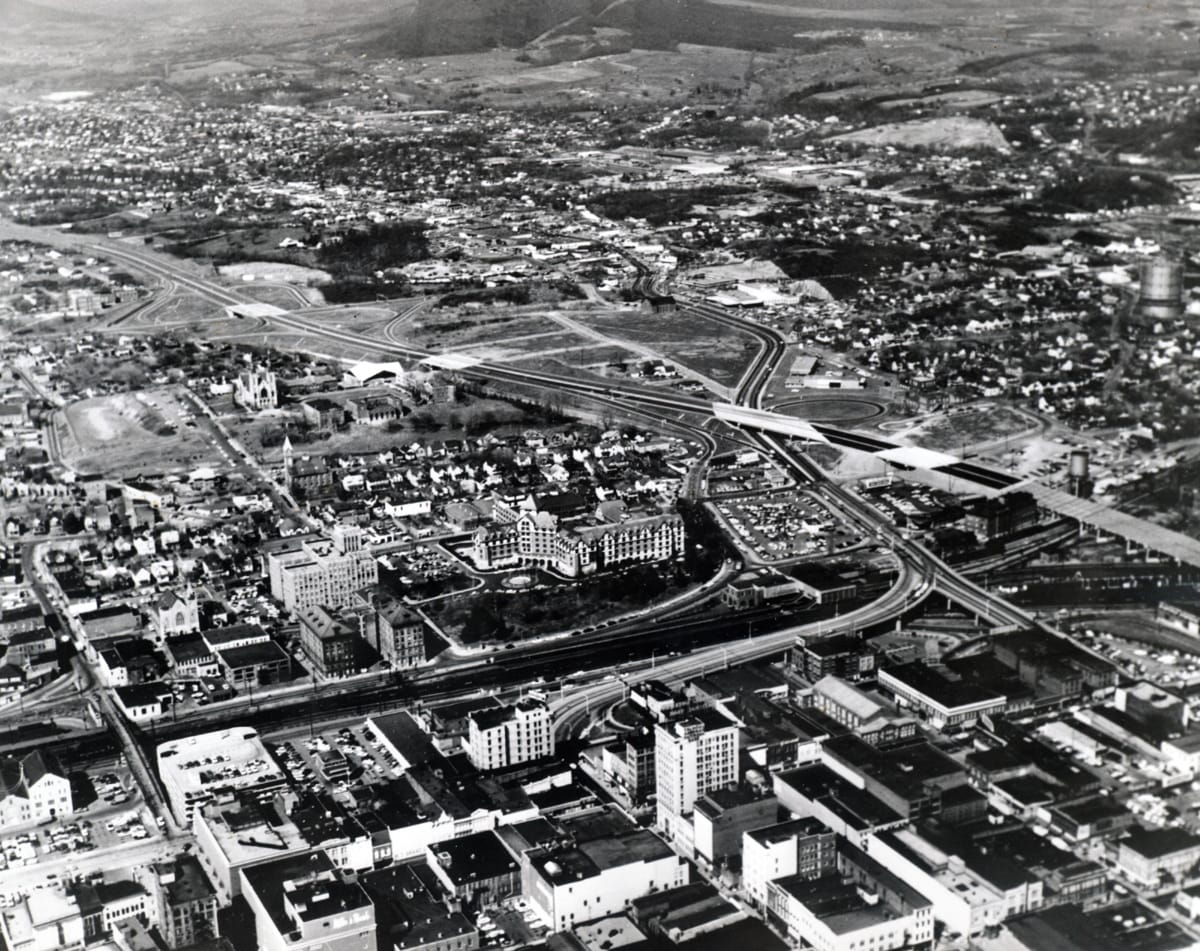
Roanoke appears poised to atone for the sins of 20th-century urban renewal.
But it may be more difficult here than elsewhere to provide financial reparations to the victims and descendants of policies that bulldozed the majority Black communities of Northeast and Gainsboro.
Angela Penn, who chairs the city’s Equity and Empowerment Advisory Board, on Monday presented a draft apology for urban renewal, after two years of stalled efforts. If approved, the apology would establish a reparations fund for individuals and their families who suffered financial losses as a result of urban renewal.
In 1955, Roanoke City Council declared the Northeast neighborhood a “slum and blighted area,” a designation that initiated the urban renewal process. The development projects that followed leveled 1,600 homes, shuttered 200 businesses, demolished two dozen churches and dug up nearly 1,000 graves to make way for the construction of Interstate 581, the civic center and post office.
The board’s report outlined several recommendations for redress, including adding a tax on Berglund Center tickets to generate revenue for a reparations fund, redeveloping the former business district of Henry Street, restoring the Washington Park cottage and installing signage at the sites of former homes, schools and churches.
Council members appeared receptive to the apology.
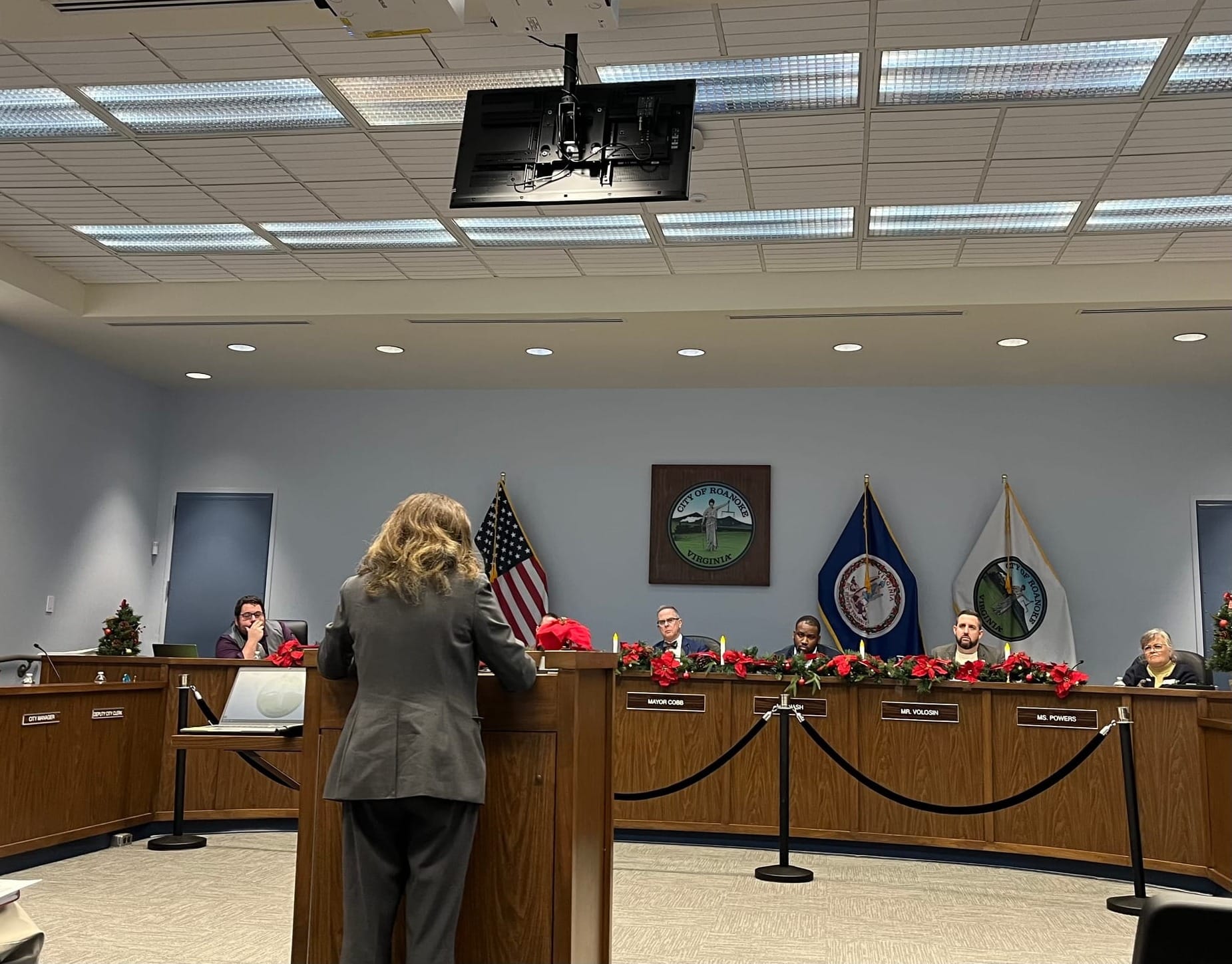
Councilman Nick Hagen, whose family is of Lebanese descent and owned a business that was impacted by urban renewal, stressed that the final apology should include commitments to action.
“One of the concerns that I have is that we’ll approve an apology and that’s it — and then nothing will be done,” Hagen said. “So I’m really hoping, hoping, to build that trust, to build that trust to actually do things and that we’re going to actually address these harms.”
Vice Mayor Terry McGuire asked Penn how the council could work with the equity board to “strengthen” the apology to make it “as impactful as possible.”
“I’m looking at the draft resolution that we have, and I also feel, personally, I would want to support this with commitments towards concrete actions and not just verbal promises,” he said.
Penn welcomed the opportunity to hold a work session with the council to finalize the details of the draft and invited council members to the board’s next meeting on Jan. 8.
After the meeting, Mayor Joe Cobb wrote in an email that he plans to work with the council and city administration in January and February to review the draft and consider additional recommendations.
Cobb could not confirm when the council would vote on the apology, but he said he is hopeful that the review will be complete in February.
Local reparations, national context
If Roanoke’s apology draft is approved, the city would join a growing list of American cities that have formally apologized for their role in the destruction of Black communities through urban renewal. This includes Charlottesville, Asheville, North Carolina and Spartanburg, South Carolina.
At least 40 localities — including states, counties, and cities — have established reparations initiatives as of December 2024, according to the Economic Policy Institute, a nonprofit economic policy think tank.
However, few have successfully implemented material reparations for affected residents.
One of the most notable examples is Evanston, Illinois. In 2019, it became the first American city to adopt a reparations policy. Funded by a 3 percent sales tax on marijuana, the program supports Black residents who were victims of redlining or other forms of housing discrimination in the city between 1919 and 1969, as well as their descendants. Eligible residents can receive $25,000 grants to pay their mortgages, renovate their homes or make a down payment on a new one. As of 2023, the city also offers direct cash payments to beneficiaries.
As the EEAB developed Roanoke’s apology draft, members and community participants often referenced Evanston’s approach as a potential model. They also pointed to progress made in Asheville, where the city voted in 2021 to appropriate $2.1 million from the sale of city-owned land for the initial reparations process.
A commitment to reparations would make Roanoke a pioneer in Virginia.
While cities like Richmond and Charlottesville have passed resolutions recognizing racial inequality and have undertaken symbolic and commemorative measures, no municipalities in Virginia have issued material reparations.
One possible reason is the Dillon Rule, which governs Virginia municipalities, according to University of Virginia law professor Richard Schragger. Under the rule, local governments may exercise only those powers explicitly granted by the state.
In the case of reparations, Schragger said, the Dillon Rule has a dual effect: It can constrain policymaking, but it can also allow local governments to avoid responsibility for inaction.
“So they can say, ‘Oh, we would love to do reparations, but Dillon’s Rule stops us,” he explained.
While the rule might limit Roanoke from adopting a program identical to Evanston’s, Schragger said reparations in Roanoke are still possible. The city should be prepared to structure its program around the powers Virginia already authorizes, he explained, such as providing grants to various welfare programs and nonprofits.
“Listen, Dillon’s Rule is a problem in Virginia, and so it may restrain you in certain ways,” he said. “But it should not be seen as a blanket way to shut down thinking about certain kinds of policies.”
While city-led reparations programs in Virginia have been limited, some targeted efforts have emerged at the state level.
Last year, the Virginia legislature created a statewide commission to investigate and consider redress for public colleges and universities that uprooted Black communities across the state to make room for expansion. Ten schools acknowledged taking part in displacement, including Christopher Newport University in Newport News, Old Dominion University in Norfolk and Radford University.
CNU and Newport News formed a joint task force to study the impacts on the Black community and consider steps towards repair. Like Roanoke’s EEAB, the Shoe Lane Task Force has been surveying Newport News residents and plans to submit a report of recommendations in the second half of 2026.
To Schragger, local reparations efforts have the greatest potential for impact.
“Roanoke knows what happened there — that’s why they’re apologizing,” Schragger said. “They’re on the ground, they’re capable of tracking who was injured by this, and more generally, how neighborhoods were injured and whole communities were injured.”