
The Power Behind the Pump: The Twin Infrastructure Crises of the Roanoke Valley

This is so far the second-driest water year on record for the region
Roanoke, VA
Author: Roanoke Rambler Staff, Hart Fowler Lead
Published: 8:00 AM EST July 22, 2026
Edited: 8:00 AM EST July 22, 2026
Two Fronts in a Single War
This is so far the second-driest water year on record for the region—with rainfall tracking at 43 percent below average—surpassed only by the historic drought of 1941, an era so severe that the Roanoke River trickled down to a series of shallow, stagnant pools, decades before Smith Mountain Lake was even a blueprint on a drawing board to catch the valley's water.
Eighty-five years later, the valley is empty of rain again, but the demands on our water have fundamentally changed. Local infrastructure is facing an unprecedented, two-pronged assault, but this time around the threat does not stem from pre-war global military aggressions. Instead, it comes from the massive resource demands of utility companies doing business with Big Tech data centers.
Public concern is naturally fixed on the Western Virginia Water Authority’s agreement to supply millions of gallons of water a day to Google’s developing Botetourt campus. With Carvins Cove and Smith Mountain Lake visibly dropping, the ecological threat to our municipal drinking supply is real, immediate, and dangerous.
Yet, while the community fights to protect its local watershed, an equally devastating infrastructure battle is quietly unfolding along the natural gas lines and electric wires winding through our mountains. These are not separate issues; they are twin crises driven by the exact same tech expansion. Carvins Cove has become the overt battleground over our municipal supply, where millions of gallons will be diverted daily to keep server stacks cool during a historic drought. Meanwhile, Smith Mountain Lake functions as the grid's silent casualty, absorbing massive ecological drawdowns just to keep a statewide power network online.
By looking at both fronts together, it becomes clear that tech companies are not just competing with households for water. Their massive hunger for utilities is forcing a permanent transformation of our regional landscape—one that threatens both the water flowing through our pipes and the electricity burning through our wires

The New Gas Rush and AEP’s Unprecedented Surge
Local pain for corporate gain. While the Roanoke Valley shoulders the environmental weight of a parched landscape, the corporate ledger reveals a entirely different reality. American Electric Power (AEP), the parent company of Appalachian Power, is performing at record levels, converting regional data center demands into massive corporate wealth. As of July 7, 2026, investor enthusiasm over this data center expansion pushed AEP stock to an all-time high of roughly $139.51 per share, capping a year where corporate net income jumped 32.2% to hit $3.65 billion.
That record-breaking financial windfall is concerning because roughly one-third of Appalachian Power’s generation mix relies on burning natural gas, while another 17 percent depends on hydroelectric power. When data centers demand a massive, non-stop supply of energy, the regional grid must burn significantly more gas and aggressively draw down local reservoirs to keep the servers humming.
This new reality breathes life into the regional pipeline battles that anti-Mountain Valley Pipeline (MVP) activists have been fighting for a decade. Instead of stretching existing infrastructure to its limits, the tech boom is actively driving the expansion of new gas infrastructure. EQT Corporation, the owner of the MVP, is openly capitalizing on this rush through its proposed "MVP Boost" project—a compression expansion designed to increase the pipeline's daily capacity by hundreds of millions of cubic feet specifically to power data centers.
The expansion hits incredibly close to home, requiring a massive new natural gas compressor station in Montgomery County near the Roanoke County line. Local officials have raised alarms about the site's safety; in a letter to federal regulators, Montgomery County Administrator Angie Hill warned that the "only evacuation route" for residents could be blocked by train traffic during an emergency. The Virginia Department of Environmental Quality (DEQ) paused a key permit for the station on July 3, 2026, the corporate pressure to feed the grid remains relentless.
To circumvent these regulatory delays, tech companies are increasingly attempting to bypass the slow-moving electric grid entirely by building their own on-site power plants right at the data centers. AEP recently signed a multi-gigawatt agreement with Bloom Energy to deploy modular natural gas fuel cells directly at large commercial sites. This means future data centers would require their own dedicated lateral pipelines hooked directly into high-pressure transmission corridors like the MVP. Local communities are no longer just looking at transmission lines; they are facing localized gas generation plants built in their own backyards.
The Cost of the Corporate Windfall
While the parent corporation celebrates record-breaking value on Wall Street, its local subsidiary is actively asking Roanoke customers to dig deeper into their pockets. On May 29, 2026, Appalachian Power filed a formal application with the Virginia State Corporation Commission (SCC)—designated as Case No. PUR-2026-00044—seeking a $61.4 million increase in base rates. If approved, this request will increase the average residential customer's bill by approximately $9.10 per month starting in March 2027.
Data Check: The Power Bill Breakdown
Roanoke (Appalachian Power) customers are paying significantly more than both the state and national averages.
Roanoke residents already pay a premium for electricity compared to the rest of the country and the state. Driven by aggressive fuel and transmission recovery fees, local Appalachian Power bills outpace the Virginia statewide average by roughly $17 a month—a cost gap that will widen further if the utility’s pending rate hike is approved by regulators."
In an official public filing statement, Appalachian Power President Brian Abraham framed the request carefully: "We understand that any increase can affect our customers' household budgets, and we do not take that lightly." The utility points to recent legislation approved by Virginia lawmakers that allows them to use securitization—a financing mechanism that bundles certain asset liabilities into bonds—to reduce the upfront size of the ask. This has been pitched as their "lowest base rate request in nearly 30 years," but for a Roanoke household already paying an average of $168 a month, the corporate spin cannot hide the baseline reality: it is still a rate increase hitting at a time of peak resource scarcity
This corporate strategy isn't being executed by a faceless, distant entity. The mechanisms driving these rate hikes operate right out of downtown Roanoke at the Appalachian Power regional headquarters at 40 Franklin Rd SW. From this building, executives are managing the flip side of the Botetourt County Google data center dispute. Just as the Western Virginia Water Authority fought to shield Google's water records from public FOIA requests, AEP routinely protects data center power contracts behind the shield of "proprietary information."
As The Roanoke Rambler argued during the paper’s successful lawsuit against the water authority earlier this year, the issue is fundamental to government transparency. That same wall of secrecy now makes it incredibly difficult for local journalists and ratepayer advocates to prove exactly how much of your monthly paycheck is subsidizing Big Tech’s grid expansion versus maintaining baseline local service.
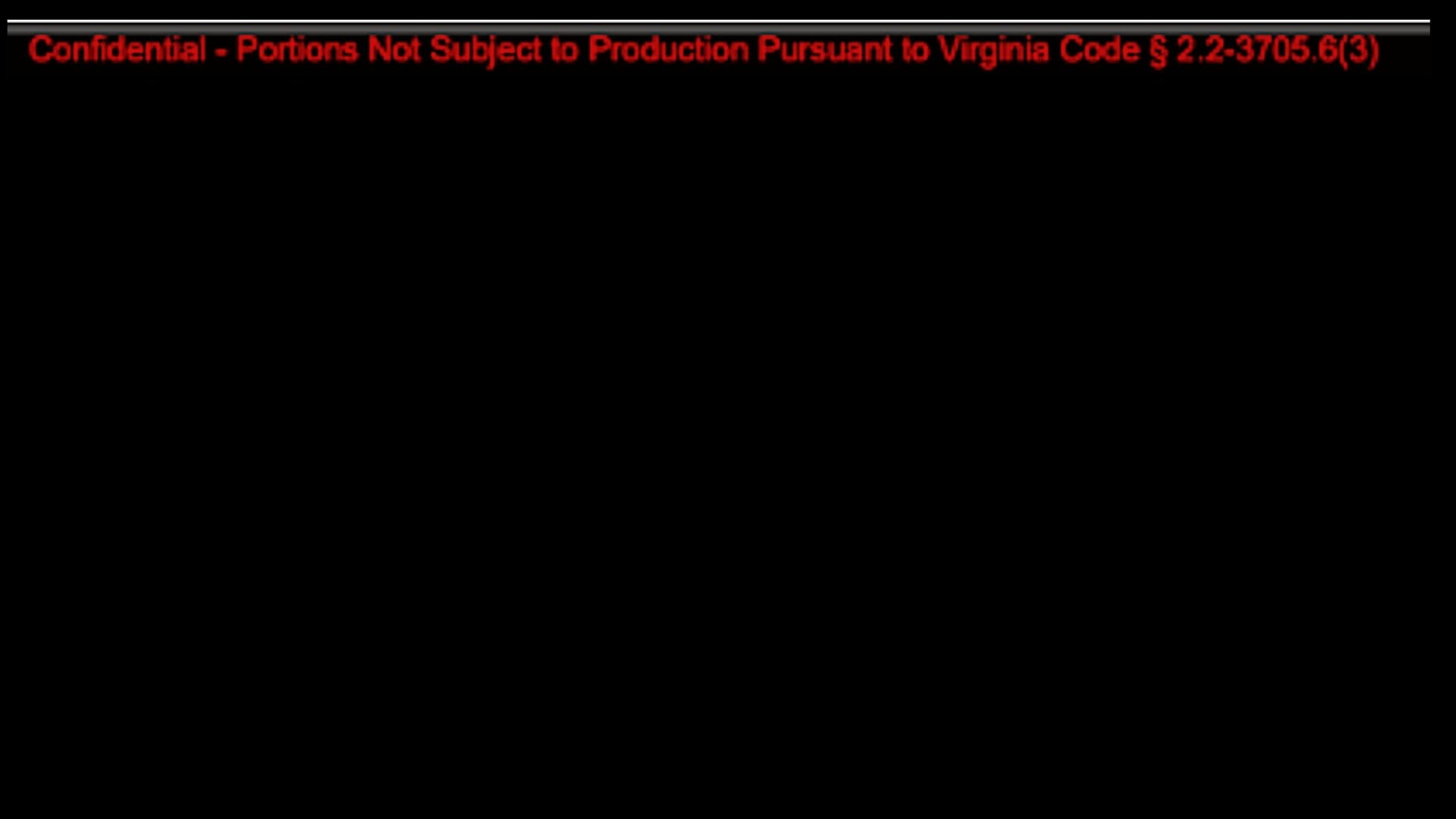
Sheet C-3000 of Google's 'Project Raspberry' civil engineering files—the master plan meant to show the overall layout and mass grading of the 312-acre Greenfield site—appears entirely blacked out in public county records. Under Virginia FOIA exemption § 2.2-3705.6(3), key infrastructure designs and land-altering layouts are legally shielded from public view as 'proprietary,' preventing local journalists and residents from seeing the true physical scale of the impending development.
The Cost of the Digital Gold Rush
This environmental deficit operates alongside a fierce regulatory battle over who will pay for the tech boom's massive grid requirements. In a rare direct intervention before the State Corporation Commission, Governor Abigail Spanberger’s administration demanded that power companies stop passing data center grid costs onto regular families. "We are taking real, practical action to address high energy costs for Virginians, protect families from future rate hikes, and meet rising energy demand," Spanberger noted when signing a package of protection laws, emphasizing her intent to "protect Virginia ratepayers from shouldering the cost of new energy infrastructure investments by data centers." Consumer advocates and state energy officials are now pushing regulators to enforce a strict "but-for" standard—arguing that if a massive high-voltage highway would never have been built but for the server farm it plugs into, the tech giant must pay the entire cost upfront
In response to growing public blowback, AEP and its industry allies routinely deploy a standard defense: they claim data centers pay their own way. To back this up, utilities point to a new Virginia law requiring data centers to pay for 85% of their specific distribution costs upfront. This industrial talking point allows utility companies to shift the public narrative, but it intentionally ignores the broader systemic impact on the energy market. Tech giants might write checks for the physical high-voltage lines that plug directly into their server farms, but their unprecedented consumption of baseload power alters the entire regional energy ecosystem. By claiming a massive share of available electricity, this tech rush drives up wholesale prices across the PJM Interconnection, the regional power network that manages the electrical grid for Virginia and twelve other states.
Claims that data centers cover their own costs also overlook the long-term reality of rising household bills and a permanently altered regional landscape. The tech footprint reaches far beyond gas lines, stretching directly into the one of the region's premier recreational assets: Smith Mountain Lake. Roughly 17% of Appalachian Power's power generation relies on hydro, with the Smith Mountain Project acting as the regional grid’s emergency battery. Unlike coal or gas plants, hydro turbines can switch on instantly. When massive data center loads put sudden, immense strain on the state grid, the regional manager legally calls on Smith Mountain Dam to release water to generate immediate electricity.
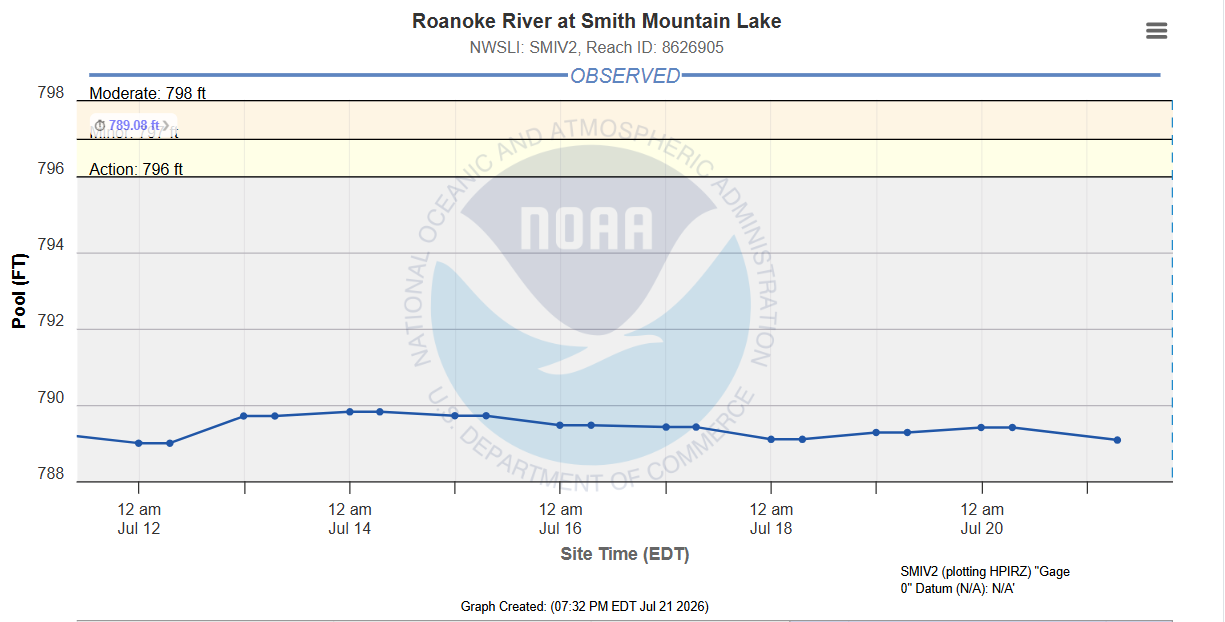
The scientific reality: NOAA tracking shows Smith Mountain Lake at 789.08 feet, seven feet below its management baseline. While Governor Spanberger notes data center water consumption currently accounts for less than 1% of state withdrawals, the historic drought unfolds alongside unprecedented grid-capacity pressure from data center electrical demands.
National Water Prediction Service / NOAA
This creates a hidden ecological trap. The lake operates on a pumped-storage system, cycling water down through turbines to generate power and pumping it back up when demand drops. Constantly cycling millions of gallons of water generates massive friction and heat, drastically accelerating natural evaporation on a lake that is already feet below full pond due to the drought. This is not a hypothetical threat: earlier this summer, Appalachian Power was forced to issue an official public alert warning users that emergency regional grid demands would trigger rapid, unpredictable water level fluctuations at the project.
The true cost of this digital boom is ultimately measured in these local resource trade-offs. We are watching public water disappear into server cooling stacks while mountain corridors are cleared for pipelines. At the same time, regional utility rates climb and Smith Mountain Lake fluctuates unpredictably, all to sustain an industrial boom designed for corporate interests far outside the Roanoke Valley.
A note from the author, Hart: This investigation was entirely reported, investigated, and written by human hands. I utilized an artificial intelligence tool purely as an organizational assistant to structure the public utility tables and format the page layouts. Individual text assistance such as formatting pulls virtually zero measurable weight from the grid. The severe infrastructure strains exposed in this piece are driven by a vastly different scale: the massive, continuous computing loads of multi-billion-dollar corporations running unchecked AI factory training and industrial data centers.