
Roanoke County Quietly Approves $11M Hollins Library Overhaul, A Small Vote with Big Stakes for Thousands

For many in Hollins, the library isn’t just a building—it’s where homework gets done, job searches begin, and life steadies; now, a long-delayed renovation could redefine what that space makes possible.
Roanoke, VA
Author: Roanoke Rambler Staff
Published: 7:10 AM EST June 3, 2026
Edited: 7:10 AM EST June 3, 2026
Roanoke County just took a quiet but consequential step that will shape daily life in one of its most overlooked corners.
At a recent meeting, the Board of Supervisors approved an agreement with Lionberger Construction to move forward on the long-discussed Hollins Library project, effectively green-lighting a major upgrade to a key community asset in the Hollins area. This will continue the construction projects done on libraries around Roanoke County, the 12th one that will undergo construction.
Right now, the Hollins Library is doing 21st-century work in a building that still feels like the last century. It’s serving as an after-school lifeline, an internet hub, a de facto office for people who don’t have one, and a quiet room for people who don’t have that at home. The Board’s vote to move ahead with a full renovation and expansion is really a vote on whether those people get the kind of space they actually deserve.
A Cave Spring High School Junior who doesn’t have reliable Wi-Fi at home and shares a bedroom with two younger siblings, shared with the Rambler, that the Hollins library is where she is able to thrive in a safe space. Three afternoons a week, she gets off the bus, walks past the same strip of aging storefronts, and pushes through the heavy glass doors of the library, clutching a Chromebook and a crumpled folder of worksheets. She knows where the outlets actually work, which table gets the least afternoon glare, and which staff member will quietly point her to a book that still feels like an escape. When she hears there will finally be a major renovation, the first since 2001, she doesn’t think about square footage or line items. She thinks about light, and noise, and whether she’ll still have to race strangers for an open seat.
This story, while anonymous, is not unique. Count the students in the nearby attendance zones, elementary, middle, and high school, plus the community college kids and adult-ed learners passing through. It adds up to several thousand young people who live close enough that, if the library is good enough, it can become part of their weekly routine. For many of them, the Hollins branch is the only place where the internet is fast, the chairs are free, and an adult is always watching the room.
Right now, that room is doing too much with too little. The building’s last major renovation came in 2001, before smartphones, before job applications and college forms went entirely online. The design reflects that older world: fewer outlets, fewer truly quiet corners, a children’s area that’s charming but cramped, and not nearly enough space when the after-school rush hits.
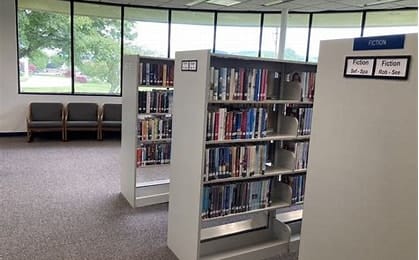
The plan on the table changes that. In plain terms, the new Hollins Library is supposed to mean more space, more light, more places to sit, and more help.
More space means students aren’t balancing laptops on their knees at the end of a crowded table. It means there are dedicated study rooms where a small group can talk out a project without someone shushing them, and spaces where tutors, caseworkers, and mentors can meet privately with teens who need one-on-one time.
More light means the building itself feels less tired. Natural light turns a room from a holding pen into a place where people actually want to linger. For parents with young children, that matters. A bright, open children’s area with low shelves and comfortable seating sends a different message than a corner carved out of an older floor plan: you’re welcome here, and we expected you.
More places to sit means seniors have somewhere to read the paper that isn’t their kitchen table. It means a nurse getting off a late shift can stop in to print paperwork without hovering over people. It means remote workers and solo entrepreneurs can claim a regular spot instead of constantly scanning for a stray chair.
More help means staffing and design that assume the library is not just about books, but about navigation. Navigation through homework. Navigation through job searches. Navigation through government forms, health information, and the constant digital static that makes so many people quietly opt out. A well-designed front desk and workroom aren’t glamorous, but they are how programming actually scales.
The most powerful part of this story isn’t the rendering or the ribbon cutting. It’s the ripple.
A larger, better-equipped Hollins Library increases the probability that:
- A student like the one we spoke with keeps her grades up because she always has a safe, reliable place to work after school.
- A parent facing a layoff finds the time, technology, and quiet to search for new work and update a resume.
- A recent immigrant meets neighbors in an English class they never would have attended in a more intimidating setting.
- A small business owner discovers that the “library program” they signed up for includes real-world help with marketing, bookkeeping, and licensing.
- A lonely senior has somewhere predictable to go three mornings a week, where people know their name and notice if they don’t show up.
The Director of Library Service, Jim Blanton explained to the Rambler that "The new Hollins Library will continue to offer the excellent resources, programming, and services it has provided to the community over the years, while also featuring expanded capacity and amenities. These include drive-thru service, expanded space for community meetings, individual study and conference rooms, dedicated children’s and teen areas, a makerspace, a reading room with a cozy fireplace, and a patio area for patrons to spend time and enjoy outdoor library programs. The renovation will truly transform the existing branch into a full featured community destination."
Over the next decade, thousands of Hollins residents will walk in and out of this building. Some will be there for story time, some for test prep, some to cool off on a hot day when their AC is failing. Many will never think of themselves as “library people.” They’ll just know that, when they needed a neutral, safe, functional space, it existed.
That is the quiet external impact that never shows up on the project plaque: fewer kids slipping through the cracks because they had nowhere to go after school; slightly stronger neighborhood businesses because more people lingered in the area; a community that feels just a bit more stitched together because there is one place everyone shares.
Twenty-five years from now, someone who is a child in Hollins today will tell a story that starts, “I spent a lot of time at that library growing up.” The Board’s vote to overhaul a building last renovated in 2001 is really a vote on what that story sounds like whether it’s about a cramped room they tolerated, or a true third place that quietly nudged their life in a better direction.
It’s easy to talk about this project as “just a library,” but the external benefits reach far beyond the building. That is why the $11 million plus investment is poised to lead to benefits that far exceed the cost.
- Local economy: A busier, more attractive library drives more consistent foot traffic in the area. People stop for groceries, dinner, or coffee before or after a visit. Small businesses nearby benefit from a steady stream of residents who now have a reason to linger in Hollins instead of driving somewhere else.
- Property values and stability: Well-maintained public spaces - parks, schools, libraries are one of the few levers local government has to stabilize and lift property values without pricing people out overnight. Families choosing where to live look closely at these amenities.
- Public safety: A lively, well-used public building with regular programming and staff presence is almost always safer than a half-empty one. Kids who have a known, positive place to go are far less likely to be hanging out in parking lots or on busy roads after school.
- Social connection: For people who are new to the area, or who feel isolated, the library is often the first low-pressure entry point into community life: story time, book clubs, tax-prep help, community meetings, citizenship classes. A stronger Hollins Library means more of those “soft landing” moments.
The Roanoke Rambler Staff