
Roanoke Plans To Clear-Cut Forest Near Read Mountain for Potential New Industry
Once given the green light to begin, it will be one of the largest tree-felling episodes in recent memory to alter the landscape of the city.

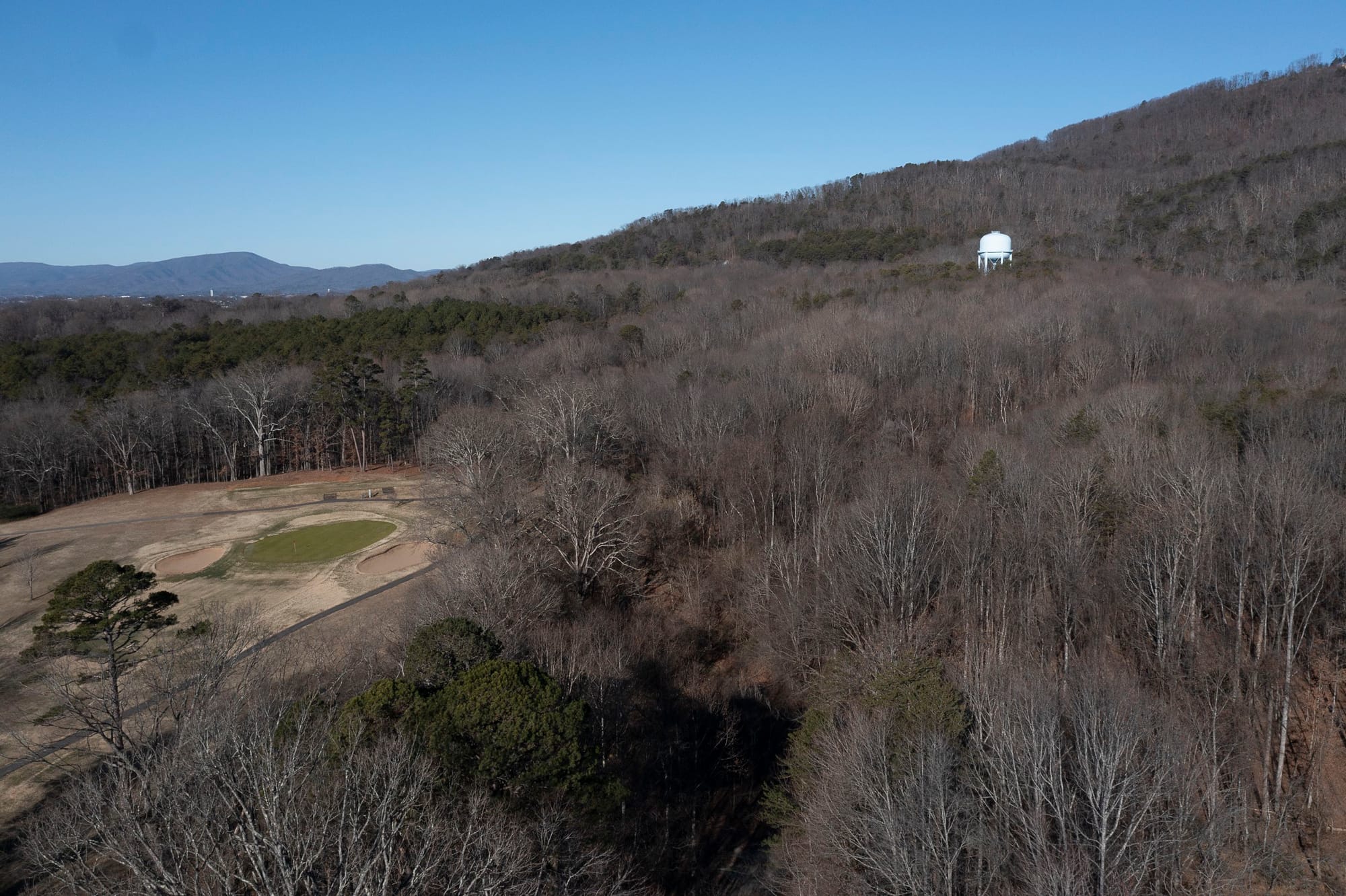
Roanoke has hired loggers to partially clear-cut a forest in a city business park this winter to accommodate new industry, according to city records.
The city signed a $95,000 contract last week for timber harvesting services on more than 30 acres at the Roanoke Centre for Industry and Technology.
The payoff? A new building pad for at least a 300,000 square-foot facility.
Officials haven’t named a specific new industrial employer for the site. They said they wanted to create a spot that is “shovel ready” for use when a good prospect comes along.
Once given the green light to begin, it will be one of the largest tree-felling episodes in recent memory to alter the landscape of the city. The tract spans 82 wooded acres and is the largest available property at the park four miles east of downtown, just below Read Mountain. About 40 percent of the trees, or 33 acres, will be removed, according to a description of the project initiated by city economic developers.
The city development review office received an application in November for permission to begin work. It was still under review Tuesday, according to city records.
Oaks, poplars, pines and miscellaneous other trees will be removed for lumber and pulpwood by March 31, under the terms of the contract. Eddie Dooley Inc. of Blue Ridge will do the work.
Past tree removals have generated public concern for the environment, most recently when developer Robert Fralin proposed townhomes on a wooded lot on Brandon Avenue Southwest. Approved on grounds that housing is a significant need, that project is underway.
The planned clear-cut at the business park has not been publicly announced, though municipal procurement officers posted details on a website used to solicit work from outside contractors.
It’s been clear that tree removal would be necessary at the site since at least 2024. That was when a state program to facilitate commercial development, the Virginia Business Ready Sites Program, awarded the city $7.5 million toward costs. After tree clearing, grading work is planned.
“The timber harvest plan was developed following best practices for minimizing environmental impacts,” Adam Fajardo, a city spokesman, said in an email. “There wasn't community outreach about the harvest plan because the land is a City-owned property with minimal borders along residential areas.”
Take a drive along Blue Hills Drive as it bisects the business park and you’ll see a series of enormous industrial buildings and warehouses. Yet only trees stand in one corner of the property — a lot called tract 8 that the city purchased 26 years ago but that no industry ever developed.
The city acquired the land from Emma Read Oppenhimer, a member of the family after whom Read Mountain was named. Tract 8 is a fraction of a mile from Read Mountain Preserve, a 600-acre hiking spot and natural area in Roanoke County. Ron Crawford, a nearby resident who heads up a volunteer group that keeps an eye on the preserve, had not heard about the planned clear-cut but voiced no concern about it.
“It won’t have any effect on the preserve at all,” Crawford said. “If they feel like they need to cut trees on their property for the development of the thing, I have no problem with that.”
Jim Pickens of Roanoke, who belongs to the Roanoke Park and Recreation Advisory Board and is president of the tree-support group Trees Roanoke, called the decision to keep some of the trees at the parcel a plus. He noted that plans call for clearing less than half the site for a project that is intended to expand the tax base.
On Tuesday the City Council authorized the acquisition of an easement on an adjacent property needed for the grading project. During the discussion, Vice Mayor Terry McGuire said he'd like for the city to keep as many trees as possible and discuss the potential of a trail link to the preserve.
"I'm wondering if there's a way to kind of have our cake and eat it, too," he said.
The clearing is happening at a time of concern about tree cover in urban areas of the United States.
Pickens said the Roanoke Valley, like many urban areas, is losing tree canopy. But it has denser tree cover than some other places. Aerial photography from 2021 estimated that 67 percent of the Roanoke Valley is tree-covered and that there are 130,000 tree-covered acres. The latest tree canopy estimate in Roanoke city proper is 33 percent. The city has a goal to increase the canopy to 60 percent, beyond a general urban benchmark of 40 percent.
“There are a lot of forests around, mountainside that really precludes development on them,” Pickens, a retired landscape architect, said. Outside the city of Roanoke, “you see trees, lots of trees, lots of forests.”
Pickens said that in northern Virginia, where he used to work, clear-cuts occurred practically daily to facilitate development “and that was a big problem. The tree canopy was declining every day because of the big projects being built, whether it was data centers or housing.”
While the trees at the industrial park face the chainsaw, Trees Roanoke and the city plant new trees annually on city property at a rate of about 160 to 200 specimens a year, Pickens said.
Roanoke Rambler Editor Todd Jackson contributed to this story.