
Harrison Museum Historian Brittney Flowers on Finding Belonging in Black History
The Rambler's Four Quadrants, One City series continues.
Roanoke’s four quadrants reveal a deep and persistent divide. The city’s legacy of segregation continues to cast a long shadow, with access to education, job opportunities and even life expectancy varying widely depending on zip code.
In our recurring Q&A series, Four Quadrants, One City, The Rambler invites members of the community to reflect on what it means to live in a city shaped by a history of division. By sharing perspectives across generations, backgrounds and quadrants, we hope to spark honest conversations that are too often left unspoken.
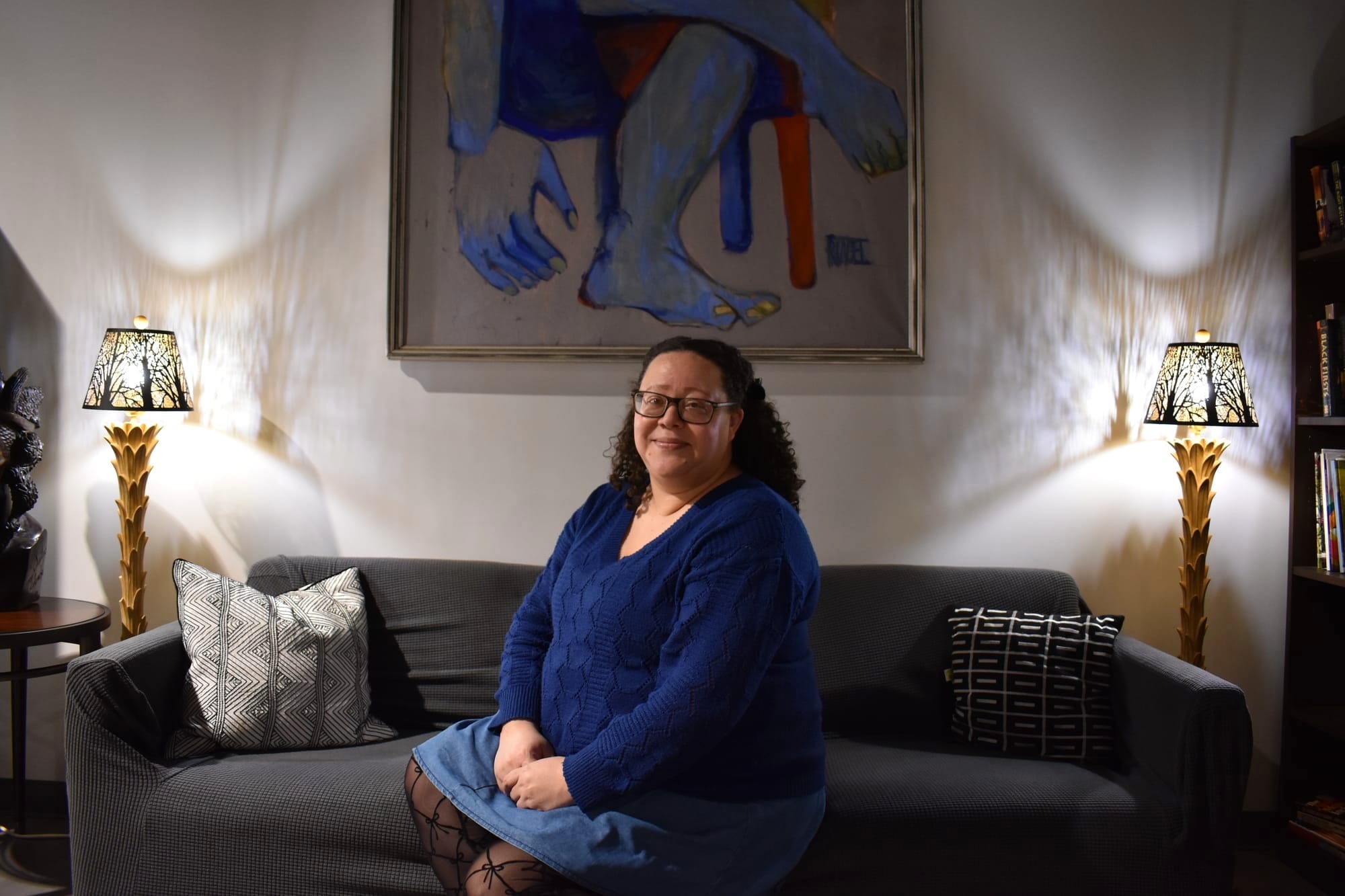
This month we spoke with Brittney Flowers, resident genealogist and public historian at Roanoke’s Harrison Museum of African American Culture. Originally from Prince George County, Virginia, Flowers first came to the Roanoke area to attend Hollins University. As a senior, she undertook an independent project to document the history of the enslaved people who built her university’s campus — a process that called her to a career in public history.
Today, Flowers uses genealogy and archival research to uncover, contextualize and share the stories of Roanoke’s Black community. Her work is showcased in the Harrison Museums’ most recent exhibit, “Healing Hands,” which highlights the innovative Black leaders and institutions that cared for the community when healthcare was segregated.
We joined Flowers at the museum, where she spoke with us about her love for local history, integration’s complicated impact on Black communities and her hopes for Roanoke’s future.
This interview has been edited for length and clarity. If you or someone you know is interested in being interviewed for this series, please reach out to sinclair@roanokerambler.com.
For those who might not be familiar, what is genealogy? How did you find yourself falling in love with the field?
Genealogy is just doing people’s family trees. You’re figuring out who came before them, and when you find out who came before them, you get a lot of context.
Believe it or not, I think I fell in love with genealogy with the Bible, which is interesting, because I would mostly consider myself deconstructed. But all the “begats” — this person begat this person, begat this person, begat this person. And I used to skim over them when I was a kid, and then one day I was like, “Oh, who is that person?” And I’d go back and I’d look, and it changes the whole story.
And now I get to do that with real histories and real people, where I can find them in censuses and various records. There’s something really incredible about that — about finding proof of life and being able to share that, to give context.
Tell me about your work studying the history of enslavement at Hollins. Was there a certain moment during that archival work that sparked your passion for public history?
I don’t know if there was a certain moment, but I noticed how it changed me. I was doing the research my senior year, so the whole summer before the fall semester began, I was in the archives building family trees, doing all that work. And when I came back on the campus as a student, I realized that I felt very differently.
It took me a while to put my finger on why. And then I realized that looking at images of the [Black] people who would have claimed me back then changed the way that I saw myself on campus. Before, I felt like I was allowed to be on campus, and I finally felt like I belonged on campus. I realized that I was living out someone else’s dream, the things that they had wanted for their children. They had literally built a school — my dream school — in hopes that people like me could go. And that changed the way I took up space on campus. So that was powerful.
Coming from both your personal experience and your professional historical background, what are your thoughts on the lasting impact of segregation?
Okay. I’m mixed. My dad’s Black, my mom’s white. They were married the year after Loving v. Virginia. I feel like my life, a lot of times, is born out of the place of convergence, where two things are coming together. And there are times that I can look at things from multiple perspectives because of that experience.
But when I look at desegregation — for instance, in schools — I see loss. I feel like desegregation was necessary for white America. I think that was part of white America healing, but I think it hurt the Black community, overall. Teachers and administrators lost their positions, and students of color who used to have people that looked like them, that would speak into their lives, that knew them, knew their parents — that gets broken and they’re sent to teachers who don’t believe in them as much, who don’t assume that they can succeed.
It’s a very different dynamic, and I said earlier how at Hollins, I felt so much different when I saw people that looked like me that would have claimed me. I wonder what kind of a person I would have been, or how my sense of self would have been shaped by going to a school where people that look like me spoke into me and demanded excellence of me. I wonder how much farther I could be in my life.
So I see loss. I see why it had to be done. And I also take pride in those who fought that fight [for integration]. I’m not saying they did anything wrong. But there was a consequence for that, and we’re still seeing the ripple effect of that. I don’t think we’ve ever recovered from what the Black community lost in integration, specifically in the school system.
The Harrison Museum’s current exhibit focuses on Black medical history. Do you think the Black medical system experienced a similar loss after integration?
I mean soon after integration, Burrell Memorial Hospital closed. Yes. There was a time when the community was working all together because they had to, because there weren’t other options, and then the funding breaks up, and all of that changes due to integration. So there are more opportunities after integration, but they’re sometimes harder to get to now.
It used to be that they literally built a medical community to uplift everyone within their community. So when Burrell Memorial was open, it wasn’t just hiring doctors and nurses. There were people who were cleaning. There were people who were doing the food service. There were people moving people from one room to another. That’s huge economic development. They started nursing programs, one of which worked with the school system at Lucy Addison, and they trained high school students and gave them nursing licenses before they graduated — which we don’t do now. It was way ahead of its time and it’s a loss that we’re not doing that now.
You’ve talked about what was lost in the Black community after integration. In your opinion, what steps can be taken to recover those losses?
I think that, first, knowing our history is probably the most empowering thing, specifically in the Black community where our history has been taken away from us over and over and over, and there are things that we can’t trace back. It’s empowering to know that Roanoke’s Black residents decided “We’re going to create a Black EMS program right here and be the first in the nation to do it.” Who dreams like that? Who says, “It doesn’t exist yet, but we’re going to do it. We’re going to start with our own vehicles, and by the end of it, we’re going to have an iron lung and boats.” Seeing that people dreamed that way, and that they worked together and they made it happen, I think that’s incredibly empowering.
The Harrison Museum distinguishes itself as the Museum of African American Culture, not a museum of history. As someone whose primary focus is the history, how do you understand culture coming into play at the museum?
For me, it’s knowing our history so that we can continue to make positive culture. I think about the Hunton Life Saving Crew, and I’m like, that should be a graphic novel. There’s got to be an artist in the community who can draw that up, because little kids need to know that they have heroes in this community.
There’s so much art to be created out of this history. There are so many stories that we could tell. There are so many ways of doing history and sharing it in a variety of forms. That’s the culture part for me. I get to lay the base like, okay, this is what’s true. Now, go do good with it. Now, go create with it. Go share it. That’s the culture part. But we first have to know what we’re talking about, so I get to be the support underneath.